Musical "Harmony of the Spheres" in concert
'The music of the spheres." It's not just a poetic turn of phrase: For centuries, from ancient Greece to the Renaissance, the idea was at the center of European ideas of the cosmos and how it worked. Classical writers such as Plato and Pliny developed the idea that the distances bet
'The music of the spheres."
It's not just a poetic turn of phrase: For centuries, from ancient Greece to the Renaissance, the idea was at the center of European conceptions of the cosmos and how it worked. Classical writers such as Plato and Pliny developed the theory that the distances between the planets corresponded with musical intervals as identified by Pythagoras, and that the heavenly bodies literally produced harmony - the music of the spheres - as they moved in their orbits around (as they understood at the time) the Earth.
That concept persisted through the Middle Ages (it's why music was grouped with astronomy, arithmetic, and geometry as academic sciences), and once the Renaissance got underway, music theorists developed an entire system in which the sun, moon, and each planet were matched with one of the ancient Greek muses and one of the modes used in sacred music. (Major and minor are the modes most of us know today; during the Renaissance, there were eight of them.)
Unpacking that system was the purpose of "Harmony of the Spheres," a multimedia concert performed by Piffaro (Philadelphia's Renaissance band) and Les Canards Chantants (the area's talented young vocal ensemble) on Saturday at Temple University's Conwell Dance Theater. The stimulating program, intelligently conceived and assembled by Piffaro's Grant Herreid, led audiences through the entire musico-cosmic scheme, mode-muse-planet by mode-muse-planet.
Each trinity was introduced by a Latin verse sung in the mode in question and describing its character, followed by a spoken equivalent in rhymed English verse (whose serviceable and sometimes witty text was written by medievalist Lawrence Rosenwald) and a sampling of pieces composed in that mode.
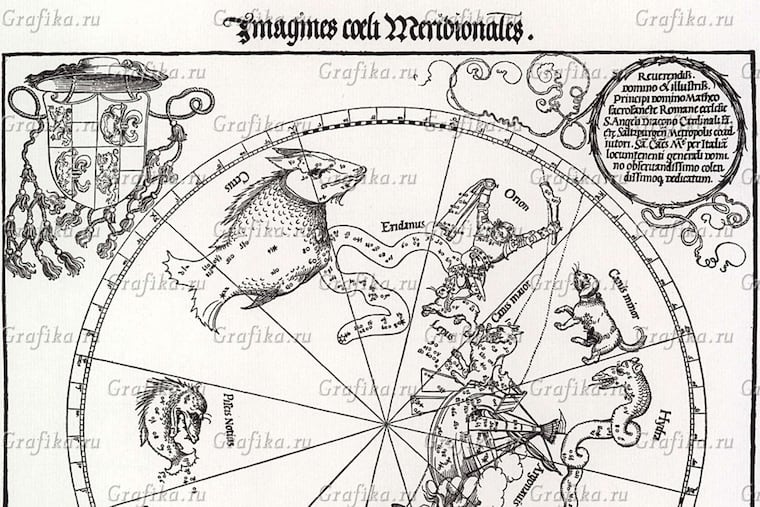
On a screen at the back of the stage, along with translations of the sung texts, appeared combinations of Renaissance imagery - diagrams of the planets in their orbits, tarot-card-style engravings of the muses, and of the classical gods after whom the planets are named - and modern-day photos of the sun, moon, planets, and infinite stars of space. (Videographer Daniel Lickteig even added some amusing animation - for instance, showing a muse's cheeks puffing out as she blew into her horn.)
The music - all performed with skill and spirit - ranged widely, from solemn church motets and wistful love lyrics to belligerent battle songs; composers ranged from the famous (Josquin and Lassus) to the lesser-known (Vincenzo Galilei, Galileo's father) to anonymous Italians and Spaniards.
Sound complicated? Obscure? Not at all. Despite a (very) few choices that misfired a bit, the entire experience was like an absorbing guided tour - but with appealing music in place of a droning lecturer.