'Democracy Now' turns 20: Amy Goodman comes to the Free Library
Launched in February 1996, Democracy Now! was born of a unique idea: an hour-long daily syndicated public radio news show focused entirely on the presidential election. Hosted by veteran journalist Amy Goodman, the show aired on five stations and was supposed to go dark after Election Day.
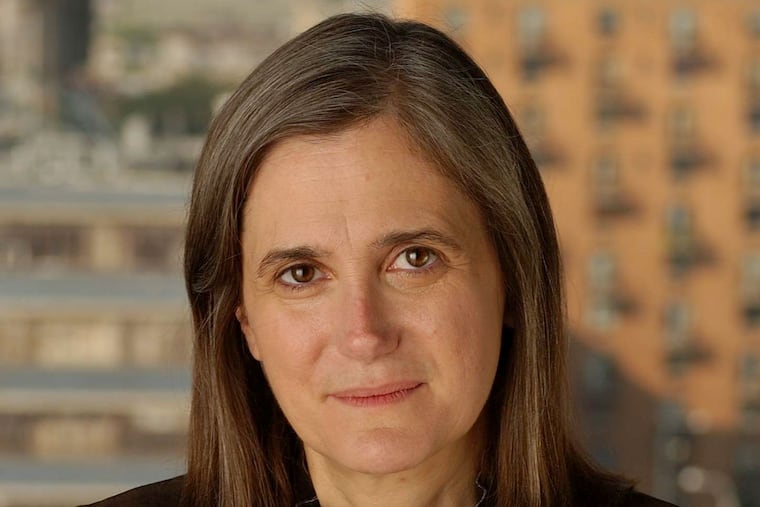
Launched in February 1996, Democracy Now! was born of a unique idea: an hour-long daily syndicated public radio news show focused entirely on the presidential election. Hosted by veteran journalist Amy Goodman, the show aired on nine stations and was supposed to go dark after Election Day.
Twenty years have passed and Democracy Now! still airs every day. Of course, it's grown a bit: Today, it's carried by 1,400 radio and TV stations around the world and is available online at www.democracynow.org. (Locally, it's available on several stations and is carried by DirecTV, Dish Network, Verizon Fios, and Comcast.)
Goodman, 59, cohosts the show with New York Daily News columnist Juan Gonzalez. She's marked the program's 20th anniversary in a new book, Democracy Now!: Twenty Years Covering the Movements Changing America (Simon & Schuster), and she'll talk about her work Monday at the Free Library of Philadelphia. She spoke to us Tuesday from her car..
You are celebrating the 20th anniversary in a unique way.
We just published the book and we are on a 100-city tour. . . . We're on to city 65, rushing from Chicago to Madison [Wis.]. The response is great. Last night, 600 people packed into a Chicago church. And we're still producing the show every day.
"Democracy Now!" is funded entirely by listeners, and you oppose any kind of underwriting from corporations or the government. Do you think for-profit news organizations that rely on advertising are really so very compromised?
News coverage has to be critical [of those in power]. You can't cover a war if [the news] is brought to you by weapons manufacturers. When we cover health care, we are not beholden to insurance companies or the drug industry. When we talk about climate change, it's not brought to you by the oil industry.
You describe your approach to journalism as "grassroots reporting." What is that?
We follow a basic tenet of good journalism: to go where the silence is. To go to the places and people that are rarely heard in the corporate media - and that's most of the people in this country. People who are concerned about war and peace, those who are concerned about inequality, about climate change. They're not a minority, they are the majority, but they are silenced by corporations.
So you believe mainstream news outlets ignore regular people?
It's about where you put the microphone, and so often the media covers the elite. We go to the people who are actually affected.
So how should the election be covered?
The [mainstream] media is obsessed with pundits and polls. They should be matching up candidates' promises to their records. I think Democracy Now! is unique because we are not about punditry. We go into the communities and bring out the stories of people and what they care about.
How do you rate the media's coverage of the 2016 election?
The coverage has been heavily slanted toward [Donald] Trump. On March 15, when there were five primaries, he had 23 times the media coverage of Bernie Sanders. Skewing coverage this much . . . the effect is enormous.
Where are mainstream media most lacking?
The networks and corporate media don't cover movements. They don't cover protests. It's the movements that change history. In 2011, we had Arab Spring, Occupy Wall Street, and the Wisconsin uprising, protests against Gov. Scott Walker's promise to bust the teachers' and nurses' unions.
We were at these protests, which the corporate media hardly covered. They didn't cover the first week of Occupy Wall Street, and it was happening in the media capital of the world! And when they do cover [protests], they tend to mock activists.
These are the people who are trying to speak.
215-854-2736
This story has been changed to correct the number of stations the program was first heard on and whom Juan Gonzalez works for, and to remove incorrect information about where Goodman was interviewed.