Famed writer's son 'vindicated': Joe McGinniss Jr. on 'Carousel Court'
Joe McGinniss Jr. tells intense, rapid-fire stories about an America that seems permanently down on its luck. The novelist, who grew up in Swarthmore, made his literary debut with 2008's The Delivery Man, about a trio of young Las Vegas natives who get sucked into criminality. Its searing portrait of a lost generation earned it comparisons to Bret Easton Ellis' Less Than Zero.
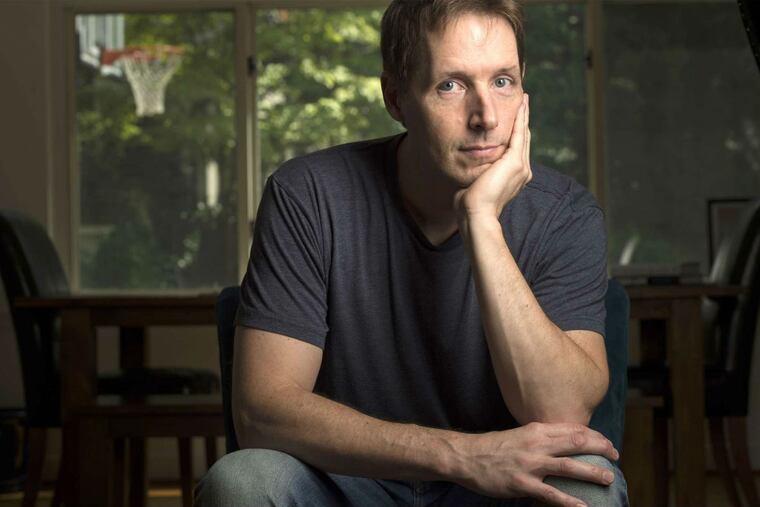
Joe McGinniss Jr. tells intense, rapid-fire stories about an America that seems permanently down on its luck.
The novelist, who grew up in Swarthmore, made his literary debut with 2008's The Delivery Man, about a trio of young Las Vegas natives who get sucked into criminality. Its searing portrait of a lost generation earned it comparisons to Bret Easton Ellis' Less Than Zero.
McGinniss' sophomore effort, Carousel Court, is about the toll the foreclosure crisis takes on a young Southern California couple.
In a recent interview, McGinniss, 45, spoke about his work and the legacy of his famous father, Joe McGinniss, a former Inquirer writer and pundit whose books include the 1968 best-seller The Selling of the President and the controversial political biography The Rogue: Searching for the Real Sarah Palin.
McGinniss will read from Carousel Court at 7 p.m. Monday at Barnes & Noble in Center City.
Writing came late for you. You were already 37 when you published The Delivery Man.
I was really into politics. I interned in Washington throughout my time at Swarthmore College. [Later], I worked on Bill Clinton's first presidential campaign, then I interned at the White House.
But by the time I went to graduate school [at American University] for public policy, I was burnt out with . . . politics. I kept working on the degree but I also started writing fiction during my free time, and it was a lot of fun.
Tell us about Carousel Court.
The job doesn't pan out and the housing bubble bursts.
How did you research the story? Did your wife [Jeanine Ford McGinniss], who is with the Securities and Exchange Commission, help?
I interviewed couples who had invested pretty much everything. . . . Middle-class people who took the plunge and took the bait and went all-in and bought these ridiculous California mansions, and they ended up losing everything.
Now, they can hardly be called middle-class. What we knew as middle-class is gone; it's now the working class.
I imagine they're enraged.
Actually, I was impressed by how emotionally resilient and how sober they were. They weren't bitter, they weren't lashing out and talking about Mexicans or illegal immigrants. They weren't blaming other people like some demagogues. They were saying, "We lost. We got taken. And we need to find a way forward."
But there are people to blame.
Sure, the brokers who convinced these folks that their houses would pay off. But those people are long gone, with their profits in their pockets.
Nick gets a unique job.
He gets a job trashing out foreclosed homes, cleaning out stuff people leave behind.
During my research, I came across all these companies that banks hire to gut houses. It's the only job people who lost their own homes can get, so it gets really emotional for them: Here they are, going through the possessions of people like themselves, kids' toys, stuffed animals, people's journals.
It's fascinating how many lives are touched by this crisis.
You describe a Los Angeles that seems postapocalyptic, on the verge of total collapse. Is that where you think we are?
It really felt like that, yeah, and I was also thinking of places like New Orleans after [Hurricane] Katrina and New York on Sept. 11. I remember we would see footage of people in New Orleans in these little rowboats trying to rescue survivors. I think it's like that in the mortgage crisis. People are shell-shocked.
Is there any one book that has shaped you most as a reader and writer?
[Richard Wright's] Native Son. It was the first novel I read. I was 13. And I was in tears, writing in my journal, "Oh my God, oh my God." The darkness of that story! And yet it was so accessible. And, of course, also Revolutionary Road [by Richard Yates]. That couple, they just devour each other, they destroy each other. It's awful and yet you want to keep reading.
Your father died in 2014, before the book was published.
He was around when it was accepted for publication. To him, it was a vindication: I had been vindicated. I think, like him, I'm prone to take it personally when a book isn't accepted or if it has bad reviews. Not to get too sappy, but my son [9-year-old Julien] really helps me keep things in perspective. He came with me on this book tour. We took a cross-country train from Washington to Chicago and Portland. On four occasions, he came up to me and hugged me and said, "I love this! I love this!" That's just amazing.
215-854-2736
AUTHOR APPEARANCE
StartText
Joe McGinniss Jr., "Carousel Court"
7 p.m. Monday at Barnes & Noble, 1805 Walnut St.
Information: 215-665-0716, www.barnesandnoble.com, joemcginnissjr.com.EndText