'The Girl on the Train': A feminist take on murder mysteries misses, despite a powerhouse turn by Emily Blunt
I've rarely felt as maddeningly ambivalent about a Hollywood hero as I do with Rachel Watson, the utterly depressed, alcoholic lost soul who narrates the tense psychological thriller The Girl on the Train.
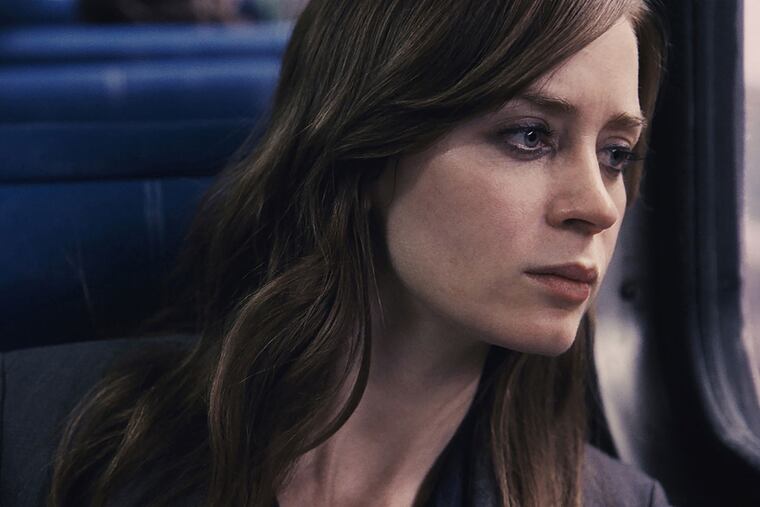
I've rarely felt as maddeningly ambivalent about a Hollywood hero as I do with Rachel Watson, the utterly depressed, alcoholic lost soul who narrates the tense psychological thriller The Girl on the Train.
Portrayed by Emily Blunt, who commits to the role with ferocious intent and disarming intensity, Rachel is one of three well-drawn female characters whose lives become enmeshed in this movie about sex and murder in an upper-middle-class suburb.
The other two are thirty-something wife and new mother Anna (Rebecca Ferguson) and her twenty-something nanny Megan (Haley Bennett).
Like the Paula Hawkins bestseller it's based on, The Girl on the Train concerns itself with the women, while relegating male characters to the background. We don't know what the guys do for a living or what car they drive - and we don't really care.
While the inversion will please viewers hungry for more female leads, the movie's feminism often feels cosmetic. All three women are lovelorn creatures who hang on their male partners' every word. And it's men's decisions and actions that move the story forward. The women are wholly reactive.
The Girl on the Train doesn't have serious feminist chops. Yet it's equally hard to treat it as a mindless thriller: The main characters are just too mired in gravitas.
I do like the film's Rashomon-like approach to storytelling, with a point of view that keeps shifting among the three women. Rachel dominates, and a more unreliable, sometimes awfully unlikable narrator you could not find.
She's in that self-pitying, heavy-drinking mode some of us fall into after being dumped. Except that it has been a full two years since Rachel lost her gorgeous, well-to-do husband, Tom (Justin Theroux), to the younger Anna.
Desperate for a child, Rachel couldn't get pregnant after years of trying. Anna got pregnant almost immediately after she moved into the catalog-perfect house the embittered divorcée once shared with Tom.
Consumed with rage - and consuming unreal amounts of vodka - Rachel rides the train and fantasizes about the perfect lives led by women she sees out the window.
She becomes scarily fixated on Megan, a restless, erotically charged woman newly married to hot, tall alpha male Scott (Luke Evans). A would-be gallery owner, Megan makes ends meet by working full time as a nanny for Anna and Tom.
The younger couple live a few doors down from Tom and Anna, so Rachel gets to stare at them during the many, many times she stands outside her old house to peer in - all psycholike - through the windows.
It's all such a mess. Then, one night, Rachel sees Megan kissing another guy. Megan isn't perfect after all. The shock sends Rachel into a tailspin. She wakes up hours later covered in bruises, her duds stained with blood.
Next morning, one of the two other women is reported missing. Detectives come by for a witness statement.
Did Rachel attack one of the women? Is she dead?
The narrative becomes a murder mystery after that.
I admit, The Girl on the Train is a fun ride, despite its failings. That's chiefly thanks to Blunt, who manages to humanize Rachel so successfully that we root for her by the end.
With its female heroines and its uncertain, constantly shifting view of reality, The Girl on the Train is a bit like a cubist, feminist episode of Law & Order.
But not much more.
215-854-2736
MOVIE REVIEW
StartText
The Girl on the Train
2 1/2 (Out of four stars)
Directed by Tate Taylor. With Emily Blunt, Haley Bennett, Rebecca Ferguson, Justin Theroux, Luke Evans. Distributed by Universal Pictures.
Running time: 1 hour, 52 mins.
Parent's guide: R (violence, sexual content, language, and nudity).
Playing at: Area theaters.
EndText