Art: Unencumbered youth
A Rosenbach retrospective re-creates Maurice Sendak's view of childhood - before adults took it over.
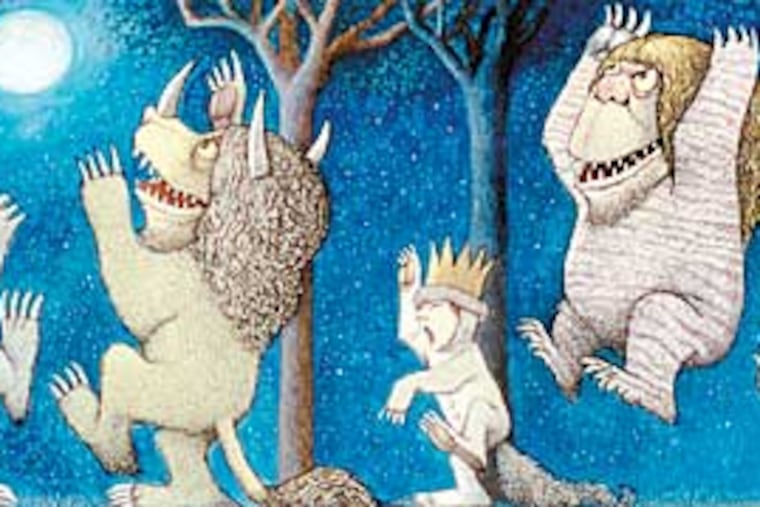
The childhood that Maurice Sendak remembers, in which children were allowed more trial and error in coming to grips with the vicissitudes of life, no longer exists. Childhood today is tightly regulated, circumscribed and electronically monitored.
Yet its looser-fitting antecedent endures in Sendak's stories and illustrations, and in his conversation, both of which can be savored in "There's a Mystery There," a splendidly evocative exhibition at the Rosenbach Museum & Library.
The world-renowned author and illustrator, who will turn 80 on June 10, has created more than 100 books for and about children, most famous among them Where the Wild Things Are and In the Night Kitchen.
Prodigious output isn't what makes Sendak a legendary American illustrator, though. Rather, it's the fact that his books expose the core of what childhood should mean - or what it used to mean before adults took control of it.
Those of us in the Medicare generation who grew up, as Sendak did, before childhood became regimented will recognize in his art, and especially in what he recalls of his youth, the intoxicating mix of fantasy, improvisation, dreamy idleness and risk-taking that once prepared kids for adolescence.
Children who once would have poked around in the dirt, climbed trees and built forts in the woods now plug into commercially produced imagination. They clamber over pre-fab "treehouses" in the security and comfortable familiarity of their own backyards. Their parents organize their games, complete with uniforms, coaches, league standings, and performance statistics.
The saddest manifestation of post-Sendakian childhood is the oxymoronic "play date." Play was once intrinsically spontaneous and free-form, a time to experiment and take chances. Testing limits was part of the fun. Now, play is like going to the dentist, two weeks from Thursday at 3:15.
When Sendak was growing up in Brooklyn during the 1930s and early '40s, childhood mixed escapism, frustration, boredom, discovery, anger, impatience, exhilaration, failure and triumph in roughly equal measures. It did not consist of dragging around the mall with one's parents on a sunny Saturday afternoon.
Those real-life pleasures appear to be lost to the Bubble-Wrap generation. Frantic competitiveness and the need to assure a place in the half of society that will survive globalization have finished off the liberated child. (But not, unfortunately, the liberated teenager.)
Yet the liberated child, sometimes fractious and even wild, lives on in Sendak's books. The Rosenbach has re-created such a childhood in its yearlong retrospective tribute to Sendak, the largest and most complex exhibition it has ever organized.
The Rosenbach has featured the artist in smaller shows, but this one attempts to reveal the heart of his creative philosophy, particularly how he understands children's impulses, needs, anxieties and motivations. As he explained years ago to biographer Selma G. Lanes:
"Too many parents and too many writers of children's books don't respect the fact that kids know and suffer a great deal. My children show a lot of pleasure, but often they look defenseless, too. Being defenseless is a primary element of childhood, and often, I am trying to draw the way children feel - or, rather, the way I imagine they feel. It's the way I know I felt as a child."
A child's view of life is one of the most distinguishing qualities of Sendak's illustrations and stories. Another is his willingness to portray children in potentially perilous situations, and to allow his characters to vent anger and rebelliousness. These attributes, prominent in both Wild Things and Night Kitchen, have distressed some parents and librarians, but haven't prevented his books from becoming among the most popular of their kind ever published.
It's not easy to tell Sendak's story through an exhibition format, even though, as the repository of his original art, manuscripts, books and ephemera since the 1970s, the museum is uniquely equipped to make the attempt. The lively and imaginative installation, guest-curated by Patrick Rodgers and designed by Philadelphian Steve Tucker, helps a lot.
Each of the show's four galleries contains a mix of finished drawings and watercolors - the latter, executed in soft pastel hues, are especially luscious - as well as sketches, text panels and touch-screen video displays.
The texts, which contain extensive quotations by Sendak, are invaluable in helping visitors enter the spirit of the work. Each video display offers four brief interview segments on various themes. Sendak's observations on his experiences, beliefs and sources of inspiration are lively and provocative.
Visitors will discover, for instance, that his literary idols include William Blake and Herman Melville. Sendak is justly acclaimed as a writer as well as an illustrator. While he began his career in the early 1950s creating pictures to accompany the words of other authors, by 1956, he began to illustrate his own stories.
As he has said, "An illustrator is someone who is in love with writing." That might be true, but still, we think of him as someone who tells stories visually. You will notice as you proceed through the galleries that he has adapted his drawing style to the mood of each story.
Naturally gifted as a draftsman, he ranges from the blocky, fearsome creatures of Wild Things to the fanciful figures of Night Kitchen (the three bakers obviously derived from Oliver Hardy) to the delicate and detailed Victorian tracery of Outside Over There.
Sendak weaves his stories from a variety of sources that include Jewish life in Europe, memories of his Brooklyn childhood, family history, and recurring symbols such as lions and the moon. It's the drawings, though, that most effectively encapsulate the blend of remembrance, ambiguity, humor and disaffection in his books.
"There's a Mystery There," which will travel to three other American museums, is a dense conglomeration of about 130 objects (they'll be rotated every four months through the run). Although the material concerns children, the show might actually be more appealing to adults, especially to those old enough to have experienced unfettered childhood.
Sendak is a complex personality, and his layered narratives - his stories within stories - are no less so. Yet no matter how the stories differ, they share an essential charm, the re-creation of a world where children were allowed to be themselves, for better or for worse, however briefly.