A racier, lusher look for 'Carmina Burana'
John Butler's rousing Carmina Burana has been a signature piece for Pennsylvania Ballet for four decades. This week, the company is doing something drastic: replacing it.
John Butler's rousing
Carmina Burana
has been a signature piece for Pennsylvania Ballet for four decades. This week, the company is doing something drastic: replacing it.
"I love Butler's Carmina Burana," artistic director Roy Kaiser said. "I grew up with it. I danced it for many years."
And that may have been part of the problem, he said. "For us, anyway, it started to look a little dated. I just didn't think we did it as well as we should have."
So Matthew Neenan, the corps de ballet dancer who in the last decade has become the company's de facto resident choreographer, was chosen to turn Carmina from a modest ballet of four principals and 12 corps dancers to a larger, more lush work for 32 dancers.
"It has a much different look, a different dynamic," Kaiser said. The new piece, which cost $75,000 to make, has more ensemble sections, as well as duets, trios and quartets.
Initially, taking on the signature work - set to German composer Carl Orff's throbbing, exuberant music - "wasn't scary," said Neenan, 32. "Then it was. Then it wasn't. Now it is."
Carmina Burana is based on a series of poems - most in Latin, many lascivious - about drinking, gambling, fate, life and love, collected in a manuscript dated 1280 that was found in 1803 in a Benedictine monastery in Germany.
"I loved reading it," Neenan said. "Some of it is just gorgeous. And some of it is really racy. It's just amazing that it was written all those years ago by, like, the rebellious rap stars of its time."
Orff scored the poems as cantiones profanae - secular songs - in a scenic cantata of 25 movements for vocal soloists, a children's choir, an adult choir and orchestra. It was first performed in 1937 and has been hugely popular ever since.
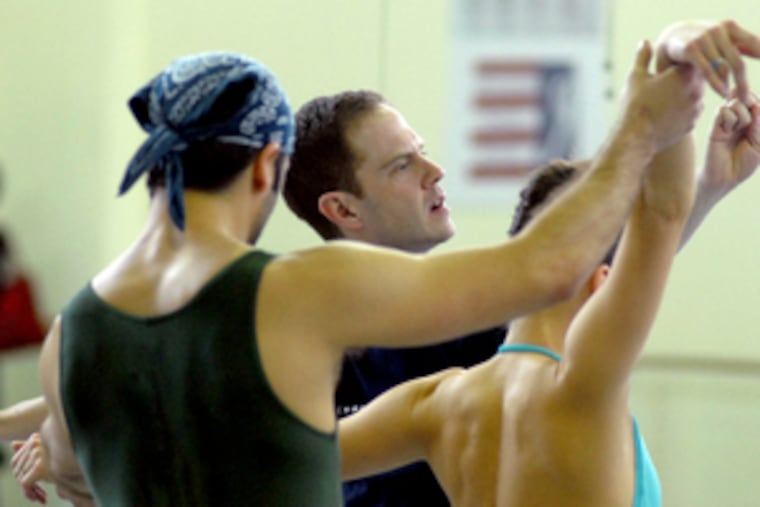
On this particular snowy mid-February day, Neenan was in the studio, choreographing a short interlude for two casts of dancers, led by Abigail Mentzer and Martha Chamberlain. Mentzer and Chamberlain threw themselves into splits and were lifted and twisted by their partners. When one dancer got knotted up, the other came up with a solution.
"I mostly work with one cast," Neenan said, "but with this, I actually liked having different people in there, because they inspired each other. They motivate each other. If the other cast, especially if they're the second cast, are doing the lift higher than you, you're going to work on it."
The new ballet, which opens Thursday at the Academy of Music, will be performed with the Pennsylvania Ballet Orchestra and the Philadelphia Kantorei Chorus.
"We're not having a children's choir, unfortunately," Neenan said. "I think that's just a little too hard to come by."
There's no storyline to the one-hour dance, he said. "It goes in cycles. It's like a journey. If anything, it's like a wheel. You just keep going."
The wheel was on his mind when he started envisioning the ballet. He talked to a set designer, who also imagined a wheel onstage. But when Neenan went online and looked up what other choreographers had done, he realized everyone had the same thought.
"So I just axed the idea. And then I really had no vision for it. I was just like, 'You can do anything with this.' And then I really thought, 'Well what do I want to capture?' It's about desire and passion. I really started getting to know the poetry, the libretto."
In keeping with the production's erotic heat, the costumes, by Oana Botez Ban, were designed to be sleek and sexy.
"You may think she's nude, but that's a unitard," Neenan says, pointing to a photo of principal dancer Amy Aldridge in an advertisement for the world premiere. "We want to get the feeling of second skin."
The set designer Neenan eventually chose, Mimi Lien, has created a mobile mountain of metal and sheer fabric that the dancers run through and around.
"The scenic element added dimension to the work," Kaiser said.
Neenan started dancing as a child in Boston, when he was dragged to ballet class with his two older sisters, only to discover that he loved it. At 14, he moved to New York to live with his sister Maria, who by then was dancing on Broadway. There he attended the School of American Ballet and the LaGuardia High School of Music & Art and Performing Arts.
In 1994, at 19, he joined his other sister, Corinne, at Pennsylvania Ballet, where she was in the corps. He performed as a guest artist for a while, then was offered an apprenticeship. He never formally auditioned.
He got into choreography rather casually as well, when he decided to try making a ballet in 1996 for Shut Up and Dance, the annual performance Pennsylvania Ballet dancers put together to benefit the HIV/AIDS support group Manna.
These days, he splits his time between making ballets for Pennsylvania Ballet and other companies and running a smaller company, BalletX, with former Pennsylvania Ballet dancer Christine Cox. He still dances, too, although choreography has taken the front seat.
Neenan never danced the Butler Carmina; he usually was in another ballet on the program, and once he had sprained his wrist and couldn't perform lifts. "But I saw it a lot, because I was in the audience," he said.
This week, his Carmina will be performed on a program with George Balanchine's Serenade.
"A lot of companies do Serenade and Carmina on the same bill," he said. "I think it kind of works out because that Tchaikovsky score is just so soothing. Everyone looks the same, but very individual, very beautiful, and you can sit back and relax, and that music is just to die for.
"And Carmina is just, like, in your face."