A properly English style in global array of dancers
Royal Ballet has assembled a dream-team company of the world's A-list principals.
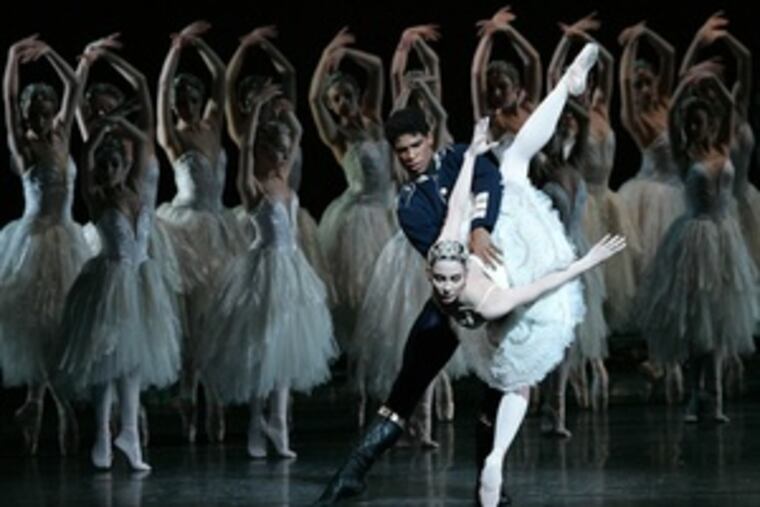
The last time the Royal Ballet performed in Philadelphia - 31 years ago, during the city's Bicentennial summer - the company was the glory of English ballet.
The British are coming again, beginning a four-night engagement tonight at the Mann Center for the Performing Arts, their only East Coast performances this year. They open with two nights of Romeo and Juliet and finish with two of Swan Lake.
The Royal Ballet is still glorious, but now it is being led - as are many of the world's top companies these days - by an international dream team of principal dancers.
Tamara Rojo is "one of our superstars," said Royal Ballet company manager Kevin O'Hare. The 32-year-old Spaniard will be dancing Odette/Odile in Thursday night's performance of Swan Lake. Her prince, Federico Bonelli, is from Italy. Other stars coming here hail from Australia, Denmark, Argentina and Brazil.
"I wanted to make sure we got as much of an A-cast list as we could on the tour," said Randy Swartz, artistic director of Dance Affiliates, who consulted with the Mann on the Royal Ballet engagement.
Despite the dancers' backgrounds, Rojo said, the company is still steeped in British choreography and style - very classical, precise yet dramatic.
"There is a lot of input and a lot of care at the Royal Ballet for that tradition and for the dance," she said in a phone interview. "But at the same time, they've been able to move with the times and to accept that the look of dancers has changed. And there is space for your own personality, as long as you respect the choreography."
The Royal Ballet's Swan Lake uses the traditional steps set by Marius Petipa and Lev Ivanov in 1895, with additional dances by Frederick Ashton - the company's founding choreographer - and David Bintley. Romeo and Juliet was choreographed by Kenneth MacMillan, the Royal Ballet's principal choreographer from 1977 to 1992.
"No one says you have to do it exactly like they did 50 years ago, because that would be completely ridiculous," Rojo said. "That's a good balance that they [the company] managed to find - the freedom for the artists to develop the choreography forward to be relevant to the public of today. You can make informed choices, which are generally right."
Rojo has been developing her ideas about Swan Lake for years. She grew up in a country that offered scant ballet tradition, yet that has produced several stars, all of them from one generation of students at a single school. In addition to Rojo, they are Angel and Carmen Corella, who now dance with American Ballet Theatre; Joaquin De Luz at New York City Ballet; and Pennsylvania Ballet's Arantxa Ochoa, all of whom studied at the small Madrid ballet school of Victor Ullate in the early '90s.
In 1994, when she was 20, Rojo won the gold medal and special jury prize at the Paris International Dance Competition, dancing the black swan from Swan Lake.
Based on that performance, she was invited to join the Scottish Ballet in 1996 as a principal dancer - where her first performance was Odette/Odile in Swan Lake.
A short time later, she was recruited to join the more prestigious English National Ballet, and in 2000 she became a principal dancer at the Royal Ballet. She also performs in galas and as a guest artist with companies around the world.
After years of dancing Swan Lake, Rojo has made some distinct choices about her Odette/Odile.
"I like the way that Nureyev thought, that the white swan wasn't a real being, but almost a projection of the prince's soul," she said. "It was his own loneliness and his own sadness and misunderstanding, and all that created this being for him to be able to project himself, and to be able to somehow release all those emotions that he couldn't. You can see how a prince even today is not really allowed to express much.
"And the black swan, I know, everybody thinks is nasty, but I find her even more sad. She's a daughter that is obviously besotted of her own father. She'd do anything he'd ask. And he's basically asking her to sell herself, so he can get another woman, which is a terrible thing."
Rojo brings this layer of psychoanalytical interpretation to her dancing in order, she said, to keep her interested year after year.
"If you make them very one-dimensional, just a nice girl that has a bit of bad luck, it's just very boring," she said. "Nice girls tend to be boring to do over and over."
Careful consideration was also the name of the game on the Philadelphia side of the engagement, Swartz said.
"The [Kenneth] MacMillan Romeo and Juliet had not been seen here, and it would look fabulous in the park," he said. Swan Lake seemed fitting because of "summertime, dance appeal, and setting."
Fairmount will not be the first bucolic setting in which Rojo dances Swan Lake. In May, she and Cuban star Carlos Acosta headlined a free performance in a park in Madrid, on a stage mounted above a lake, before an audience of 25,000. Clips are available on YouTube.
"It was actually quite beautiful to suddenly do it on a lake," she said. "It put everything into perspective."