All the world's a stage for Landscape dance
Happenings. Be-ins. When everything old is new again, it generally just gets a new name. To celebrate nature and free the body from ballet's formalism in the early 20th century, Isadora Duncan larked in parks with her Isadorables; today, what she did would be called "site-specific dance."
Happenings. Be-ins. When everything old is new again, it generally just gets a new name. To celebrate nature and free the body from ballet's formalism in the early 20th century, Isadora Duncan larked in parks with her Isadorables; today, what she did would be called "site-specific dance."
Last weekend, choreographer Malcolm Shute and his Washington, D.C., company, Human Landscape Dance, explored already-probed territory - West Philly's Clark Park, which Philadelphia choreographer Anne-Marie Mulgrew had surveyed more than a decade ago. In fact, the genre has many wonderful practitioners here: Leah Stein, with her notable 2004
Cornerstone
and the spectacular 2006 takeover of Girard College's chapel for
Carmina Burana
; Merian Soto, with her just-completed One Year Wissahickon Park Project; and Mulgrew, most recently with the 2007 Hidden River Project at Schuylkill River Banks.
At Shute's Clark Park performance Saturday, he confined his project, Rituals of the First Year, to a roughly trapezoidal space close enough to attract some of the crowds across the green at the weekly flea and farmers market, but not so close as to be disturbed by it.
(On Sunday, Human Landscape took over a small portion of Northern Liberties' Liberty Lands with the same program. Saturday's low humidity invited a large audience, while Sunday's heat was too oppressive for all but a hardy few.)
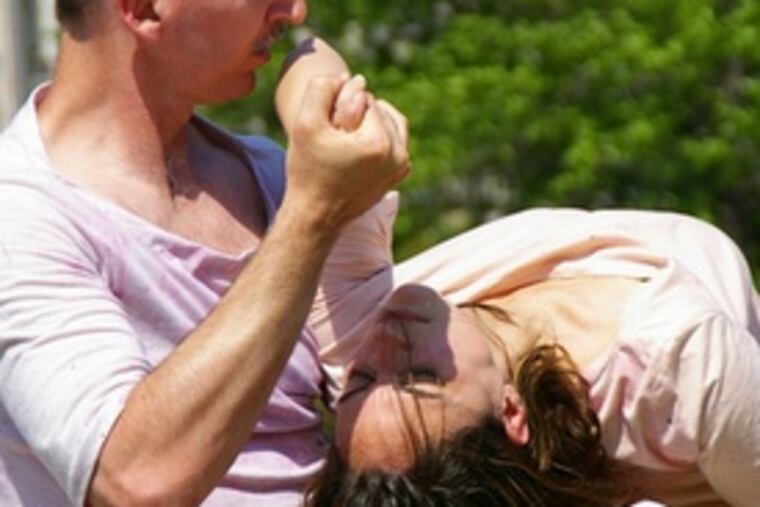
In four dances, Shute moved his three dancers - April Betty, Jennifer Rivers and Alexander Short - around the space, compelling the audience to move around with them. Watchers dropped in and out, sometimes taking a seat on the shaded grass.
All four pieces shared the same tempo - slow, slower and slowest - yet each was sprinkled with enough abruptly humorous movement to pique interest. Shute composed all the soundscapes, and in
Coming Unstuck
, the dancers suddenly bobbed their heads up and down rapidly to a pneumatic-jackhammer sound. At the same moment, an insistent car alarm went off, merging perfectly with the movement.
Shute's concepts revolved around family dynamics or overcoming fear, as in his solo,
Looking Over My Shoulder
. Tethered to a tree, he tried to escape but could only do so by losing his shirt, with its attached rope.
Each of Human Landscape's pieces was simple, straightforward and accessible, requiring skillful if not great dancing. Whatever you'd choose to call it, an annual outdoor summer series built on performances like these would surely enlarge the audience pool for dance all year long.