Highly personal theater from a dream
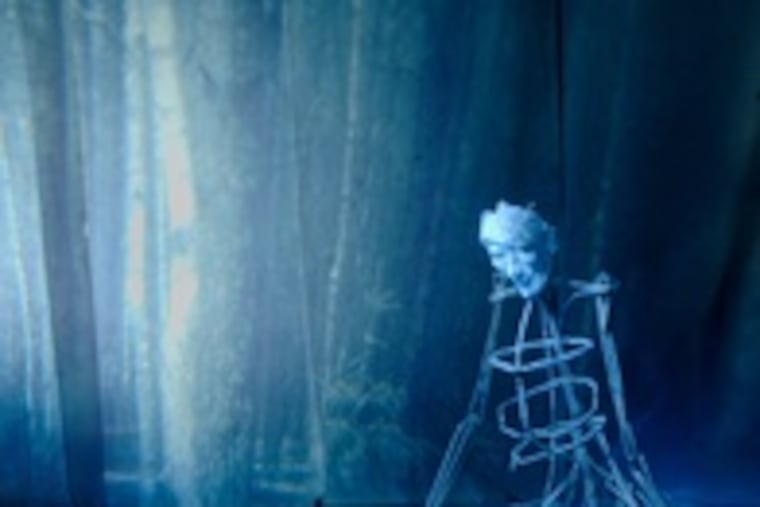
A self-confessed perfectionist, Sebastienne Mundheim built the dome for Sea of Birds three times. Each time, she cut about a hundred bamboo poles, each 24 feet long, then drove them to the Crane Arts complex's Ice Box, where her Live Arts Festival/Philly Fringe show will open tomorrow.
A self-confessed perfectionist, Sebastienne Mundheim built the dome for
Sea of Birds
three times. Each time, she cut about a hundred bamboo poles, each 24 feet long, then drove them to the Crane Arts complex's Ice Box, where her Live Arts Festival/Philly Fringe show will open tomorrow.
She was building the container she had seen in a dream - a dome that is "head, womb, shelter, a fragile, organic place." And, if a bamboo pole "was gesturing in the wrong direction, it had to be moved." So what should have taken one day took 10. The result, she says happily, is "stunningly beautiful."
Sea of Birds
, a multimedia piece, features huge, elegant paper puppets as well as dancers and musicians (playing an original score composed by James Sugg), photographs and videography. It is, in part, a child's fantasy (with characters called Ivars the Butterfly Catcher, and Serpent With Supercilious Eyebrow), and in part the story of her mother's escape from wartime Latvia as a child - although that story's "truth," Mundheim, 40, notes wryly, is the product of years of hearing it, "my mother being an incredibly compelling storyteller."
Storytelling is now Mundheim's role: She appears onstage, off to the side, as the show's narrator. Her voice is deep and fluent - more the voice of a teacher than of an actor; the goal, she says, is to create an onstage presence that is simultaneously intimate and disembodied.
Using personal sources is new for this native Philadelphian. Her method in the past has been intellectual; she has created 17 shows based on research, including one about James Joyce and another about Marianne Moore for the Rosenbach Museum, and a third about Benjamin Franklin that was part of the Fringe in 2006 - all intended to be accessible to children as well as enjoyable for adults.
Sea of Birds
is "risky for me - the piece is more like a conversation," developed with "less concern for the audience," which she says she has always viewed as a hostess would her guests, wanting everything to be right, wanting all to enjoy themselves. This show is less formal, more intimate.
Mundheim's new figures - somewhere between sculpture and puppets - are manipulated by the dancers "to explore the metaphors in the story." Physically building them was a challenge. The technique - rolling paper into long batons, reinforced internally with wire and then wrapped in mulberry paper - was developed years ago when she was teaching children. (She taught at the Fleischer Art Memorial from 1993 to 1998 and lectures widely.) "The fragility of paper is," she says, "like the fragility of history."
Mundheim discovered her aesthetic when as a child she made little sculptures - out of clay or oyster shells or cork or the plastic hooks socks come on - and then tape-recorded stories for them to act out. When she was 16, she expanded this process by taking photographs of the characters, adding background music, "and then forcing friends to watch these slide shows."
She says her art has developed from a complex of interests. "First," she says, "I'm interested in the process. But there's also content: my love of history, of nostalgia - represented [in
Sea of Birds
] by my mother's story. Finally, there is the thematic element, the philosophical question of balancing engagement with detachment." She explains that "we tend to focus on what happens - life's events - but what happens in the space in between matters too."
A recent grant from the New England Foundation for the Arts will allow
Sea of Birds
to tour New England after it leaves Philadelphia. Mundheim knows that "to grow you have to take a risk; the question is how much of that risk do you want to show the public?"
Evolving what she calls her "interdisciplinary biographic portraiture" - shows about famous people - she feels the newness of this venture: "Now I've made a show about someone important to me. This aesthetic is bigger and more beautiful."