Dark and stormy 'Journey Into Night'
The O'Neill drama is a classic stage study of a dysfunctional family.
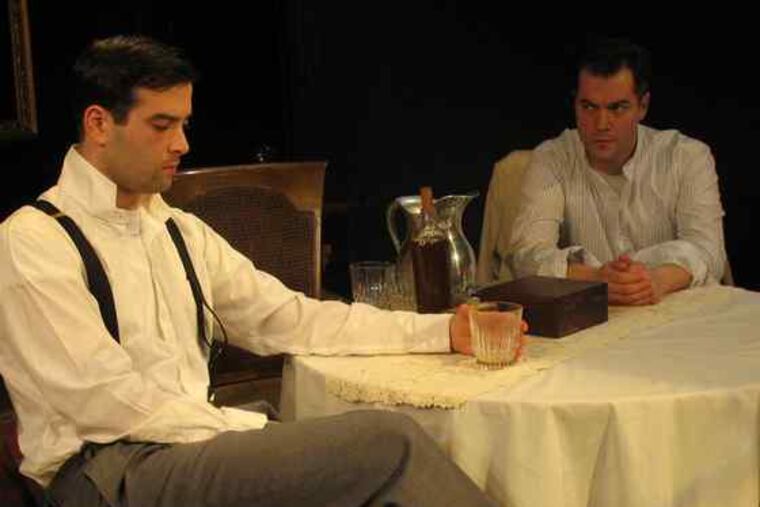
Soaked in whiskey and regret, Eugene O'Neill's mighty
Long Day's Journey Into Night
was a work, he said, of "old sorrow, written in blood and tears." Simpatico Theatre Project's production is remarkably accomplished and moving. On a little stage at the Adrienne Theatre, with a modest set and under Carol Laratonda's strong direction, the cast makes this famous drama its own.
Dysfunctional family puts it mildly: O'Neill's autobiographical play traces his recovering-drug-addict mother's descent back into addiction, while his poverty-haunted father - a famous actor who sold out his talent - and their two grown sons, both failures, drink themselves into desperate oblivion. It is no accident that O'Neill gave the Tyrone family's dead baby, the cause of all their subsequent misery, his own name.
Larotonda's only false step is to literalize the autobiographical element by having Edmond (a writer, thus the playwright's surrogate) writing the play we're seeing. This is both confusing and too clever; the play starts with muddled voice-overs reading the character descriptions from the script; if you haven't read the text, you'll have no idea what you're hearing. And the power of the final scene is compromised by Edmond taking out his notebook to write, presumably, what we're watching. O'Neill knew what he was doing - there's no no need to improve on a masterpiece.
What Larotonda gets absolutely right is the naturalism of the dialogue - people talk as they do in families, interrupting, stepping on one another's lines, sniffing, coughing.
The long day begins happily just after breakfast: sunshine, laughter. It's downhill from there. Mary (Peggy Smith) asks her older son, "Why are you staring, Jamie, is my hair coming down?" Over and over she will ask this question of them all, hating being watched, as their dread and suspicion grow that she has succumbed to morphine again; the stage is thick with looks and glances.
There is more to dread, however: Edmond (Kevin Meehan) is clearly tubercular, although Mary keeps trying to persuade herself it is just a summer cold. This is part of the family's pattern of denial, until finally all the guilt and blame and hatred and self-disgust cannot be denied.
As the long day darkens into night, Jamie (Allen Radway), whose self-loathing is toxic, will finally give up on himself. Long Day's Journey ends in darkest night; there is no promise of dawn, of new beginnings. The lighting design (Steve Heitz) doesn't quite capture this grim progress.
Every character speaks in two voices - blame and self-blame - and this cast can reverse on a dime. Smith (ill-served by costume designer Regina M. Rizzo) gives Mary a wonderful assortment of fidgety hand gestures, while Meehan gives Edmond an apparently painful leg - he must use his hand to cross his legs. Megan Slater as the maid Cathleen is adorably Irish and tipsy. Steve Gleich as Mary's husband, James Tyrone, has just the right looks for a former matinee idol, but his voice is wrong for the role, neither Shakespearean nor Irish. Radway, in what is arguably the most difficult role, reveals Jamie's bitterness with great subtlety.
Each character has a huge monologue, a gorgeous aria. Meehan's memories of "ecstatic freedom" are beautifully, persuasively delivered, and Radway's "in vino veritas" speech is terrifying and painful. The actors' challenge is how to cope with all the poetry-quoting and theatrical histrionics inherent in this family, making it seem natural to them. This cast meets the challenge handsomely.
Theater Review
Long Day's Journey Into Night
Through March 29 by Simpatico Theatre Project at the Adrienne, 2030 Sansom St. Tickets: $15-$18. 215-423-0254, www.simpaticotheatre.org