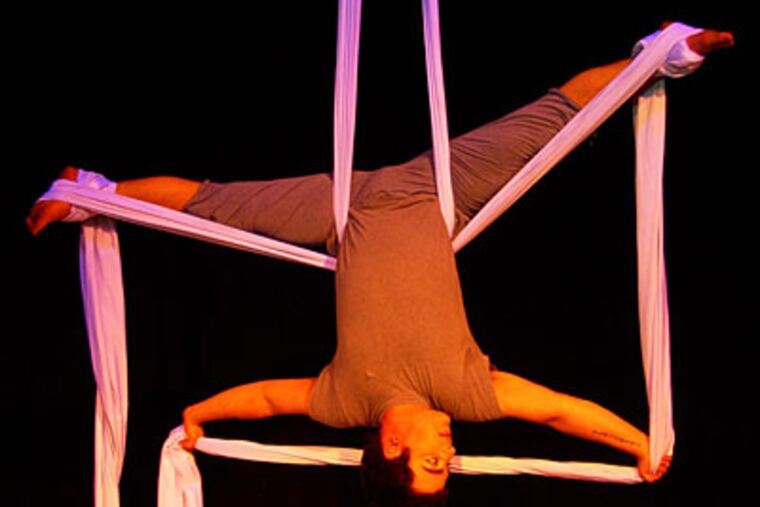
The word fringe implies on the edge or outskirts, so some might worry that the acts at this year's Live Arts Festival/Philly Fringe - collectively and casually known as "the Fringe" - would be so far out that they might be unreachable or incomprehensible.
But many shows during this 13th annual event - which runs for 16 days - address familiar concepts such as social networking, infomercials, and reality TV shows. The "fringe" comes in via the creative ways they present the concepts.
Take Kill Me Now, the Melanie Stewart Dance Theatre's world premiere performance that allows the audience to vote for the fictional characters dancing before them. Unknown to the contestants, the price of losing is more than they bargained for.
"Yes, they die," said artistic director and founder Stewart, adding, "It's more of a theatrical death than a real death."
That's a relief, because even for a festival that prides itself on the outrageous, actual homicide is certainly too much.
When the festival began 13 years ago, it was, in some cases, literally underground. It was low-budget - run on less than $100,000 - and attracted maybe 5,000 people, but that's just an estimate since no one was counting, said Nick Stuccio, the festival's producing director and cofounder.
Now the Fringe is legit, legally permitted when it hosts shows in abandoned buildings like an old swimming pool and an empty store. This year, there are 16 Live Arts shows and 185 Fringe productions. While Live Arts prices are set in the $25 to $30 range, Fringe shows can cost as little as $5.
Stuccio said last year's shows drew about 50,000 people. With a budget of $1.8 million, the festival can afford to bring in dynamic acts from as far away as Australia. (Back to Back Theatre, which will be taking over parts of Penn's campus, is one of the down-under groups.)
"We can go anywhere in the world and bring the greatest artists in the world here to Philadelphia," Stuccio said.
All that, while remaining steadfast supporters of local artists such as Stewart. She began working on the story for Kill Me Now two years ago and then became concerned that the reality dance-competition craze would have peaked by the time the show premiered. But the shows are as strong as ever.
"I was interested in that mirror of society and our interest in judging and being judged," she said.
Another mirror is held up by New Paradise Laboratories with Fatebook: Avoiding Disaster One Party at a Time. Billed as a look at what happens when online relationships collide with real life, the show began in cyberspace months ago as thousands of would-be audience members got to know the characters via Facebook and the show's Web site.
When the characters come together for a party, the result is "something like film noir, a little bit of a detective story with supernatural elements," said artistic director Whit MacLaughlin. "Fate is a weird thing."
In a shout-out to our era of constant chronicling of our lives, the performance features video screens showing footage of the show's 12 characters like "a movie where you see all the scenes happening at the same time," MacLaughlin said. The audiences can spin through this hyper-stimulating presentation before the actors begin.
"A person has to be able to walk into the show, off the street, having never been on the Internet," MacLaughlin said. "In some ways, it's as if all your friends are talking at once."
Meanwhile, The A.W.A.R.D. Show - Artists With Audiences Responding to Dance, takes advantage of our reality TV obsession with a show that entertains and engages while promoting dance and giving a financial boost to a local choreographer.
Besides a nightly competition, the winner of which is decided by audience vote, The A.W.A.R.D. Show features a post-dance discussion, allowing choreographers to be quizzed.
"In dance, it's so hard to build an audience because so many people who are theatergoers don't come because they're afraid they're not going to understand it," explained Linda Shelton, executive director of New York's Joyce Theater, which is copresenting the show with Live Arts/Fringe. "This is a way to bridge the gap."
The genres vary: Contemporary. African-influenced. Ballet. Hip-hop. Over three nights, Fringe-goers will be able to vote one of four performers into a final contest with the winner determined by both the audience and a panel of judges. First prize is $10,000. Runners-up get $1,000.
"It comes at a time when people are very interested in these competitive reality shows," Shelton said. "It's a great way to generate new audiences."
Kate Watson-Wallace's Store is described as "part performance art, part dance party, part absurdist infomercial." Set, literally, in a store - the former Rite Aid in the 4200 block of Walnut Street - the show is inspired by how and what we buy, according to Watson-Wallace, director of the troupe Anonymous Bodies.
The audience surrounds the set of an infomercial being filmed and then is guided by a shopping lady avatar who watches a pile of clothes morph into different shapes.
Like the other shows, it's different, thought-provoking and unique. This is fringe - and the Fringe - at its finest.