Scaling down the musical 'Light in the Piazza'
The Light in the Piazza, shining in a richly textured regional premiere by the Philadelphia Theatre Company, set Broadway aglow a few seasons back. But it's a little different these days: This Light is like one of the newfangled ones - same illumination, lower wattage, more bang for the buck.
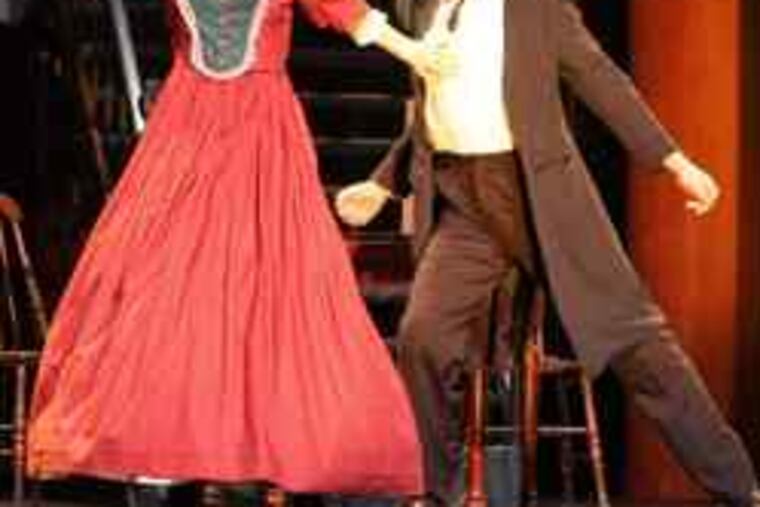
The Light in the Piazza,
shining in a richly textured regional premiere by the Philadelphia Theatre Company, set Broadway aglow a few seasons back. But it's a little different these days: This
Light
is like one of the newfangled ones - same illumination, lower wattage, more bang for the buck.
The story is based on a 1960 novella by Elizabeth Spencer about a woman traveling in Italy with her beautiful, childlike daughter, who enchants a young man she meets and is, in turn, smitten. It's a curious story of love and exploitation; each family wants something from the romance but never discloses it up front.
About the same time the book came out, it appeared in a scaled-down version as a short story in the New Yorker. Interestingly, another such slimming process would have to repeat itself decades later, before the Philadelphia Theatre Company could even consider producing what had become a musical both expansive and expensive.
The decision to stage it in affordable form - reshaped by its composer/lyricist - has paid off for the company, which has extended the production through Dec. 13.
"I want the show to be produced in all kinds of places, of course," says Adam Guettel, who won one of the show's six Tonys in 2005, for its complex music and affecting lyrics; the script is by playwright Craig Lucas.
"All the pieces I write are scalable," he says. "I consider the economics of a musical to be as important as casting the musical. One measure of a good piece is a piece that can fly back and forth, small or big."
Bigger and bigger
And Guettel has seen
Piazza
soar - from a cast of 10 and an orchestra of five musicians that included the conductor, at its world premiere in Seattle in 2003, to its Broadway run of 540 performances and a company that filled out Lincoln Center's Vivian Beaumont Theatre: 16 actors on stage, plus 15 musicians and a conductor. It's also been done even more grandly, as an opera. (And there was a 1962 movie with Yvette Mimieux, George Hamilton, and Olivia de Havilland.)
The version at Philadelphia Theatre Company's Suzanne Roberts Theatre seems to have lost nothing in its leaner form: four musicians, musical director Eric Ebbenga, and eight actors, some doubling in a big role and an incidental one.
In fact, you'd have to know the play inside out to tell the difference between the Broadway version and Joe Calarco's production here, with its lush set of moving arches, curtains and furnishings by Michael Fagin, and theater-filling sound design by Ryan Rumery.
Guettel himself scaled Piazza back, which is probably the only way the show could have been reworked. In straight plays, unless they're old classics anyone can stage without acquiring rights, a script is a script - you produce the play you've purchased and woe betide you if you tinker with it. Musicals have always been a little looser; musical directors for particular productions rearrange orchestrations to fit an ensemble's size - but even then, more judiciously than not.
Composer's grandson
Guettel, the 44-year-old grandson of composer Richard Rodgers (a man who also won Tonys), was first contacted about downsizing the show by Weston Playhouse, near his Vermont home. The playhouse wanted permission to do the slimming, but Guettel decided he'd rather tackle the work himself.
"I wanted to reimagine the orchestrations, he says. "I thought it would help support the characters and I wanted to make a smaller instrumental ensemble sound fuller." As for the script, not a word was deleted.
In a way, what Guettel did in his refinements also equalled a restoration - Piazza in Philadelphia is closer to its first realization but employs the richer theatrical illumination it acquired as it traveled through different stagings to Broadway.
"It brings back to a smaller scale something that is very character-driven. And the second part of this is, it makes it more affordable for other theaters to do this piece," says Andy Einhorn, who assisted Guettel in transcribing the music for Broadway as well as in this reduction.
There's no sign that the Philadelphia Piazza - the first production of the new version by a large professional theater - begins a trend for musicals once they leave Broadway and rights become available to regional companies. No other musical is believed to be undergoing such a process.
Moreover, the theater here - for all the concern over the general economic challenges that torment local companies even in the best of times - has not scaled back in any visible way this season. One new theater, the Devon in Northeast Philadelphia, canceled its inaugural season after December, but the Devon is an anomaly, dependent largely on state support that didn't materialize.
Moreover, Philadelphia stages have seen several large-cast shows this season, notably the Arden's version of The History Boys (12 actors) and Media Theatre's Show Boat (30). The cast of the Walnut's current Oliver! is its largest ever, with 71 actors.
"Everything is a balance - it's about doing big things and doing small things," says Bristol Riverside Theatre's artistic director, Keith Baker, echoing leaders among metropolitan Philadelphia's 40-plus professional companies. "It's about doing things that have something familiar about them and doing things that are startling. The economy is an issue but it's not a controlling one - it's not dominating our thinking. It's not the center of the conversation."
The Philadelphia Theatre Company can mount expensive productions - each of its shows is budgeted between $200,000 and $600,000. The company will not say how much Piazza costs, only that it hovers in the upper range, and that the Broadway version would have cost 50 percent more. That tab could have been near $900,000.
On Broadway "it was breathtaking and enormous, with a huge cast and lush orchestrations, and the scope of it was just beyond what any theater could really undertake," says Sara Garonzik, Philadelphia Theatre Company's producing artistic director. "It's so beautiful, we thought, there's got to be a way of doing this that is not beyond the realm of possibility."
After she heard about the compressed version, Garonzik went after it. "We have the eight essential characters and five pieces in the orchestra, and we do it without losing the beauty of the story. Every note is being played and every note is being sung," she says. "We're not missing any complexity."