With the opening of "Picasso and the Avant-Garde in Paris" at the Philadelphia Museum of Art, the Year of the Minotaur begins. Besides this city's, a half-dozen museums in New York and New England are planning significant Picasso exhibitions, not to mention smaller shows in Florida and California.
Art Museum curator Michael R. Taylor, who organized the local show, thinks the resurgence of interest in Picasso reflects a broad realization that it's time to take another look at the most famous artist of the 20th century, one whose prodigious creative output has already spawned dozens, if not hundreds, of such exercises.
Fortunately, the Picasso well has yet to run dry. The Art Museum's exhibition focuses on Picasso as the generative spark of modern art. It's extraordinary in being drawn almost entirely from the museum's permanent collection.
The Metropolitan Museum of Art will offer something similar, a Picasso survey based on its permanent collection that will open April 27. The Guggenheim Museum is working on a show tentatively titled "Picasso: Black and White," while the Yale University Art Gallery will examine "Picasso and the Allure of Language." Even the Frick Collection, bastion of Old Masters, is getting into the act with a Picasso drawing show.
Right now, though, the exceptional production at the Art Museum has the stage to itself. It's exceptional because it satisfies on several levels simultaneously.
First, it offers a reasonable summation of the heart of Picasso's career, from the collaboration with Georges Braque that produced the startling innovation of cubism to the dark, melancholy years of World War II.
Second, it does a splendid job of elucidating the development of cubism and its vast influence on artists in Europe and America. To achieve this, it brings in a supporting cast that includes several dozen major European and American artists, from Juan Gris and Fernand Léger to Charles Demuth, Marc Chagall, the Park Avenue Cubists, and the three Duchamp brothers.
Third, it reveals the extraordinary richness of two donated collections within the whole, those formed by Albert E. Gallatin and Walter and Louise Arensberg.
In this display of more than 200 paintings, sculptures, and works on paper, the Gallatin and Arensberg collections account for more than half of the items. Rarely has such a large percentage of these landmark gifts been put on the walls.
In part, this is because more than one-third of the show consists of drawings, prints, and watercolors that haven't been exhibited publicly for many years. So the Picasso show offers the public a rare opportunity to savor these exceptional artifacts of modernism.
While Picasso is the headliner, he's far from the whole story. Works by him comprise about a quarter of the total, and they tend to be concentrated in the earlier, cubist stages. Cubism is clearly the core of the show's identity; Picasso, Braque, and Gris, the primary cubist triumvirate, account for about 40 percent of the checklist.
A capsule history of cubism is the fourth level on which this show delivers the goods. The first three or four galleries alone, with splendid examples of analytical and synthetic cubism, could stand as an exhibition by themselves.
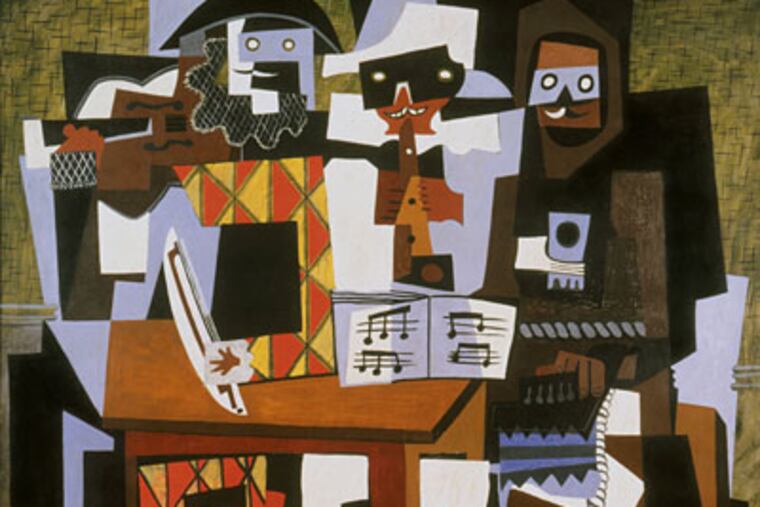
It's good that the exhibition offers so many pathways, because the story it tells about the glory years of modern art is familiar. There aren't any eureka! moments for the seasoned museumgoer, but there is an abundance of wonderful things to admire, from Picasso's iconic Three Musicians to Léger's monumental The City to Constantin Brancusi's marble head of Margit Pogany (her self-portrait hangs nearby) framed by a massive oak arch.
Art historians have debated endlessly the moment of modern art's Big Bang. Taylor has chosen to identify that moment with the invention of cubism. The museum might not own Picasso's Les Demoiselles d'Avignon, the most identifiable fountainhead, but it does own his final compositional sketch, a small watercolor made in 1907 that foreshadows the final masterpiece.
This is a highlight of the show's introductory section, which displays the full prismatic complexity of analytical thinking, rendered in muted, neutral colors of gray, brown, and ocher.
Some people find this early cubism both puzzling and chromatically dull - that is, difficult to read - perhaps because it represents such a radical departure from the painting that immediately preceded it: impressionism, postimpressionism, and fauvism.
Yet cubism gives the narrative a powerful push, with lush, intriguing interpretations such as Picasso's Man with a Guitar and Man with a Violin, and Braque's Violin and Newspaper. Far from being irrational, these pictures are paragons of clarity and classical repose.
The addition of papier collé (pasted paper) to the cubist vocabulary made it even richer and more securely tethered to the real world. There are few, if any, works in all of Western art more sublime than, for example, Braque's 1912 Still Life, rendered in charcoal, crayon, and pasted paper.
If you require a dash of color in your cubism, then the synthetic variety - reduced from analytical cubism's jigsaw patterns to flat planes - of which Three Musicians is the canonical example, is your dish. Before you arrive before it, you'll pass through an explosion of color in the gallery devoted to Salon Cubism, an evocation of the 1912 Salon d'Automne in Paris, in which many of cubism's fellow travelers exhibited.
(Picasso and Braque did not, because their dealer, Daniel-Henry Kahnweiler, forbade them from doing so. He wanted an exclusive, and he got it.)
The second half of the show, the part that comes after Three Musicians, is a bit less exciting. Taylor has devoted a gallery to Picasso's flirtation with surrealism, but he's not the dominant artist here. Joan Miró is.
There's also a gallery devoted to artists from Eastern Europe who gravitated to Paris during Picasso's ascendancy. This is where Brancusi comes in, and Chagall, with his green-headed poet, and artists such as Chaim Soutine, Jules Pascin, Ossip Zadkine, Natalia Goncharova, and even Vassily Kandinsky.
The advent of cubism made Paris such a hotbed of modernist creativity that artists gravitated there from all over Europe and from America. Some even gave themselves French names. Pascin, for instance, was born Julius Mordecai Pincas in Bulgaria. When he arrived from Poland, Louis Casimir Ladislas Markus became Louis Marcoussis.
The final gallery, "Death and Sacrifice," is elegiac, not only because World War II has torn Europe apart, but because modern art has all but exhausted itself. Picasso's painting of a gladiolus plant on a chair affirms life in its humble way, but it also can be read as a memorial to those who suffered.
Certainly, this painting lacks the energy, the passion, and the inventive brilliance of the work just inside the show's entrance. By then, though, Picasso had long since achieved the immortality that he no doubt will enjoy until museum curators run out of ways to package him.
Even though "Picasso" is a collection show - only 10 exhibits are loans - the museum has packaged it as a special-ticket attraction, and legitimately so.
For the reasons cited, it is very much a special exhibition and is certainly worth the extra $4 one pays over the usual general admission price. Plus, you get the recorded tour free.
Art: Pivotal Picasso
"Picasso and the Avant-Garde in Paris" continues at the Philadelphia Museum
of Art, 26th Street and the Parkway, through April 25. Museum hours are 10 a.m. to 5 p.m. Tuesdays through Thursdays, 10 a.m. to 8:45 p.m. Fridays, and 10 a.m. to 6 p.m. Saturdays and Sundays.
Admission to the exhibition, by special ticket, begins one hour after opening and ends an hour and a half before closing, except Fridays, when the last tickets are timed for 7:30 p.m. Prices are $20 general, $18 for seniors, $16 for students and visitors 13 to 18, and $14 for visitors 5 to 12.
Tickets can be purchased at the museum, by calling 215-235-7469 between 9 a.m. and 5 p.m. Mondays through Fridays, and through the museum Web site. Phone and Web reservations carry a service charge of $3
per ticket.
Information: 215-763-8100, 215-684-7500 or www.philamuseum.org.
EndText