That which makes Estelle Parsons excel
The highly acclaimed actress will play the Forrest in "August: Osage County."
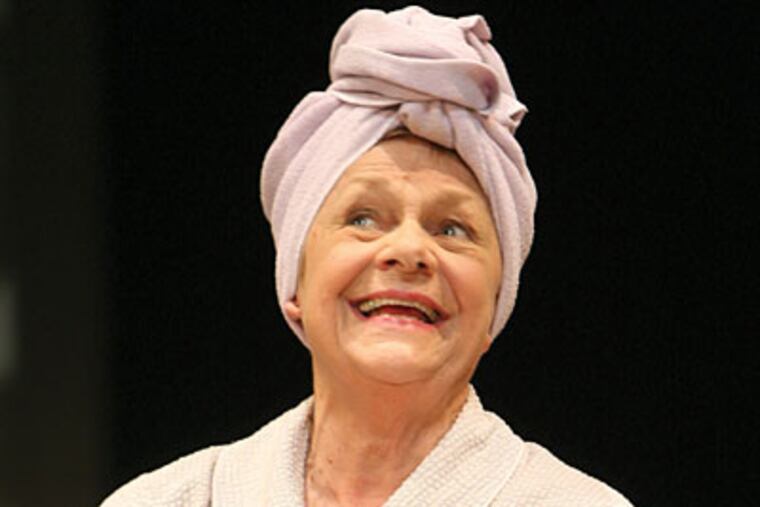
With her all-encompassing earth-mother voice and her easy poise, Estelle Parsons - opening here Tuesday in a week's run of the Tony-winning August: Osage County - fully inhabits the American stage's newest indelible role: the pill-ravaged, tongue-lashing, acid-fueled, man-shrinking Violet.
And did we mention foot-stomping? Much has been made of Parsons' emphatic ups and downs on the imposing staircase Violet treads - a total of 352 steps per performance.
For Parsons, 82 and a lifelong exerciser, it's all in a day's work, or a double day's work when there's a matinee and an evening performance, bringing the total to 704.
Violet is the fictional matriarch of the highly challenged (and strikingly funny) Weston clan, based both in rural Oklahoma and in a tight space sandwiched between lucidity and madness. Tracy Letts wrote the play for Chicago's Steppenwolf Theatre; Chicago-based Deanna Dunagan created the role, then moved with it and the cast to Broadway in 2007, where she won a best-actress Tony, and Letts won for best play.
When Dunagan, in her late 60s, left the cast, citing exhaustion in a role whose intensity alone is draining, Parsons, at 80, took over on Broadway, then in this national tour. She says she looks forward to coming to the Forrest. "I'll be so glad to get to Philadelphia. I played in so many out-of-town tryouts there, and now I'm back."
Parsons has acted through enough generational shifts to have two different "best-known-fors": one is her 1967 Oscar in Bonnie and Clyde, as Clyde's sister-in-law, the other her 1990s role as the mother of TV's Roseanne. But for all her film and TV work, hers is a solid stage career: a 1956 Broadway debut with Ethel Merman in Happy Hunting, and now, 26 Broadway plays and musicals later, the lead in August: Osage County.
(Roseanne wasn't her first TV experience: After she left Marblehead, Mass., to find a career in New York, she became the first female news reporter for a network - NBC, as an original member of the Today show in 1952.)
Parsons has three children and three grandchildren. One of the latter, she'll tell you proudly, is Eben Britton, offensive tackle for the NFL's Jacksonville Jaguars. "He has a lot of the issues you have if you're a successful actor - being in the public eye and performing and all that - so we have become closer. He's a great guy." The tour schedule allowed her to see him play in person last season, and he's seen his grandmother in Osage. Verdict? "Oh, he loves it," she says. "He thinks I'm terrific."
I spoke with Estelle Parsons by phone a few days ago. She was in Cleveland, the national tour stop before Philadelphia. Here's a sampling of our conversation.
Question: You seemed on Broadway to be a more motherly Violet than Deanna Dunagan's version.
Answer: If I did, it's just me. (Laughs.) Frankly, I just learned the lines and hoped I could remember everything. I never replaced anyone before but I thought, why not try it?
I take my work so seriously, and I'm used to having a very good relationship with playwrights and directors, and creating characters. I'd seen the play, and like most actors, what you see is seared into your brain, so I did what Deanna did and just fit into a big show that was a big hit.
Then, as I got working on it . . . it's gotten much, much deeper and has more overtones.
Q: When Deanna Dunagan announced she was finished with the role, your friends at Steppenwolf said this part was a natural for you. This woman, Violet - what did you think of that?
A: I could not imagine why they thought that and I can't to this day! I don't see myself in this part at all - which is probably good because I'm always trying to see different things about her.
I used to take a contract for four months. I wouldn't go longer. I don't want to get stale in anything, and I just want to create things. I've done this part almost two years now and I keep discovering stuff all the time.
But I have no sense why people said that. I know that [film director] Arthur Penn would say, well, I'm outspoken. I don't know if that's part of it. But this woman is full of drugs all the time. You never see what she'd be like as a non-drugged person.
Maybe it's because I do tragicomedy, and I've been extremely successful in that. But I think comediennes were not particularly hired for August: Osage County, and I certainly don't feel this part is me at all.
Q: It sure is demanding.
A: I'm healthy and I've always been since I was a kid. I like to be moving. I love dancing - I dance around my dressing room for a half hour before I go on. My son gave me an iPod with all this great music. This play requires so much physical and psychic energy, I feel you have to be ready to go out there and play basketball.
I go to the gym every day and walk or swim, and my husband does, too. I do yoga on the two-show days when I can't get to the gym. Otherwise, I swim and ride or do weights every day.
Q: I read that after Broadway, you asked to tour.
A: I was very eager. I love to tour, I love it deeply - it's really being in theater. All these different theaters, all these different crews, all these new audiences - it's the dream, what theater meant to me when ever since I was a kid. It's like vaudeville: I've got to prove myself in every city.
Q: When you became TV's first woman to hold an on-air news job, had you wanted to be a journalist?
A: No, no, no. I got to be successful in it, but I wasn't interested in that at all. I was singing [at a club] in Great Neck, on Long Island, and I had in mind to get into musicals. This was a time when people didn't even know if daytime TV would ever catch on, it was an experiment. It was my 9-to-5er job.
I did all the literary features, and fashion, and kind of fell into the news department. I was the first woman to be part of the news department to handle a presidential primary campaign [Tennessee Sen. Estes Kefauver's]. We were really pioneers.
But I just hated interviewing people on TV. If it were print, you'd get to talk to somebody, get to be interested in people. On camera, it's just look for something. It wasn't something that came naturally to me, it's not my bag - even though I'd like to be doing something socially responsible. I know I'm good at what I do, but it's not really real life.
Q: So you sang at first. Were you studying theater?
A: You couldn't do that at that time. I thought I'd go into politics, actually. It was hard to think about acting as a grown-up experience. It still is, by the way. . . . In Marblehead, Mass., I was elected to the planning board at age 21 - I ran for that. My father was a local politician and was also in the state legislature.
The terrible thing was, in those days people just ignored girls - nobody really cared what I became. I was always first in my class, and nobody suggested that I should do anything but just marry the first good-looking guy who came along.
I spent a year at Boston University law school - I was interested in constitutional legal theory. The next year was the first that Harvard, where my father and grandfather went, took women, and they [Harvard] wanted me to start all over again. I thought, get me out of this profession.
Q: So it was singing that got you into the theater?
A: I was singing with a band in Boston and in cocktail lounges and I played piano. There were eight of us, we put a show together.
Q: You're playing in one of the most compelling new plays to tour the United States in some time. Do people gasp at it all over the country?
A: All the cities are different in some ways. My opinion is, Tracy [Letts] writes people without joy - I don't know how else to say it. I've never played anything quite as stark. But the way Tracy tells their story, it's terribly entertaining for the audience and that's the beauty of it. Anything that engages people the way this play engages the audience is astonishing.