'Vanya' raises the curtain on a Chekhov Festival
Our word drama comes from a Greek word meaning action. So how do you write a drama in which there's no real action? Ask Anton Chekhov.
Our word
drama
comes from a Greek word meaning action. So how do you write a drama in which there's no real action? Ask Anton Chekhov.
And how do you create a festival of inaction? Ask Lantern Theater Company.
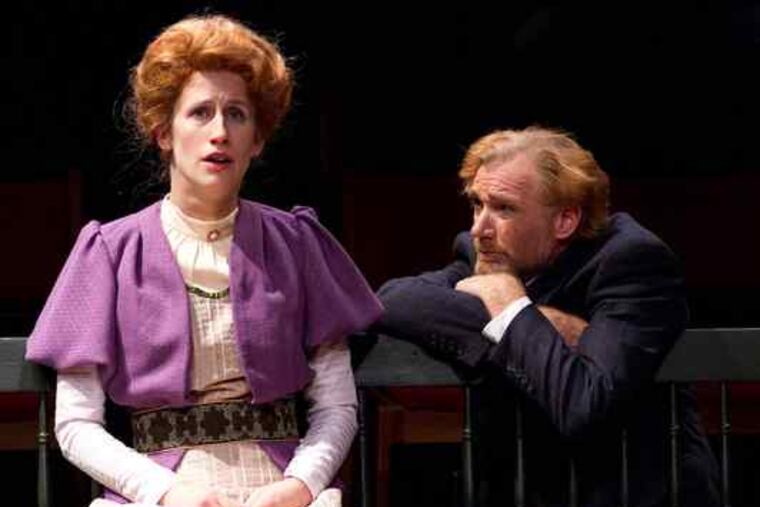
Lantern's production of Uncle Vanya, currently in previews, opens Wednesday at St. Stephen's Theatre and will serve as the centerpiece of the company's Nov. 5-7 Chekhov Festival, which will include a cluster of little one-acts showcasing the Russian master's range and charm.
These include two curtain-raisers, "On the Harmful Effects of Tobacco" before the Vanya performances on Nov. 5 and 7, and "The Death of a Government Clerk" on Nov. 6.
On the afternoon of the 6th, a collection titled "Letters, Lovers, and a Lapdog" will be presented in a new upstairs space, the Lantern Lab: "The Bet," directed by Josh Browns, "Lady With the Lapdog," (M. Craig Getting), and "Chekhov in Love," an original dramatization of Chekhov's letters written and directed by David Howey, who takes the role of Serebryakov in Uncle Vanya.
(Sandwiched between all this drama on the 6th is a "Scholars' Dinner," a discussion of Chekhov's life and work by Patricia Denison of Barnard University, and - full disclosure - me, a professor at University of the Arts, wearing for the occasion my academic hat.)
Uncle Vanya is one of Chekhov's masterworks - the five full-length plays he wrote near the end of his shockingly short life (he died of tuberculosis at 44, in 1904). It centers on a country estate (the playwright's usual setting) where the remains of a family await the arrival of long-absent relatives (his usual setup).
The plot involves a round robin of unrequited love. Uncle Vanya (Peter DeLaurier), his mother (Ceal Phelan) and his niece Sonya (Melissa Lynch) have scraped through their meager lives in the country, always nearly broke, when Professor Serebryakov, Sonya's demanding, pompous father, arrives from Moscow with his beautiful young second wife, Yelena (Sarah Sanford).
Vanya is romantically obsessed with Yelena. Dr. Astrov (Charlie DelMarcelle), a physician friend of the family, also is smitten with Yelena, who may or may not care for anyone. Sonya is shyly, hopefully, hopelessly in love with Astrov. It is, as it always is in Chekhov, an emotional mess, full of ardor and humiliation, made more painful by everyone's self-awareness of his or her ludicrous despair.
The contemporary relevance of Vanya is startling; Astrov's outrage over the lack of conservation of the land could have been spoken by Al Gore - the destruction of the forests, animals, and birds over the preceding 50 years, while the miseries of disease and poverty remain unchanged. Astrov sees a world that "throw[s] everything into the flames today and let[s] tomorrow look after itself."
The first task of any director of a Chekhov play is to choose a translation; this is not easy, as everyone seems to have taken a shot at translating or "adapting," the solution for contemporary playwrights who don't read Russian but work from a literal translation. David Mamet, Craig Lucas, Emily Mann, Michael Frayn, Brian Friel, Jean-Claude van Itallie - all have published their versions. Director MacMillan settled on Mike Poulton's, a clear, unobtrusive yet distinctly British, version.
Another challenge is the "ensemble" question: how to create a sense of the naturalness and dailyness of a group of people living together. This is partly solved in this production by the actors' familiarity with one another; Peter DeLaurier and Ceal Phelan, husband and wife in real life, son and mother in Vanya, have been acting together for 39 years. Most of the actors, all Philadelphians, have worked together before. And there is nothing like professionalism: MacMillan refers to DeLaurier and Howey as "titans" who arrived on the first day of rehearsal already off book, their lines perfectly committed to memory.
In turn, Howey notes that it's the director who makes an ensemble out of a cast, and Phelan adds that the "table work" - the discussions actors have before rehearsing - is crucial, establishing the backstory of the family as well as the individuals so that the actors feel they know these characters intimately, as if they really were a family and old friends.
Asked how performing Chekhov differs from other playwrights' work, DeLaurier said that it was most important for him "to take off my American instincts; they are Russian people, and they live large, and one simply can't be afraid of embodying the emotion."
Howey, formerly of the Royal Shakespeare Company, said, "You have to discipline yourself to keep moving forward so that you don't sink into those famous Chekhovian moods."
DeLaurier goes on to say that he's waited 25 years to play this role; he both identifies with Vanya and sees it as a theatrical opportunity to solve the puzzle of the character. "He's a fascinating man to live inside. I have to find in me what is true in him."
(There's a bizarre 2009 movie called Cold Souls that stars Paul Giamatti as an actor named Paul Giamatti who is so profoundly weighed down by playing the lead in Uncle Vanya that he decides to have his soul extracted. Chekhov does make extraordinary demands.)
Vanya says, "The comedy is turning into a farce," as is, of course, the tragedy. This lends itself to a future cherry on top for local theater lovers to anticipate: Anton in Show Business, a hilarious Chekhovian spoof by Jane Martin, directed by Rick Stoppleworth, will be performed by the University of the Arts' School of Theatre at the Arts Bank Feb. 17-20.