In Walnut revival, Shanley's 'Doubt' still disturbs
Ripped from this morning's headlines, as they say. And yesterday's. And tomorrow's. John Patrick Shanley wrote Doubt, which won the Pulitzer in 2005, conscious of the "ever-widening Church scandals," but before the current shocking escalations about predatory pedophile priests. Its very relevance skews this fine revival at the Walnut Independence Studio on 3; the play should leave us in doubt, but the audience's response has preemptively moved beyond doubt to condemnation. It's 1964 in the Bronx. Father Flynn (Jeff Coon), a young, basketball-playing priest who seems devoted to the parish and the students at St. Nicholas Church School, finds himself at war with Sister Aloysius (Ellen Tobie). In full black habit, she is formidable: rule-bound, cold, suspicious, and intolerant, while he is warm, compassionate, and flexible. Caught in the crossfire is a young, naïve nun, Sister James (Karen Peakes), whose naiveté is exploited by them both.
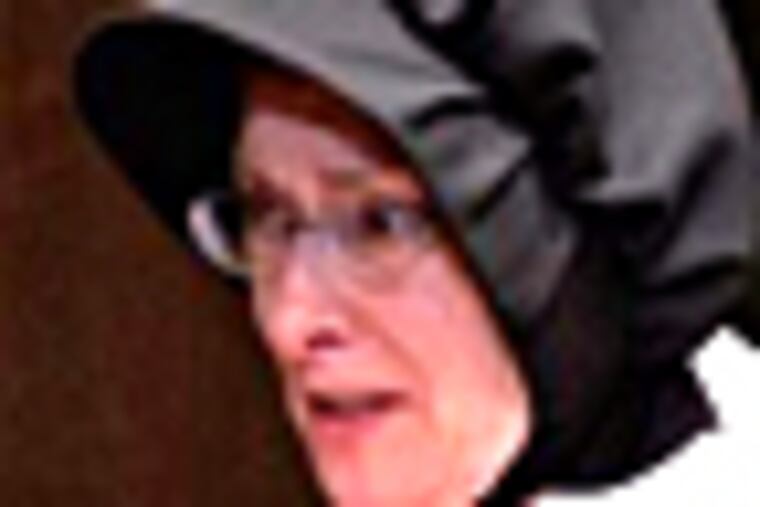
Ripped from this morning's headlines, as they say. And yesterday's. And tomorrow's. John Patrick Shanley wrote Doubt, which won the Pulitzer in 2005, conscious of the "ever-widening Church scandals," but before the current shocking escalations about predatory pedophile priests. Its very relevance skews this fine revival at the Walnut Independence Studio on 3; the play should leave us in doubt, but the audience's response has preemptively moved beyond doubt to condemnation.
It's 1964 in the Bronx. Father Flynn (Jeff Coon), a young, basketball-playing priest who seems devoted to the parish and the students at St. Nicholas Church School, finds himself at war with Sister Aloysius (Ellen Tobie). In full black habit, she is formidable: rule-bound, cold, suspicious, and intolerant, while he is warm, compassionate, and flexible. Caught in the crossfire is a young, naïve nun, Sister James (Karen Peakes), whose naiveté is exploited by them both.
At issue is a new boy at the school, the first and only black child to be admitted; we will learn from his mother (Kaci M. Fannin) how terrible his home life is, and how grateful he has been for Father Flynn's kindness and attention. But Sister Aloysius suspects that attention is abusive and corrupt, and sets out to bring Father Flynn down.
Part of what is so interesting about this play is that it is both idea-driven and character-driven. And each actor creates a character so distinct, so nuanced, that we feel we know them far better than this hour-and-a-half acquaintance, and each glance and gesture contribute to the play's issues. Tobie's pursed lips and raised eyebrows; Peakes' clear blue gaze that seems to cloud over; Fannin's shift from accommodating to steely; Coon's alternation between smug male entitlement and panicky outrage.
Director John Peakes manages to create both the distance and the intimacy this debate play requires, as the action moves across the handsome set (by Glen Sears) on this tiny stage, from the pulpit to the garden to the principal's office.
Doubt's subtitle is "A Parable," and the play's debate serves as one of the clever and pointed illustrations Father Flynn invents for his sermons (which Coon delivers very well). The dialogue is full of wise observations about human nature, forcing us to shift from side to side as we find ourselves agreeing with each of the four characters. Shanley wrote in the preface to the play, "Doubt requires more courage than conviction does.?…? We've got to learn to live with a full measure of uncertainty. There is no last word. That's the silence under the chatter of our time."