One weekend, three 'Eroicas'
'Were we even at the same concert?" So goes the standard complaint critics hear from readers who had a completely different experience from what they read about in the newspaper. And the answer is, often, we weren't.
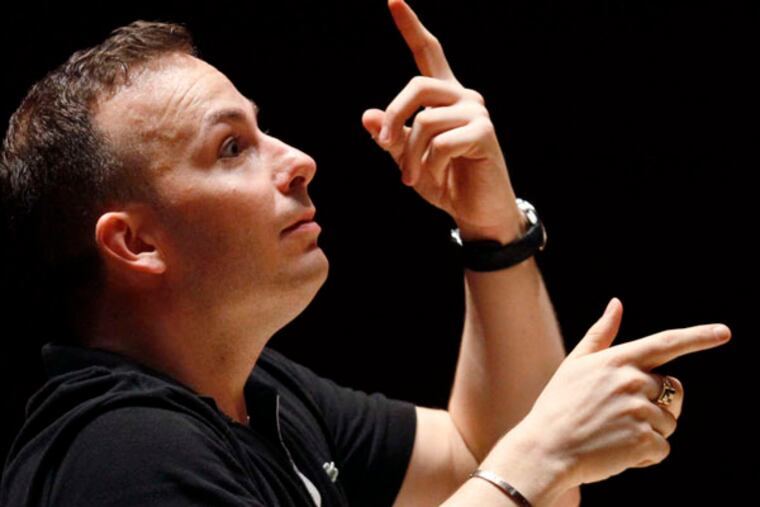
'Were we even at the same concert?"
So goes the standard complaint critics hear from readers who had a completely different experience from what they read about in the newspaper. And the answer is, often, we weren't.
In our cinema-dominated world of standardized experiences, it's hard to believe the Philadelphia Orchestra's repeated subscription concerts vary so significantly that a listener might come away from the same program with radically different impressions.
But the performances do indeed change. Maybe not so much with the late Wolfgang Sawallisch, a paragon of consistency. But artists from soprano Deborah Voigt to conductor Roberto Abbado can be far from their best at first performances.
Current music director Yannick Nézet-Séguin conceives a concert week as an evolving arc from first rehearsal to last performance. "The first concert is the one critics go to and it's not a finished thing," he told WRTI-FM at a recent broadcast of Beethoven's Symphony No. 3 ("Eroica") and Strauss' Metamorphosen. "It might be interesting if you attend each of these four concerts to see how it grows and evolves."
That particular week (Feb. 20 to 23), I heard the first one live and caught the second and fourth in separate radio broadcasts, one from Carnegie Hall the other from Verizon. At one point, I played the two broadcasts simultaneously to see how each got to where it was going.
Examining them individually, differences were incremental, but their accumulation yielded different experiences indeed.
Changing halls can change everything. The only time I saw Sawallisch come close to losing his cool was when the Philadelphians played the ultra-lively Zurich Tonhalle (a "shower stall" said one player), with the conductor frantically pulling back the orchestra's sound in midperformance. Carnegie is far from that, but it has a participatory acoustic: You can hear the Philadelphians not pushing so hard, thanks to the hall's helping hand.
On-the-spot decisions are likely to be greatly influenced. Metamorphosen went slower at Carnegie; Nézet-Séguin savored it, enjoying the structural turning points devised by this most fluent of 20th-century composers. His Metamorphosen sound was ethereal and unforced in all three performances, but had extra spring-water clarity at Carnegie.
The final 20 percent of the piece is tough to sustain in the best of times, but Nézet-Séguin didn't seem to worry, perhaps because of the greater transparency of sound - especially when compared to the Verizon performance, which had more consistent tempos, a stronger sense of drive, and more extroverted, impassioned solos by concertmaster David Kim. Each was its own singular, complete experience, and I loved them equally for different reasons.
The "funeral march" movement of Beethoven's Eroica is the most likely place for on-the-spot performance choices: Few movements have so many kinds of moving parts, each open to infinite shades of meaning. Sakari Oramo, a conductor of Nézet-Séguin's generation whose Eroica is comparably compelling, plays the central fugue more militaristically, growing ever larger until its pathetic collapse, like a Napoleonic monument hitting the ground.
In general, Nézet-Séguin's has less exterior grandeur: The central fugue feels more like encroaching tragedy than billowing grandiosity, with an intensity that doesn't let up until the very end of the movement. This time at Verizon, though, the shape was different: The fugue was even more harrowing, and the rest felt like an emotionally spent epilogue to one of music's most intense expressions of trauma. In other words, the movement's center of gravity was more centralized and discrete at Verizon; at Carnegie it was expansive and wide-reaching.
Of course, listeners absorb musical input according to their own experiences. The broader, bolder strokes of the Verizon performance might seem visionary to some, overcooked to others. Also, acoustics change from one Verizon seat to another.
During the Curtis Symphony Orchestra's recent Shostakovich Symphony No. 7, I had a last-minute-ticket chance to move from the main floor to the generally preferable first tier. Problem was, I was in the back row, deep underneath the second-tier overhang, and felt like I was listening through the wrong end of the telescope. Friends whose ears I trust say they were swept away by the sheer force of sound - which didn't reach my seat. I spent the performance puzzling over the piece. I knew I wasn't getting the full effect. But I can only write what I hear.
Returning to the question "Were we even at the same concert?" The answer again is no, even though we shared the same auditorium at the same time.