This 'Menagerie' sadly misses
Tennessee Williams' heartbreaking early play, The Glass Menagerie, is about the remembrance of things past, reminding us that "Time is the longest distance between two places." A man, haunted by the mother and sister he abandoned, looks back and tells us about them.
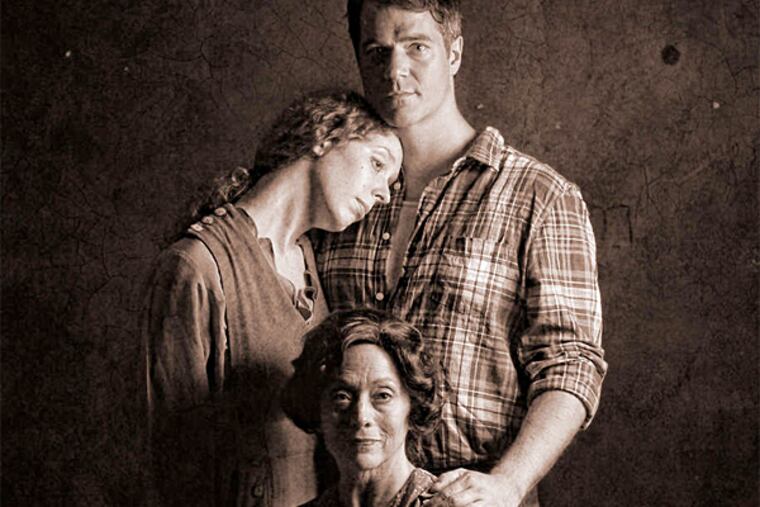
Tennessee Williams' heartbreaking early play, The Glass Menagerie, is about the remembrance of things past, reminding us that "Time is the longest distance between two places." A man, haunted by the mother and sister he abandoned, looks back and tells us about them.
It necessarily follows that the interpretation of these famous characters is not merely the director's - in this Commonwealth Classic Theatre production, Joshua Brown's - but also Tom's (Allen Radway), the character doing the remembering. How we feel about his impossible mother, Amanda (E. Ashley Izard), and his fragile sister, Laura (Isa St. Clair), depends on how Tom feels about them, how they exist in his mind.
So it's possible that Izard's Amanda, looking a lot like Bette Davis and sounding as if she has marbles in her mouth, is Tom's caricature of his mother, just as St. Clair's Laura seems not just painfully shy but brain-damaged. Tom's guilt makes them extreme versions of themselves. Who's to say Amanda wasn't really a sensible single mother trying to deal with two difficult adult children in hard times? Who's to say Laura was not a sweet, possibly autistic girl, hardly as peculiar as Tom recalls?
Having deserted them, leaving them literally in the dark after spending the electric-bill money, Tom bears the burden of choosing to have a life rather than sacrifice it to them. Williams' script gives us ample ways to sympathize with everyone.
What distinguishes this production is the rhythm of the voices, especially Radway's. His Southern accent and unusual inflection create the Tom who narrates the story. With glasses and a different stance, he becomes an older version of the young, desperate Tom he also plays - but who, oddly, doesn't sound the same.
The second act is enlivened with the addition of Jim, the Gentleman Caller (Jamison Foreman), an emissary from the "real" world. Laura comes to life, and we realize we had hoped, just as Amanda had hoped, that romance would solve their problems, that somehow . . . .
The thrilling scenes I always await are disappointments here: Amanda charming Jim so we see how her Southern-belle thing still works, Amanda's crushing sadness and frustration when Laura doesn't know what to wish for on the moon.
In the same way, the costumes (John Hodges) seem to miss the point. Amanda's vintage cotillion dress should be both shocking and embarrassing in its youthfulness and fanciness; here, it's far too subdued and mature. The men's clothes lack that pre-WWII-era grimness.
Sadly, the lighting (Tim Martin) misses almost every evocative opportunity: the Paradise Ballroom across the alley, Jim's proud shadow, the silvery moonlight on the fire escape, the glass menagerie's delicate sparkle, the darkness of Tom's world. Williams wanted the lighting, like the music, to suggest both the "surface vivacity of life" and the "underlying . . . inexpressible sorrow." That's the point of sound and light designs: to express the inexpressible, which, here, remains unexpressed.
THEATER
The Glass Menagerie
Where: Commonwealth Classic Theatre at Off-Broad Street Theatre, 1636 Sansom St.
When: Through Aug. 24.
Admission: $15-$20.
Information: 610-202-7878 or www.commonwealthclassictheatre.org.EndText