Falling for Fraktur
For more than a half-century, since not long after they were married in 1955, Victor and Joan Johnson have been on the hunt.
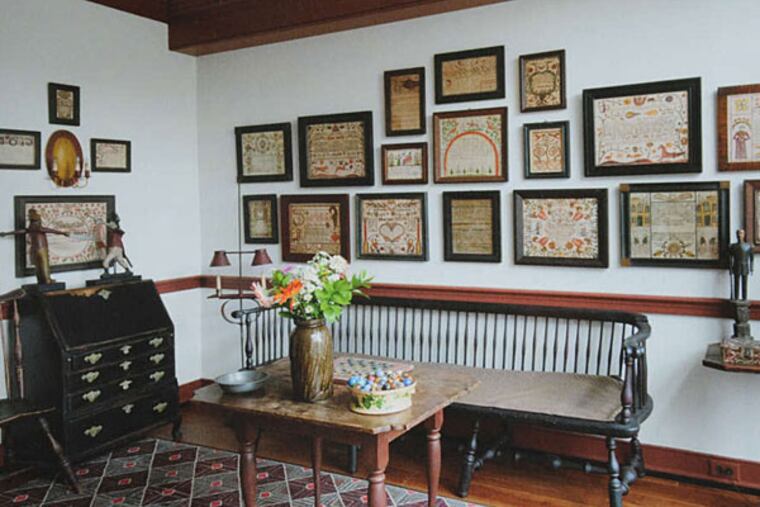
For more than a half-century, since not long after they were married in 1955, Victor and Joan Johnson have been on the hunt.
Joan Johnson says they just fell into it, a by-product of buying and decorating the "little derelict farmhouse" in Huntingdon Valley as newlyweds.
The hunt involved a search for the Pennsylvania German folk art known as Fraktur, a form of decorated or illuminated document with distinctive broken letters.
The whimsy of Fraktur is what got her, Joan Johnson said - that and the charm.
Birds, flowers, animals, rosy-cheeked people, delicate lines, and vivid colors abound in Fraktur, used by rural schoolmasters and pastors in the 18th and 19th centuries to ornament papers relating to "life's events - birth, death, education, house blessings, New Year's greetings," she said. There is also a quirkiness to Fraktur, even a weirdness. Drawings of hybrid fish with the heads of men. Humans mottled like snakes. Long-tongued lions.
The Johnsons built one of the great private collections of this unusual art form and have now promised it as a gift to the Philadelphia Museum of Art. The museum has mounted a show in its Perelman Building to share more than 200 works from the Johnsons, "Drawn With Spirit: Pennsylvania German Fraktur," on display until April 26.
But the Art Museum's current embrace of Fraktur is not an isolated instance of idiosyncratic programming. In fact, a kind of Fraktur frenzy is about to break out in the region.
On March 1, the Winterthur Museum, Garden, and Library in Delaware will open an exhibition of Fraktur and related folk art called "A Colorful Folk: Pennsylvania Germans & the Art of Everyday Life." The Free Library of Philadelphia will open an exhibition of its own impressive collection of Fraktur on March 2, "Quill & Brush: Pennsylvania German Fraktur and Material Culture."
There is also a conference at the University of Pennsylvania's McNeil Center for Early American Studies from March 3 to 7 organized by the exhibiting institutions to examine Fraktur and the everyday lives of Pennsylvania Germans.
The Johnsons are a major part of this frenzy, though that's hard to believe as they sit serenely in the quiet den of their Center City home, where the picture window looks out over the bare treetops of Washington Square. Only a glance at the denuded walls, dotted with picture hooks from which nothing hangs, tells the visitor something is out of the ordinary. Almost all of their 230 Fraktur pieces are at the museum.
Joan, 82, is an interior designer, and Victor, 87, is an entrepreneurial computer services and banking pioneer. Together, they are a kind of Team Fraktur, though neither started out thinking Pennsylvania folk art would dominate their lives.
Joan remembers her first Fraktur - "a little tiny Indian; it was just charming." And, even more important at the time, only $25. She bought to decorate, going to local auctions in the area, acquiring and eventually studying this unique art.
"I thought it was a wonderful art form I'd never heard of," she said. "And it was cheap."
But there came a day when she and her husband were seriously contemplating buying an entire collection to acquire one piece.
There were 83 pieces in the collection, Victor said. Joan added, "We had no business buying it" because of the price. But Victor had her quietly appraise each Fraktur and they took a gamble - buying all to acquire one - and hoping they could sell off the rest to ease the financial burden.
They did.
The piece they acquired that night, Samuel Gottschall's Adam and Eve (c. 1834-35), is one of the great images in the exhibition, two human figures, virtually genderless, beneath an almost Matisse-like Tree of Knowledge.
"We knew we were collectors when we bought an entire collection to get that one piece," Joan said.
Another "ah-ha" collection moment, said Victor, came shortly after he had given Joan her first answering machine. The first message she received led to the acquisition of three "mint" Frakturs by Durs Rudy.
She was going to buy one. But they were all gorgeous.
"Vic said to me, 'So on a scale of one to 10, what do you think?' " she recalled. " 'Vic, they're an 11. And I can't decide which one I want.' Vic said, 'If they're an 11, we should buy all three.' That was an enormous amount of money. Yeah, he really thought big. I was just decorating. That was the second time I knew we were collectors."
The Fraktur hunt took them all over Southeastern Pennsylvania and brought them into contact with many prominent members of the Pennsylvania German community - people who were "buying back their own heritage."
Some of them were big personalities, too. Joan fondly remembers "my guru," Pastor Frederick S. Weiser, who died in 2009, and whose collection forms a prominent part of the Winterthur exhibition opening next month.
She remembers Pastor Weiser coming to her home to see her collection for the first time.
"He's a big, fat, roly-poly, jolly guy, and he looks at this [wall] and he says. 'Joan! What is a nice Jewish girl like you having my Fraktur?'" she remembered, laughing and mimicking in her best Pennsylvania Dutch accent.
"He says, 'Do you know what they say?' 'No.' He says, 'That's good! You wouldn't want them!' "
As it happens, the contents of the documents can sometimes be fierce, invoking hellfire and condemning evildoers - not what you might expect from the cheery floral borders.
"What this little collection has meant to us," said Joan. "We've met marvelous people we never would have known. We've been to areas of Pennsylvania we never would have gone to. We've gone to museums, historical societies we never would have gone to."
Said Vic, "How about all over the country and Europe?"
"And Europe, of course," she said.
ART EXHIBITION
Drawn With Spirit
Through April 26 at the Philadelphia Museum of Art Perelman Building, 2600 Benjamin Franklin Parkway. 10 a.m.–5 p.m. Tuesday–Sunday.
Admission: $20; 65 and older, $18; students, $14; children 13–18, $14; children 12 and under, free.
Information: 215-763-8100 or www.philamuseum.orgEndText
215-854-5594
@SPSalisbury