Recycling art? It's all happening at the zoo
New exhibit mixes animals and the environment
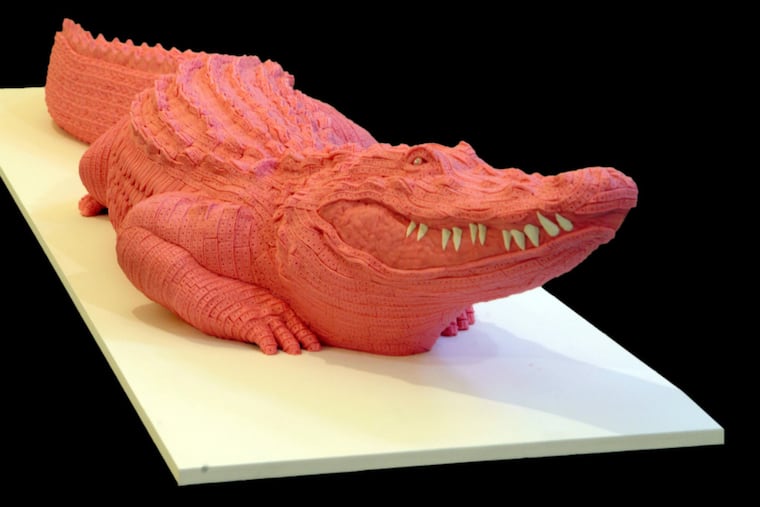
A CROCODILE made of bubblegum, a giant gorilla composed of car parts and tiny creatures carved from crayons are all trying to tell you something: Recycling is important, and our everyday actions have an effect on our friends in the animal kingdom.
"Second Nature," opening Saturday, is the Philadelphia Zoo's latest feature experience. The exhibit's name holds a two-pronged meaning: Trash gets a second life in art pieces, and recycling can become "second nature" to humans. "Second Nature" is free with regular zoo admission.
Installations by 12 artists will be scattered throughout the zoo, many created from repurposed materials. The artists range from Philadelphia to international locations, which the zoo's creative director, Barbara McGrath, said was an intentional choice to show that habitat conservation is a worldwide problem.
"People are the source of the problem, and we need to be part of the solution to the problem," McGrath said.
Many of the installations are extraordinary in size, the largest being a 35-foot tree made from plastic bags, bottles and other materials.
"In order to create something that people really find exciting in an outdoor setting . . . you have to lean toward a spectacle," McGrath said.
However, not all the pieces tower over visitors - Seattle artist Diem Chau carved two packs of Crayola crayons into 48 endangered species. Amy Shearer, the zoo's chief marketing officer, said these tiny works are also spectacles in their own right.
"The creativity that goes into this kind of work is the same creativity that will be needed to solve these problems," Shearer said.
Some of the works will be installed on-site, including an abstract overhead sculpture made from more than 4,000 plastic bottles, by New York-based artist Aurora Robson in the zoo's McNeil Avian Center. So many bottles would take nearly 1,000 years to decompose, according to the zoo's website.
Kristen Waldron, the zoo's director of conservation education and integration, said that art is a great way to spread messages of energy conservation and recycling to the zoo's 1.35 million annual visitors.
"I think art reaches everyone," Waldron said. "It connects with you emotionally, your creative side, your imagination, and when you combine art and animals as we are doing here, we feel it is a great opportunity for action."
The exhibit has two large gorilla sculptures - a 13-foot piece made of car parts, and a 9-foot piece made of cardboard.
"That's the springboard to be able to talk to people about the importance of reducing paper, cardboard being one, to reduce energy and save animals like gorillas," Waldron said.
In addition to the sculptures, gorillas are the stars of a photo display by world-renowned wildlife photographer Gerry Ellis. Visitors will get to track Ellis' whereabouts on a map and have the chance to interact with him via email.
Philadelphia artist Leo Sewell also will be featured. Sewell, who grew up near a dump, uses found objects to create art pieces. Sewell's piece for "Second Nature" is "White Rhinoceros," a 3 1/2-foot-tall, 175-pound figure made from silver-plate serving trays and other dinnerware he collected from curbs, junk sales and scrap piles.
Sewell has created other found-object animal sculptures before, but this is his first rhinoceros.
"It's become a symbol of extinction, and I started to work in silver-plated objects lately, and they just lend themselves so well to a rhinoceros," Sewell said.
The artist is pleased with his contribution to the exhibit.
"Other than marrying my wife, that rhinoceros is one of the best things I've ever done," Sewell said.
From silver plates to spark plugs, the materials used by artists featured in "Second Nature" vary immensely. Shearer said that all the items are connected by the theme of repurposing materials to have a second use, and that conscious, environmentally friendly behaviors can become "second nature" to all of us.