At the first concert, bumps and surprises
LUXEMBOURG - Listeners probably thought they knew what they were getting at the Philadelphia Orchestra's Thursday opening concert of its 2015 Europe tour here.
LUXEMBOURG - Listeners probably thought they knew what they were getting at the Philadelphia Orchestra's Thursday opening concert of its 2015 Europe tour here.
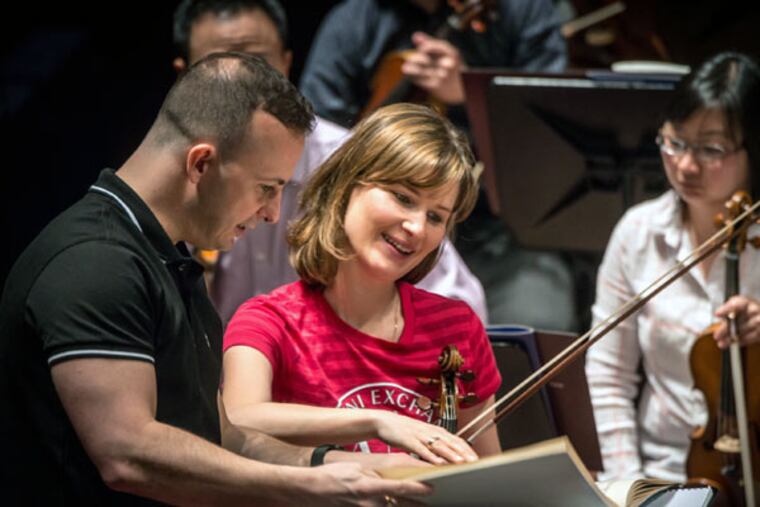
But after guest soloist Lisa Batiashvili played a hot Shostakovich Violin Concerto No. 1, she and music director Yannick Nézet-Séguin regrouped in the rear of the stage where the piano was parked. They played Tchaikovsky.
The two had cooked it up in Philadelphia before leaving on tour, choosing the first of the composer's Six Romances Op. 6 ("Do Not Believe, My Friend"), which they had recorded together a few years ago - in what felt more like a spontaneous gift to the audience than a typical encore. It was also a moment of repose near the end of what hadn't been the easiest day.
"It has a big personality, this hall," Nézet-Séguin told the orchestra at the morning rehearsal. "I love it, but . . . it doesn't just let you play."
The orchestra sounded great in the auditorium. But the reverberation time - 1.5 to 2 seconds - is generous enough that the musicians couldn't always monitor each other onstage. The nostalgic, distant, folklike melody that begins the Rachmaninoff Symphony No. 3 requires a seamless cello/clarinet/horn blend among musicians who are physically distant from one another. They made it happen somehow.
In the Shostakovich, Nézet-Séguin requested a less gentle sound, reminding the players that Batiashvili had to sound like "a lonely voice against the souvenir of a bigger world." Ever the multitasker, he conferred with her while conducting the frenetic finale. But backstage noise tested his patience; his fuse isn't limitless.
Congenial pianist Emanuel Ax was also tested when he showed up at his hotel, the Sofitel Luxembourg Le Grand Ducal, exhausted after an overnight trans-Atlantic flight, to discover an extremely loud fire alarm (false) delaying his check-in. Nonetheless, three hours later he was up and out to practice for his Friday performance of Beethoven's Piano Concerto No. 3.
But heaven help him, or any musician, taking a cab to the concert site: Drivers don't always know where the Luxembourg Philharmonie is and have been known to simply drop passengers off anywhere and blithely drive away.
As much as the Grand Duchy of Luxembourg might have a lingering reputation for being exceedingly cute, provincial, and self-satisfied, the orchestra's two concerts here are no backwater gig. In fact, Luxembourg has changed enormously in recent decades, thanks to the iron industry, low taxes, and a multicultural influx. The Luxembourg Philharmonic's latest recording is with world music singer Angelique Kidjo. Prime Minister Xavier Bettel recently became the first serving leader in the European Union to marry a same-sex partner; he threw a citywide party at the scenic Place Guillaume II to celebrate.
The Philharmonie itself - only 10 years old, designed by architect Christian de Portzamparc, and among Europe's most attractive halls - has ocean-blue seats with wavelike backs, their slightly staggered rows creating visual ripples. Along the sides of the auditorium are eight towers intended to suggest the side boxes of a Shakespearean theater.
The Thursday audience seemed a bit puzzled by Nico Muhly's stylish if distinctly American brand of post-minimalist music in the concert opener, Mixed Messages. And while the Rachmaninoff was warmly received here - more so than last week in Philadelphia - the long-planned encore, his muted, wistful Vocalise brought the audience to its feet.
So the program is clearly working out, as the eyes of classical-music Europe are fixed on the Philadelphians. On Thursday, Holland's morning daily De Volkskrank was on hand to herald the orchestra's June 4 visit to Amsterdam. Journalists from Germany's Die Welt, the London Times, and France's Le Figaro all traveled to Philadelphia to write advance pieces on the tour. On some of those visits, travel expenses were subsidized to varying degrees by the orchestra. But subsidized or not, journalists go where the story is good.