Plumbing the mysteries of Sondheim's 'Passion'
When the moment of romantic consummation finally arrives between the main characters of Stephen Sondheim's Passion, the man and woman who have been pondering, dismissing, and obsessing over each other are standing on opposite sides of the bedroom in an odd state of wonder.
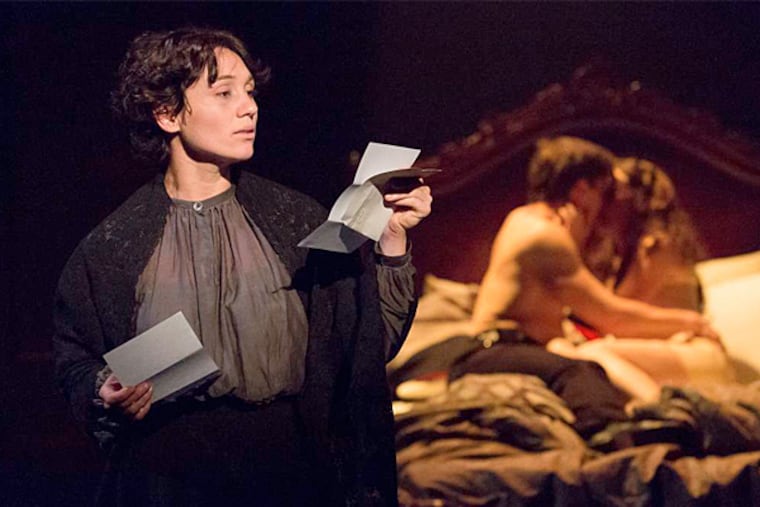
When the moment of romantic consummation finally arrives between the main characters of Stephen Sondheim's Passion, the man and woman who have been pondering, dismissing, and obsessing over each other are standing on opposite sides of the bedroom in an odd state of wonder.
Nobody in the Arden Theatre cast is entirely sure why this violation of theatrical common sense feels so right. But it does. "If it was the standard Tony-and-Maria prom pose [in West Side Story], nobody would believe it. Everybody's 'truth meter' would go off," said leading man Ben Michael.
"Our job," co-star Liz Filios said, "is to tell the story of impossible love. They've found what love is and it has nothing to do with physical proximity."
Once again, Sondheim's least conventional musical - in previews, opening Wednesday - has made the actors and director Terry Nolen forget what they thought they knew. Set in 19th-century Italy, the show begins with two typically handsome people in bed, the soldier Giorgio and his girlfriend, Clara. But the real love story unfolds when homely, sickly, hysterical Fosca, who lives on charity on the remote military outpost where Giorgio is stationed, claims the soldier for herself.
She does so with music that can't help but put performers and audience on new ground. The score doesn't have songs as much as it has emotional weather fronts, harmonically saturated tunes that begin in one key and end in another a fair distance away, without the usual signposts that tell Broadway ears "this is the beginning, the middle, the end." Other songs are letters sung by one character to another. No wonder the 1994 show ran for only 280 performances on Broadway. Nothing so short-lived before or since has won the Tony for best musical.
"It doesn't conform to traditional expectations. It subverts so many of them. So, again and again it asks you to accept and enter into the show on its own terms," said Nolen, who has directed 13 Sondheim musical productions.
He saved this one until he was ready - and not because he'd cracked it: "The only way I could really figure it out was by doing it."
Passion
isn't esoteric or complicated so much as it's emotionally direct in ways audiences aren't used to. The usual artifice doesn't stand between characters and audience. No applause points. No intermission. Yet some of Philadelphia's best actors were drawn to it - Jennie Eisenhower, Ben Dibble, Frank X - even in secondary roles, partly because it's a one-of-a-kind experience.
"It's taught me a great deal about perspectives I never considered before," said Filios, who won the 2014 Haas Award for an emerging Philadelphia theater artist. "They speak of the psyche of the sick. There's a lot of discussion about love and death, and what is true. It's an honor to swim around in those questions every day and let them knock around in my mind at night."
Of course, she fully realizes Fosca is "well beyond the bounds of sanity" - a stalker, in effect, who lives in a cycle of inappropriate romantic aggression, apologetic retrenchment, and then renewed, more outrageous aggression. Similar stories in modern times end with a restraining order. Instead, the object of her obsession is won over but then suffers a nervous breakdown.
During the original Broadway previews, audience arguments broke out between those defending Fosca and those dismissing her. Some of that was quelled by the last-minute inclusion of the song "Loving You," a simple, selfless declaration of love that shows Sondheim at his most distilled.
"We all know what it's like to desire somebody. We know what it's like when it's mutual - and when it's not," Nolen said. "That's the great strength of this piece. We understand the characters in a very personal way."
Bringing those characters to life is another matter. The Wilma Theater staged Passion in a 2001 production directed by Jiri Zizka in which the leading man's significant vocal illness threw off the show's delicate power dynamics. Nolen had most of his production storyboarded last summer, then threw it out and started again, more simply. "We want to be as close as possible to the characters and their thoughts," he said. "We want to be with them, not looking at them. It's constantly close-ups."
And like the characters on opposite sides of the room in a love scene, Filios and Michael seem to have taken a contrarian tack in preparation: Though they've been working on the music since November, many rehearsals have been without music, treating the show like a straight play, speaking the lyrics. Emoting is seriously resisted.
"We have a code word - 'going down the rabbit hole,' " Filios said. "Emotion is never the goal. We have our objectives in any scene, and we go after that. If emotion comes, it's a by-product, just as sweat is a by-product for athletes."
She and Michael became friends while working on Theatre Horizon's recent Into the Woods - another Sondheim - but vowed never to hug or touch before the show. "If people can sense that kind of connection early on, we don't have anywhere to go," Michael said. "We're screwed."
After all, Passion comes from a more formal time, one full of symbolic gestures, like enclosing a lock of hair in a letter, which makes candid moments all the more disarming. "We hear their thoughts. We see their needs and their longing," Nolen said. "When we start at the beginning, we're in bed with Giorgio and Clara . . .."
But the nakedness - figuratively speaking - is only beginning.
SONDHEIM AT THE ARDEN
StartText
Passion
Through June 28 at the Arden, 40 N. Second St.
Tickets: $15-$50. Information: 215-922-1122 or ardentheatre.org
Storyteller Award
Given the Arden's commitment to Stephen Sondheim - who has said, "It is heartening for every serious and experimental composer, lyricist, and librettist to know that the Arden exists" - it should be no surprise that the composer himself, 85, will receive the theater's first Master Storyteller Award at a June 1 ceremony, concert, and reception. Presenting the award will be Tony-winning composer Jason Robert Brown. Tickets: $250. Information: 215-922-1122 or www.ardentheatre.org
EndText