Insider tips on how to enjoy the Art Museum's Impressionist show
THE BLOCKBUSTER "Discovering the Impressionists" exhibit that opens at the Art Museum tomorrow - after wowing crowds in Paris and London - brings to Philly a cavalcade of the art world's monster hits.
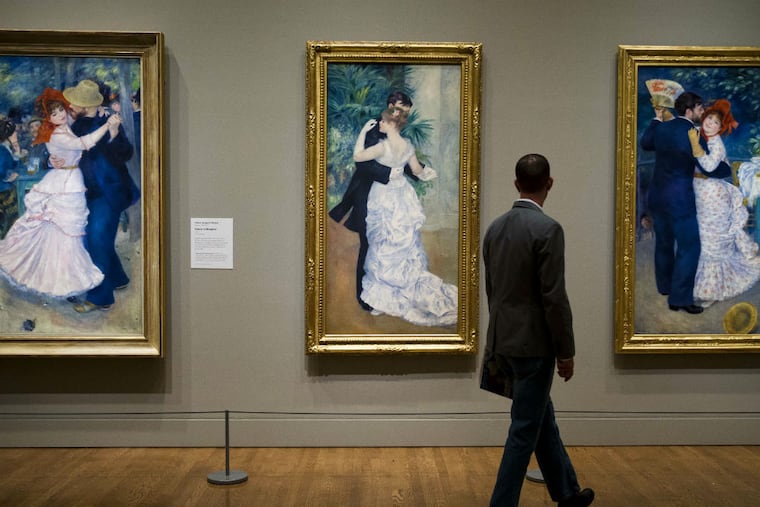
The blockbuster "Discovering the Impressionists" exhibit that opens at the Art Museum tomorrow - after wowing crowds in Paris and London - brings to Philly a cavalcade of the art world's monster hits.
You've got Renoir's dancing couples, Monet's poplar trees, Mary Cassatt's "The Child's Bath," Degas' ballet class and jockeys - it's a college-dorm poster sale come to life in painterly high-def.
Chances are you've seen the mega-masterpieces somewhere: on note cards, coffee mugs, jigsaw puzzles, your bohemian auntie's silk scarves. "I was joking with our gallery guides," said show curator Jenny Thompson: " 'How many of you have gone to your dentist and seen one of them on the wall?' "
But of course your dentist and your WHYY gift tote have the great works in reproduction. So, if you're thinking, "Meh, nothing new here, move along," Thompson would urge you to reconsider. (And having visited the show in preview we'd be with her on that.)
"There's no substitute for seeing a work of art in person," she said.
Renoir: Totally tubular
Take, for instance, those Renoir couples. If you've seen them only as playing cards, the life-size originals are surprisingly large, with some unimaginably bright colors. Instead of mixing and layering paints, the Impressionists worked "directly from the tube," Thompson said, and they worked fast, often outdoors.
Something you can't see in posters and other reproductions are the spots where two primary colors touch ("wet on wet" in artist parlance), where a pure red and a pure blue "sort of smear" into purple, she said. Put your face up close - gallery etiquette calls for about 30 inches of personal space between you and the canvas - and dig those masterly smudges.
The "Discovering the Impressionists" show has three dancing couples side by side on one gallery wall, two on loan from Paris and one out of Boston. So, in addition to admiring those surprising pops of color, "You can start to play a game of compare and contrast," Thompson said. "Look at the women's dresses, and the woman's bonnet that appears in two of them, and the cut of the men's suits."
Look, too, at the woman's face in the painting hung at the far right, Renoir's "Dance in the Country." The model for that composition was the painter's wife-to-be.
Monet: Tree's a crowd
Lucky Philly is already up to its ash in Monet's poplars. The man painted 24 of them, and the Art Museum has two in its permanent collection. "You think, 'Oh yeah, I know that series,' " Thompson said. "You see one poplar and you think you've seen them all."
The new exhibit's most jaw-dropping display has six of them hanging side by side in one gallery. If you spend time looking, she said, you'll see that Monet painted some individual trees repeatedly - his closely observed renditions are almost like tree portraits.
With the six originals lined up in front of you (the visiting poplars hail from London, Paris and Tokyo), now's your chance to play another game: finding tree "characters" that repeat.
Thompson isn't talking, except to hint that some "knobby branches" are the giveaway. "You need to come to the exhibition and look," she said.
Even among the Impressionists, who are known for their beefy brushstrokes, Monet really lards on the paint. If you go, spend a minute appreciating the 3D bumps and ridges. "The texture of paint is something that doesn't come across in a poster or a note card," Thompson said.
Cassatt: Philly strong
The new show's full name is "Discovering the Impressionists: Paul Durand-Ruel and the New Painting." Along with bringing a hit parade of masterpiece paintings to town, it tells the story of Durand-Ruel, the Parisian gallery owner who bought works from Monet, Pissarro, Renoir and Degas in bulk when the rest of the art world was still mocking the way they painted.
Ruel was a keen businessman who bought and held, sometimes for decades. In a neat touch, the labels beneath individual paintings in the exhibit list their buy and sell dates.
Philly-girl Mary Cassatt's famous 1893 painting "The Child's Bath" - visiting her home turf for the show from its permanent home at the Art Institute of Chicago - sold quickly to a private collector, just a year after she painted it.
But then, five years later, Durand-Ruel bought it back, keeping it for 11 years before selling it to the Chicago museum.
Another fun tidbit in the backstory: Cassatt, a young woman from a fine Philly family, helped the Impressionists get a foothold in America by networking for Durand-Ruel with collectors she knew here in town.
Art for art's sake
Cassat's "The Child's Bath," a staple of college poster sales and sophomore girls' dorm rooms, might be the single most familiar painting in the exhibit. Thompson said that what's new to see with the real thing - and this applies to Degas' dancers and racetrack paintings, too - is the painting as a painting, without the distractions of beanbag chairs, dentists' chairs and (we're talking to you, guys) sophomore girls.
The composition of the bath scene isn't random, she said. Look for the "tight crop" and how it heightens the tender moment between mother and child. Imagine the sensation of the child dipping its toes into the water. Notice the masterfully controlled jumble of contrasting textures: "the mother's hands, the child's foot, the combination of skin and cloth."
"When you stop and look at a painting, rather than just glancing at the poster, it focuses your attention," Thompson said. "You're not distracted by other furnishings and other goings on."
Philadelphia Museum of Art, 2600 Benjamin Franklin Parkway, tomorrow through Sept. 13, timed tickets $12-$25 (under 5 free, adult tix discounted to $20 after 3 p.m. weekdays through July 31), 215-235-7469, philamuseum.org.