'Hamilton': Rapping with the Founding Fathers
Before Lin-Manuel Miranda's celebrated musical Hamilton became a must-see Broadway sensation, it was a hip-hop mix tape. At least, it was a work in progress called The Alexander Hamilton Mixtape. That was the name Miranda - a 2008 Tony winner for best musical for In the Heights, written with West Philadelphia playwright Quiara Alegría Hudes - used for his rollicking, rapping project about "the 10-dollar Founding Father" during its gestation.
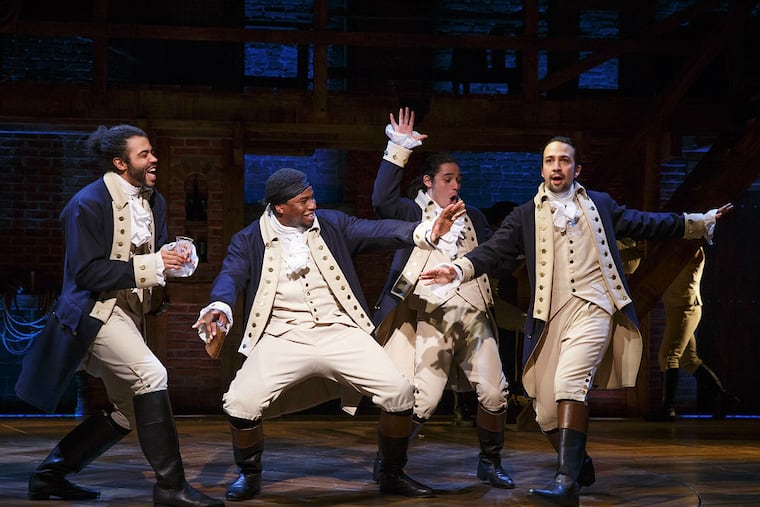
Before Lin-Manuel Miranda's celebrated musical Hamilton became a must-see Broadway sensation, it was a hip-hop mix tape.
At least, it was a work in progress called The Alexander Hamilton Mixtape. That was the name Miranda - a 2008 Tony winner for best musical for In the Heights, written with West Philadelphia playwright Quiara Alegría Hudes - used for his rollicking, rapping project about "the 10-dollar Founding Father" during its gestation.
Now, the show, which opened Thursday in New York at the Richard Rodgers Theatre after a sold-out Off-Broadway run, is generating rapturous reviews.
With Hamiltonian gumption, Miranda - who wrote the words, music, and book, and also plays Hamilton - premiered the opener, "Alexander Hamilton," as a piano-powered rap at the White House in 2009.
The song, performed in front of President Obama that night - and again when he brought daughters Sasha and Malia to see the show last month during previews - portrays Hamilton as a can't stop/won't stop hustler. Like self-made rappers from Jay Z to Meek Mill, he "wrote his way out of his circumstances from the get-go," Miranda has said.
In that showstopping opener, stylishly and efficiently directed by Thomas Kail, the period-costumed cast, almost entirely actors of color - with the notable exception of Jonathan Groff, who does a wicked King George III, taunting with Beatlesque English music-hall songs - ask Hamilton's essential question:
How does a bastard, orphan, son of a whore
And a Scotsman, dropped in the middle of a forgotten spot
In the Caribbean by Providence, impoverished, in squalor
Grow up to be a hero and scholar?
The answer: with a mixture of brilliance and hard work. Or to put it in hip-hop terms, by staying on his grind:
The 10-dollar Founding Father without a father
Got a lot farther
By workin' a lot harder
By bein' a lot smarter
By bein' a self-starter.
Hamilton was born into poverty on the Caribbean island of Nevis and was orphaned before going on to become George Washington's right-hand man during the Revolutionary War. He was at Valley Forge during the deadly winter of 1777-78. Later, he was the principal author of the Federalist Papers. All that before serving as the nation's first secretary of the Treasury, becoming "the father of modern banking," as Citizens Bank commercials played incessantly during Phillies games the last few years have reminded us.
Hamilton presents its protagonist as an embodiment of the American dream. From history class, we remember he was shot to death in a duel with rival Aaron Burr, and we see his face on the 10-dollar bill. But listen, Miranda is saying, and ye shall hear the story of an outsider who found his way in, an aspirational figure who calls out from the past: "Hey, yo, I'm just like my country / I'm young scrappy and hungry."
This has been called Broadway's "first authentic hip-hop show" by no less than Ahmir "Questlove" Thompson, drummer of the Philadelphia hip-hop (and Tonight Show) band the Roots, which is producing the original cast album.
And the show's credibility as a rap musical is certainly a large part of its appeal. Miranda, along with being a history geek and a theater geek - who was raised by Puerto Rican immigrant parents in northern Manhattan on a steady diet of Fiddler on the Roof and Camelot - is obviously a hip-hop geek.
Hamilton is outlandish, all right. Having Washington, Madison, and Jefferson (Christopher Jackson, Okierete Onaodowan, and the particularly charismatic Daveed Diggs, respectively) played by African American actors seems radical. But once the briskly paced action kicks in, it seems both ingenious - at a time when there's a black president (and Hamilton fan) in the White House - and a theatrical device that the audience, once caught up in the narrative, quickly accepts.
Similarly, hip-hop makes sense in the hands of a natural storyteller like Miranda, as well-schooled in Man of La Mancha as he is in the Notorious B.I.G. and Eminem, whose influence is particularly felt on "My Shot."
Debates between Jefferson and Hamilton about monetary and foreign policy come to life as highly entertaining mic-dropping rap battles. After rhyming about the pivotal military strategy in the war, Hamilton and the Marquis de Lafayette pointedly rap, "Immigrants, they get the job done," and share a high five - and a big cheer from the crowd, which was not nearly as multicultural as the cast.
In one of the funniest scenes, Hamilton's son (played by adult actor Anthony Ramos in breeches) aims to impress his father on his ninth birthday. While his mother, Eliza (Phillipa Soo), provides beat-box rhythm, he rhymes: "My Daddy is trying to start the first American bank / Un, deux, trois, quatre, cinq!"
But one reason Hamilton works so well is that's it's not purely hip-hop. It shows Miranda's affinity for a multiplicity of genres. In the sung-through production, domestic drama scenes involving Hamilton's wife and her sister Angelica (Renee Goldsberry) tend to be told via traditional Broadway balladry.
At the start of Act II, Jefferson arrives from France after the war in a sprightly boogie-woogie number called "What'd I Miss?" That jaunty jazz insouciance also shows up when Hamilton confesses to his extramarital affair publicly - an act of compulsive oversharing ahead of its time - giving his rivals reason to celebrate that he is "never gonna be president!"
The real-life Hamilton, of course, never was, although he did become one of three non-presidential faces on U.S. paper currency (with Ben Franklin and Salmon P. Chase, Abraham Lincoln's Treasury secretary, on the $10,000 bill).
That distinction will soon diminish. The Treasury Department announced in June that Hamilton's image will shrink, beginning in 2020, when he will be joined by the image of a woman yet to be named. Harriet Tubman and Eleanor Roosevelt are the leading contenders.
Ron Chernow's 2005 biography of Hamilton first drew Miranda to the subject. Chernow called the 10-dollar idea "a shockingly wrongheaded and poorly timed decision." Why, he asked, will Andrew Jackson, a slave owner, remain on the 20-dollar bill while Hamilton, an abolitionist, gets shrunk? Miranda himself said on Twitter: "But Jackson stays? The MURDEROUS Andrew Jackson is still money?"
So Hamilton's picture will shrink - just as a wildly popular musical, of all things, is causing his reputation to soar. The unlikely life story of the guy you never stopped to think about, whose face is on the sawbuck in your pocket? It's now being told in a hip-hop history lesson that manages the fabulous feat of turning a Broadway musical into the essential pop-culture entertainment of the season.
215-854-5628
@delucadan
