Review: Young pianists muster a many-hands finale
Classical once spread the word in a setting largely unknown as a musical venue to listeners today: Home. Many a first outing with Beethoven's symphonies came in the form of four-hand piano transcriptions played by amateurs in the living room. There was a critical social aspect to such gatherings. They were, to use the current argot, about sharing, liking, and friending.
Classical once spread the word in a setting largely unknown as a musical venue to listeners today: Home.
Many a first outing with Beethoven's symphonies came in the form of four-hand piano transcriptions played by amateurs in the living room. There was a critical social aspect to such gatherings. They were, to use the current argot, about sharing, liking, and friending.
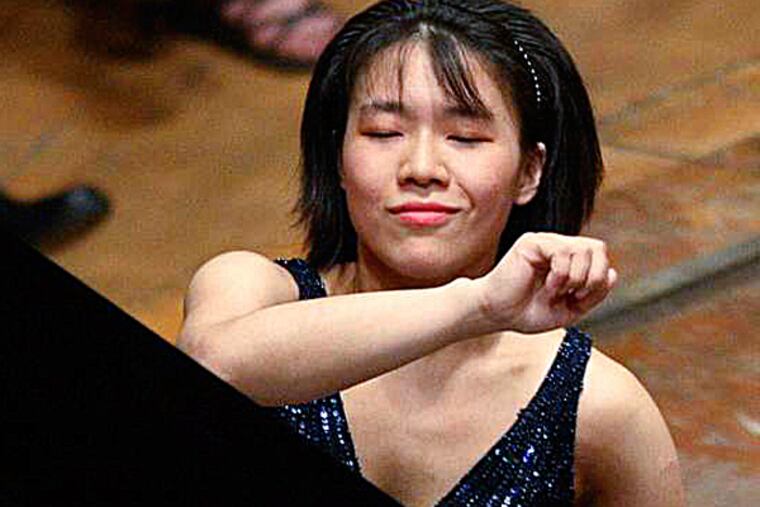
Sunday afternoon's final Philadelphia Young Pianists' Academy (PYPA) concert of the summer brought some of this repertoire into the Curtis Institute's Field Concert Hall, and it didn't stop at four hands. In a flourish rare to any venue, performers went out on a limb to six hands and eight pumping away at a single keyboard.
The novelty ventured further still. A transcription of Chopin's Piano Concerto No. 1 for piano and string quartet made a strong case for itself as chamber music. For a while, you would find yourself listening as translator to that bassoon solo now handled by viola, or violins posing as horns. But especially in the second movement, this iteration, crafted by contemporary Polish pianist Bartlomiej Kominek, worked well on its own terms. One recurring sensation showed a clear deficit: When the piano drops out, its rich bass notes absent, the loss to the fullness of the ensemble is jarring.
A quartet assembled by the Chamber Orchestra of Philadelphia found its footing after some initial weakness, but Ching-Yun Hu, the academy's artistic director, was a superb pianist, and the transcription allowed her urgent, finely detailed phrasing to be appreciated to a degree not always possible with full orchestra. Her legato is lovely, and the way she adjusted her playing - articulation, tone - to what the ensemble was doing at the moment was a lesson in what it means to be a listening and sensitive musician.
There could have been no better experience for her students, some of whom were in the audience, while others joined her on stage as hands multiplied. Debussy's Petite Suite made a predictable appearance for four hands, and Rachmaninoff's Waltz and Romance kept six fully employed.
Albert Lavignac's Galop-March for one piano, eight hands - a morsel of paler flavor than the "Galop" from Khachaturian's Masquerade - came complete with choreography. Pages were tossed aside and pianists engaged in brief, amorous pantomimes.
And yet the playing was, if not serious, convincing that the young talent was serious and ready to graduate to better repertoire.
215-854-5611