Artist Shelley Spector took liberties, then got a reality check
When artist Shelley Spector based her latest work on the life of the late Philadelphia folk-art historian Frances Lichten, it was, she said, an act of "creative nonfiction." She assumed Lichten had been in a semi-closeted, 40-year romantic relationship with the author and illustrator Katherine Milhous.
When artist Shelley Spector based her latest work on the life of the late Philadelphia folk-art historian Frances Lichten, it was, she said, an act of "creative nonfiction." She assumed Lichten had been in a semi-closeted, 40-year romantic relationship with the author and illustrator Katherine Milhous.
"I took all these liberties with the story," she said, "and I always thought that there were no living relatives that would be close enough to this to care about it that were going to call me up."
Then, one did.
A week ago - just a month before the exhibition, at the Philadelphia Museum of Art's Perelman Building, was set to close on Sept. 24 - Lichten's great-niece got in touch.
"My first thought was, 'Oh no,' " Spector said.
Spector, 54, of Bella Vista, began exploring Lichten's biography after Dilys Blum, senior curator of costumes and textiles, invited her to explore the Art Museum's archives for inspiration.
Spector sifted through hats, gloves, shoes, and endless rows of wedding dresses. Amid all that finery, a humble tapestry by Lichten sparked her interest.
Blum was surprised by the selection. "It's funky. I wouldn't say it's a great work of art," she said.
But Spector kept coming back to it.
"I was really enthralled with it immediately. The energy behind it, the colors," she said. "It was very simple but felt personal to me as well. It had figures, flowers, birds, churches, buildings - all these very homey types of things that I relate to. But the thing that really struck me was the text."
In the tradition of samplers, the piece was signed in embroidery: It was designed by Lichten and stitched by her mother.
As Spector did more research on Lichten, she kept encountering Milhous' name. She learned the Free Library has an archive, about 27 boxes' worth, of Lichten and Milhous' correspondence, manuscripts, and ephemera from 1903 to 1977.
Nothing explicitly defined their relationship. But their sign-offs - with pet names like "Poosey" and "Kitty" - were telling. One letter ended, "Keep the home fires burning"; Spector borrowed the phrase as the title of her show.
Spector, who is gay and got married a few months ago, saw parallels between her life and Lichten's. She approached the research, she said, as an artist rather than a historian - which left holes but also room for imagination.
She decided she, too, would collaborate with her mother on a series of works that, like Lichten's tapestry, explored the trappings of domestic life.
"This work symbolized things that most people want in their lives, like hope, protection, love, peace - really basic human hopes. I started thinking about these two women having a home, but not one they were able to acknowledge except to their small circle of friends. It seemed really poignant."
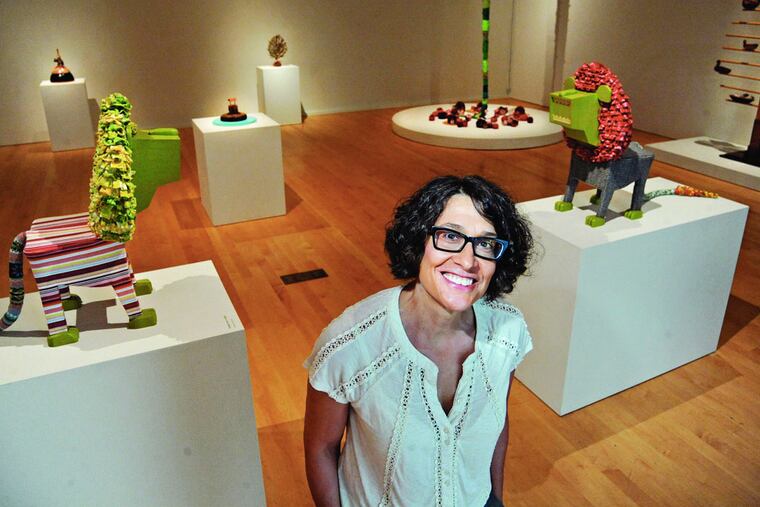
Spector, who works using reclaimed materials, responded to those images with a series of sculptures: Papasan chairs turned into looming monumental figures, inviting but inaccessible, in one corner of the gallery; canopies crocheted from thrift-store T-shirts that look like vibrantly colored oversize flowers; and a matched set that's part child-size chair, part lion, upholstered in flowery fabrics.
The semiabstract pieces are shown alongside Lichten's original tapestry.
Spector's mother, Anita, of Northeast Philadelphia, is in her 80s, just as Lichten's mother was at the time of their collaboration. She helped with the upholstery and learned to crochet for the project, and caught her daughter's fascination with the backstory.
"When she's inspired, you get some of that inspiration that she's talking about," she said.
Some pieces reference the couple's relationship more directly, including one called Frances Loves Katherine, and another, The Egg Tree - a reference to Milhous' most famous book - that includes two diminutive figures. They're positioned beneath a barren tree - a reference to their isolation and to a family tree that, Spector believed, had ended with the two of them.
She learned that wasn't exactly the case when she received an email from Joan Gunin, Lichten's great-niece, who had come across the exhibition online.
Gunin, 60, who lives in Plano, Texas, said Lichten's relationship with Milhous wasn't discussed much when she was growing up. But over the years, she became fascinated with Lichten's work and began collecting her books and related memorabilia. Still, she couldn't help noticing that Milhous was more celebrated than Lichten.
"I was really surprised to see that there was an exhibit dedicated to my aunt, especially because my aunt was the lesser-known of the two," Gunin said.
She hopes to come to Philadelphia to see the works in person if her schedule will allow it. She's drawn to the tapestry designed by her great-aunt and handmade by her great-grandmother, but also to Spector's artwork.
"It's a very impressive undertaking," she said. Though, she conceded, "I don't know if my aunt would get it."
215-854-5053
@samanthamelamed