Smaller, edgier choirs are the future
Once considered a charming pursuit for part-time musicians, choral organizations are virtuosically redefining a number of vanguards, and they were bound to do so in Philadelphia if only because they're so portable and artistically singular.
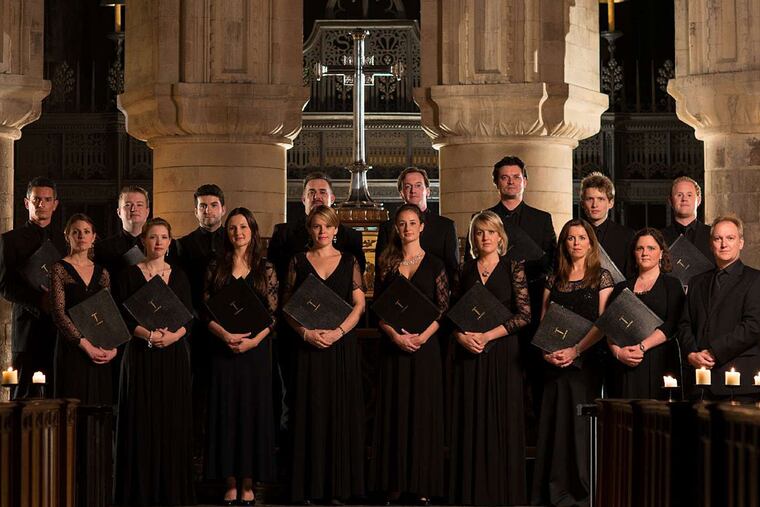
Once considered a charming pursuit for part-time musicians, choral organizations are virtuosically redefining a number of vanguards, and they were bound to do so in Philadelphia if only because they're so portable and artistically singular.
Unlike the lumbering monster choirs of the past, the 18-to-20-voice Tenebrae Choir of London (8 p.m. Friday at Philadelphia's Basilica of SS. Peter and Paul), the nine-voice Roomful of Teeth (3 p.m. Sunday at Princeton's McCarter Theatre) and Bach Collegium Japan (4 p.m. Nov. 7 presented by the Bach Choir of Bethlehem) form a cross-section of previously uncharted sound with repertoires both ancient and new, and differences that can be outrageous but that are most often subtle.
"Only a few people can really explain what it is," says Nigel Short, founder of Tenebrae, which performs ancient, 19th-century, and newly commissioned repertoire. "Listeners are on the edge of their seats, which is nice. That's something I'm told wherever I go. Obviously, it has to do with the intensity with the way we work."
Bach specialists of all stripes have long been part of the landscape. Yet Bach Collegium Japan inspires great long-term loyalty both in concerts and on the 100 or so discs that encompass all of Bach's sacred cantatas - despite the cultural and religious gulf that yawns between the composer and the performers.
"I think I am very lucky to be of Asian background," said founder/director Masaaki Suzuki. "It's much far removed from European culture. But because of our background, we can make more effort to understand and express the music. That makes us more fresh. We are musicians, not theologians."
In contrast, Roomful of Teeth's fusion of classical, pop, and ethnic vocal styles would seem to come from an alternative universe, thanks partly to its alternative role model. "We think of ourselves as a band. We're about generating our own work. Only one or two of our pieces preexisted before the group in some form," said Brad Wells, who founded the choir in 2009.
The result sounds like a global version of the jazzy Manhattan Transfer, and its greatest hit so far - Partita for 8 Voices by group member Caroline Shaw - won the 2013 Pulitzer Prize. For something so innovative, there's been remarkably little resistance among audiences. "The world seems to be much more oriented toward concerted vocal music," said Wells.
Two instigating historic factors are the fall of the Soviet Union, which opened up worlds of alternative vocal sound to the West (starting with the eerie polyphony of the Bulgarian Women's Choir) and the rise of the early-music movement, which did away with the bigger-is-better mentality in performance.
It's now agreed that the likes of J.S. Bach usually had, by 20th-century standards, only a madrigal-size choir. Out of artistic necessity, early-music specialists explored such ideas with a freedom that comes with forming their own vocal groups - not tethered to a larger institution.
An incomplete list starts with groups such as Chanticleer, the Tallis Scholars, and Anonymous 4 (to be presented by the Philadelphia Chamber Music Society Dec 11). Later groups include Stile Antico, New York Polyphony, Conspirare, Philadelphia's own the Crossing - many of them with a strong recording presence on Harmonia Mundi, ECM, and other labels.
But they pay a price for independence by existing on a financial razor's edge. Even the better-paid groups, such as the Tallis Scholars, make only a small fraction of the star salaries in more mainstream classical music. Frequently, a gig is made financially worthwhile by ancillary activities such as singing workshops in schools.
The venerable Bach Collegium Japan, which formed in 1990, is making its current U.S. tour (and stop at Bethlehem) with a chorus of one - the acclaimed Bach soprano Joanne Lunn, singing solo cantatas. "Even with a small choir," Suzuki said, "the number of musicians make it more and more expensive. Maybe next time -."
What keeps them going? "In all honesty," says Tenebrae's Short, "if I knew how difficult it was going to be, I wouldn't have set upon this path." Yet the musical rewards are so great, he wouldn't dream of stopping.
Besides their sense of dedication, all three have curious common ground: They aren't young firebrands but seasoned professionals who reject the typical dictatorial model of conducting. Wells formed Roomful of Teeth in 2009 only after exhaustive auditions in search of singers who could master, say, yodeling and Inuit throat singing. Suzuki is an organist by training who works with seasoned professional singers who can look after the technical matters of their singing.
Tenebrae began by accident. "I put the choir together for a Christmas tour when I living in Switzerland," said Short. "I didn't want to be a dictator conductor. I wanted to work as an ensemble . . . with singers listening to each other rather than watching a conductor's beat. And the singers really went for it."
Though the mentality shift may not seem great, singers who don't subscribe to the approach immediately stand out, says Short. Roomful of Teeth would seem to face the greatest challenges when one of its members falls ill before a concert. But then, the rules are all different with these groups. Philadelphia tenor Steven Bradshaw, a member of the Crossing, has sung with Roomful of Teeth on several occasions with little rehearsal.
He compares the experience to skydiving. "At first, I was afraid. Then it was fun," he said. "The level of ability is so high with every member . . . the chute always opens. I absolutely loved it."
Information: Tenebrae Choir of London, www.cathedralphilaconcerts.org; Roomful of Teeth, 609-258-2767 or www.mccarter.org; Bach Collegium Japan, 610-866-4382 or www.bach.org