Review: Trisha Brown, through the decades
I don't put much stock in performing-arts retrospectives. A gallery can hold decades of paintings; an evening of dance lets us peer back at just a handful.
I don't put much stock in performing-arts retrospectives. A gallery can hold decades of paintings; an evening of dance lets us peer back at just a handful.
Such is the case with Trisha Brown Dance Company's "Proscenium Works, 1979-2011," which features three of Brown's creations from the 1980s to 2003. To Bryn Mawr College's credit, the dance performance is one of many events for In the New Body, a yearlong celebration of Brown's artistry that includes lectures, master classes, and performances culminating in June, when the Pennsylvania Ballet presents O zlozony/O composite, the first American ballet company to stage one of Brown's works.
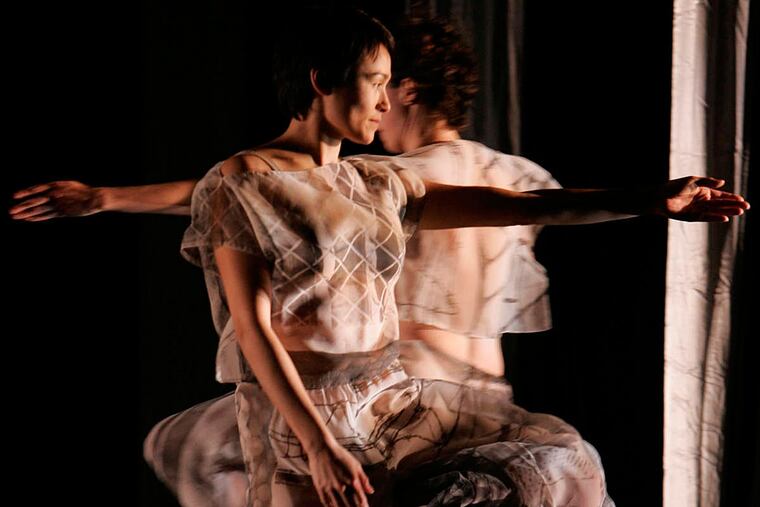
"Proscenium Works" starts with 1983's Set and Reset, a Brown collaboration with artist Robert Rauschenberg scored to the music of Laurie Anderson. In Rauschenberg's sinuous, see-through costumes, the dancers congregate near translucent offshoots of the stage wings. A group carries one dancer, who walks as she lies across their hands (reminiscent of Brown's earlier works set on roofs and the sides of buildings).
To Anderson's electronica score, pairs and trios glide toward the center in sharp, angular, repeated, and mirrored movements before pulling back toward the wings. The transparent patterns on their sheer tops makes it seem they are passing through one another as ghosts.
Brown's 2003 Present Tense provides a mini-retrospective of its own, blending choreographic devices from various points in her career. Seemingly formal and at times staccato, her seven dancers manipulate one another in turn; one pulling another across the floor, a pair draping a third across their bended knees, each group holding for a beat before another group enacts a variation on that sequence. John Cage's score harks back to his influence on Brown when she started choreographing in the 1960s.
The middle piece in this presentation lends the most insight into Brown's artistic contributions. In If You Couldn't See Me, a solo dancer turns away from the audience, her face hidden during the entire eight-minute work set to a Rauschenberg score.
What in 1994 continued Brown's tradition of innovation might today seem gimmicky. It serves as a poetic meditation on the scapula, or shoulder blade; in her exquisite performance, Cecily Campbell arches her shoulders like an eyebrow and spreads her back like a frown, assisting our imagining of the dancer's emotions in relation to her clenched fists and severe postures.
Rauschenberg's backless white dress reveals the tableau painted by this odd little wing-shape bone, one that enables us to abduct the arm at the shoulder, stretch forward and backward, and, much like Brown's innovations, extend our upward grasp.