True Philly stories of immigration, addiction in new dance productions
Dance, as a genre, might not appear conducive to documentary storytelling, what with the lack of words and all.
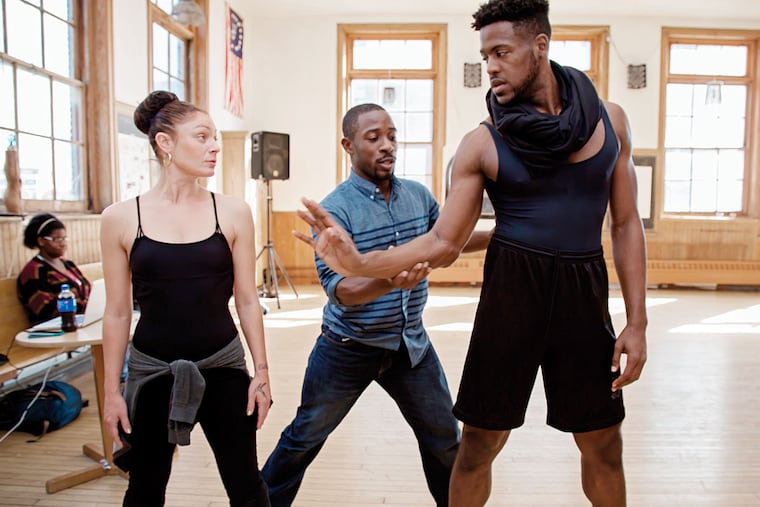
Dance, as a genre, might not appear conducive to documentary storytelling, what with the lack of words and all.
Yet two such projects, both based on sociologies of marginal Philadelphia communities, are set to debut within a week - and a few blocks - of each other.
One of these world premieres, at FringeArts, is Home/S. 9th St. by Kun-Yang Lin/Dancers, a kinetic tale of migration that draws on interviews with more than 60 immigrants in South Philadelphia. The other, at the Painted Bride, is Pushers from Dance Iquail, based on choreographer Iquail Shaheed's family history of addiction - his father died of a heroin overdose in March - and on conversations with young people from the city's Mantua section, where he grew up.
Kun-Yang Lin said dance was uniquely able to convey the essence of lived experience.
"Dance is not theater: We cannot tell the story. But we can bring the feeling out," he said. "A lot of feelings we can't articulate through words. So sometimes I observe those people who I interview - not just what they say, but the simple gestures they make. I translate those simple gestures into dance. A gesture is a word we all know. In dance, we take that bigger."
For Lin, the story of immigration starts with his own biography. He arrived from Taiwan in 1994 and opened his studio on Ninth Street in 2008.
"When we first moved here, we had a lot of challenge and conflict from the older generation," he said. "But now, people embrace us. We shifted their viewpoint."
While creating Home, he reached out to neighbors and invited them to view the work in progress. Then he asked them to share their stories.
But turning community members - expatriates from Mexico, Southeast Asia, and Italy - into collaborators wasn't easy. He reached some of them through open-dialogue sessions and Zumba classes held at his studio. Others he found by visiting parks, community centers, and breakfast joints.
"Some of them really opened themselves up. They don't feel we're the outsiders. They trust us," Lin said. "Some of the older Italians, I had to go to five or eight breakfasts before they would talk."
But he persevered. The result is a performance that begins with humans migrating out of Africa two million years ago, and that lands in the Italian Market, where dancers remark on the wonder of snow and the rigor applied to the language of cheesesteak-ordering.
There are visual references to vintage photographs from Ellis Island and Philly's Washington Avenue Immigration Station, and snippets of interviews mashed into the sound track. There is, perhaps, the most ambitious artistic application to date of Ikea folding chairs, which serve variously as luggage and gates, tunnels and cages, belongings to pack and unpack. At moments, there's agitation and fragmentation; other times, there's optimism.
"A lot of immigrants have those struggles and confusion," Lin said. "At the same time, I try to honor what makes this country great, and why we want to be here."
There is, likewise, ambivalence in Pushers, the work Shaheed based on the addictions that rule life for some young residents of Mantua - and on his memories of his parents, both of whom died from effects of drug use.
"Addiction is ruining the community. There's a loss of family and connection," Shaheed said. "I thought, can I use my work and process not only to create a work of art but also as therapy and as activism?"
Shaheed found his way out of that cycle by participating in double-dutch competitions and drill teams, learning to dance along with Michael Jackson videos. At the High School for the Creative and Performing Arts, he realized dance could be a career. He continued his training with Philadanco and, later, many New York dance companies.
Still, he likes to return home to develop new works in collaboration with area community organizations - in this case, the Mantua Haverford Community Center and the nonprofit Mighty Writers.
He worked with nine teens, inviting them to meet and write in journals, discussing drugs, or issues in the media, or their obsessions with social media. One 12-year-old revealed that she has 5,000 Instagram followers and sometimes shares sexualized images with them.
"Talking to her and getting her to write, we realized she was lonely. That was a way for her to not be lonely," he said.
He concluded that social-media-addicted teens - much like drug pushers following fathers or brothers to the corner - are hooked, above all, on validation. The dance he developed explores manifestations of that, and the score integrates sounds from social-media sites.
The kids were invited to help, as stagehands or ticket-takers. Some are hoping for bigger roles.
Kayla Watson, 15, would like to get on stage and read her poetry during the show. She break-dances, so she can relate to what Shaheed is doing.
"Dancing is a way to express yourself without having to go to violence or putting everyone's business on social media. It helps me a lot," she said.
Back on Ninth Street, meanwhile, Lin found the reaction was mixed. Some of his contributors are eager to see the show. Others, not so much.
"We're allowing people to understand what is the purpose of art. Every day I see my neighbors and say to them, 'Come see the show! I'll give you tickets.' They sometimes say, 'Well, maybe not. I enjoy watching my TV,' " Lin said. "You can't force them, but you extend yourself."
215-854-5053@samanthamelamed