Pow! The Art Museum goes Pop!
By 1970, it was everywhere. It was coast to coast in the States. It consumed Britain. It hit Brazil and Latin America, Japan, and even the Eastern Bloc dominated by the dread Soviet Union.
In 1960, pop art was nowhere.
But POW!
By 1970, it was everywhere. It was coast to coast in the States. It consumed Britain. It hit Brazil and Latin America, Japan, and even the Eastern Bloc dominated by the dread Soviet Union.
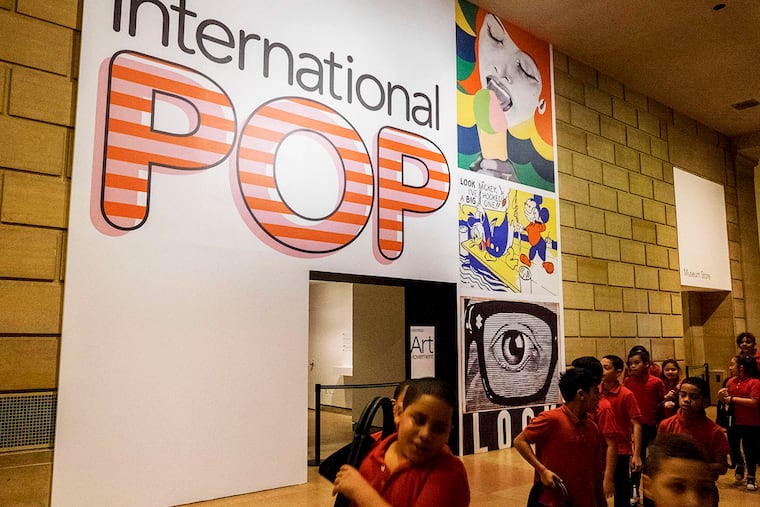
On Wednesday, the Philadelphia Museum of Art opens "International Pop," a giant exhibition that explores how pop art zipped all over the world like a tsetse fly, spreading images and groans and money and pronouncements - glib and maybe even profound - wherever it showed up.
Largely focused on the period from 1956 to 1972, "International Pop" represents a "a moment of informational connectivity unlike anything before," said Erica Battle, associate curator of contemporary art at the museum.
Everybody knew it, everybody shared it, all over the world.
Andy Warhol, whose Campbell's Soup can images adorned countless college dorm walls in the 1960s, could tell you why.
"Everybody looks alike and acts alike, and we're getting more and more that way," he said in a 1963 interview. "I think everybody should be a machine. I think everybody should like everybody."
It is this sense of replicated uniformity, a product of ubiquitous mass media projecting largely American corporate images and desires all over the world, that drove pop so quickly and so far and wide.
Pop art rode the media, studying them, critiquing them, and using them. Pop foreshadowed the digital universe like a trailer foreshadows a movie.
Not everyone enjoyed the show.
One early seminal event in the United States was a 1962 exhibition of so-called new realist painters at the Sidney Janis Gallery in New York. Janis had risen to prominence on the back of New York's great abstract expressionists in the 1950s.
When he turned to pop artists like Claes Oldenburg and Jim Dine among the new realists, several of his older artists, including Robert Motherwell and Mark Rothko, quit the gallery in protest.
A debate arose among the cognoscenti of New York: Was pop art an abomination or worse? At a well-attended symposium held at the Museum of Modern Art in September 1962, art critic Hilton Kramer, master of the half-sneer, deplored pop as "indistinguishable from advertising art."
Pop and advertising each seek to "reconcile us to a world of commodities, banalities, and vulgarities," Kramer sniffed.
In fact, pop reflected the growing power of media, which was reworking and filtering the world and everything in it. The medium may not be the message, but it sure dominates the narrative, a point that escaped Kramer at the time.
Pop "is art made in response to mass media," Battle said. "It is about action and activity, a subversion of the market. This is a moment in which the art world emerges in a way it hadn't before."
Warhol's shrewdly bizarre musings reflect this perfectly.
"What's great about this country is that America started the tradition where the richest consumers buy essentially the same things as the poorest," he said in 1975. "You can be watching TV and see Coca-Cola, and you know that the president drinks Coca-Cola, Liz Taylor drinks Coca-Cola, and, just think, you can drink Coca-Cola, too. A Coke is a Coke, and no amount of money can get you a better Coke than the one the bum on the corner is drinking. All the Cokes are the same, and all the Cokes are good. Liz Taylor knows it, the president knows it, the bum knows it, and you know it."
The roots of pop go back to dada and Duchamp and the use of found objects - ready-mades. In the 1950s, artists in Britain began exploring images of American popular culture, mirrors, as it were, distributed by America and held up to American eyes.
In Argentina, Charlie Squirru pulled pop culture, Buenos Aires folklore, and sensationalist news stories into his repetitive paintings. Pop!
In Japan in 1963, artist Ushio Shinohara began showing assemblage paintings. "This is pop!" he proclaimed.
In 1966, Hungarian painter László Lakner showed a Robert Rauschenberg-like montage, Rembrandt Studies, replete with historical references and newspaper images. Pop!
"Pop," Squirru said, "expresses things that art didn't visit before."
Around and around it went.
"By 1964, pop is totally entrenched and has found its groove," Battle said.
Battle and the museum have organized a particularly robust series of additional programs for "International Pop," which closes May 15, including a film series held in conjunction with International House and a series of conversations with artists from around the world.
The session titled "In the Artist's Voice - Pop Salons" will feature "Swinging London" with artist Derek Boshier and curator Battle, March 5; "Subversion and Desire" features artist Rosalyn Drexler and Battle, March 19; artist Sergio Lombardo and curator Luigia Lonardelli talk pop in Italy, March 23; and "Tokyo Pop" features artist Ushio Shinohara and scholar-curator Hiroko Ikegami, April 2.
"The work seems incredibly fresh," Battle said. "It's immediately recognizable."
For more information on the many pop-related programs, visit the museum website at www.philamuseum.org.
ssalisbury@phillynews.com
215-854-5594