'Red' at Walnut Studio 3: Captivating, heady, heavy focus on Rothko
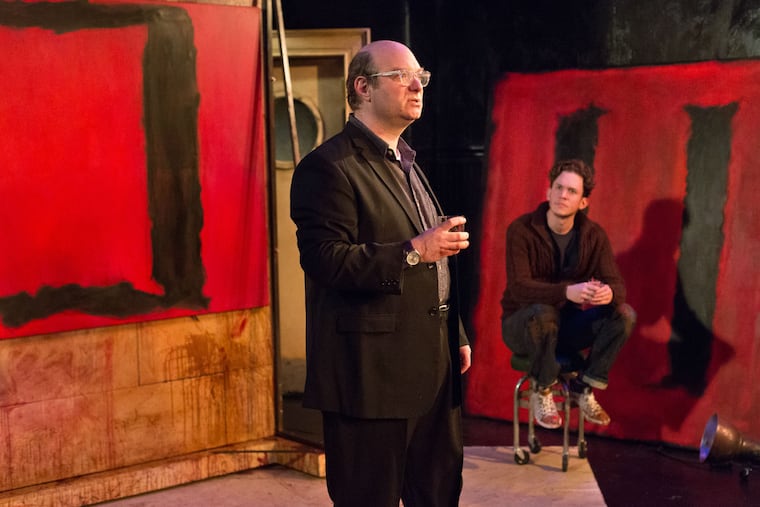
'What do you see?" That question drives John Logan's play Red, a two-hander depicting a few years in the life of 20th-century abstract American artist Mark Rothko (David Volin) as he struggles to complete a series of paintings for a prestigious commission.
'What do you see?"
That question drives John Logan's play Red, a two-hander depicting a few years in the life of 20th-century abstract American artist Mark Rothko (David Volin) as he struggles to complete a series of paintings for a prestigious commission.
The Walnut Street Theatre's engaging and balanced production invites no easy answers, and a pair of assured performances engage the audience, while testing their preconceptions, their knowledge, and, dare I say, their pretensions.
It's 1958, and the Seagram's Company hires Rothko to produce paintings for the soon-to-be completed Four Seasons restaurant in Manhattan. Rothko at first agrees, accepting the hefty commission and the prestige (Mies van der Rohe and Phillip Johnson designed the building) this corporate gig offers.
But at the relentless prodding of Ken, his idealistic young assistant (Daniel Fredrick), Rothko questions his willingness to display his art in an atmosphere so exclusive to New York's wealthy elite. Volin delivers Rothko's recalcitrance and egoism in a sympathetic fashion, while Fredrick plays an able and amiable foil.
So where do you stand? It's not an easy call. Do we agree with Rothko, as he bashes crass commercialism? He is, after all, the giant of the aesthetic movement that preceded (and abjured) the commercial roots of Andy Warhol's pop art period. But taking the anticommercial side seems odd in the postmodernism of today, which sells to the super-rich in its startling exhibitions and Sotheby's auctions that can tally in the hundreds of millions. And Rothko's claims about art as a monastic experience sound as quaint as pop art's vulgarity.
Under Dan Olmstead's direction, Ken and Rothko's back-and-forth steamrolls from one topic to the next - abstract technique versus "my kindergartener can do that"; the role of galleries versus the sanctity of art in private spaces; old versus new in art (with Rothko declaring to have "buried" cubism, so that his art and that of his peers could flourish).
A few moments of humor and genuine character development punctuate the heady ideas. Roman Tatarowicz's strong set features several reproduction paintings that impress themselves starkly in the small space of the Walnut's Studio 3.
While it sometimes seems meant to be endured as much as watched, this is not a play meant to be merely watched. The question "What do you see?" means more. What beliefs are you willing to examine, to criticize, and even to defy? Therein lies the power of Logan's play and this captivating production.