Picturesque, sublime, beautiful: American painting exhibits at the Brandywine Museum
Thomas Cole fully expected viewers to be knocked out by his painting Mountain Scenery, a vista of craggy mountains, portentous clouds, majestic trees, deep gorges, and vertiginous cliffs.
Thomas Cole fully expected viewers to be knocked out by his painting Mountain Scenery, a vista of craggy mountains, portentous clouds, majestic trees, deep gorges, and vertiginous cliffs.
In works like this, Cole, founder of the group of artists commonly known as the Hudson River School, sought the "union of the picturesque, the sublime, and the magnificent." The words are quoted in the label for the work in the Brandywine River Museum exhibition "The Poetry of Nature: A Golden Age of American Landscape Painting." Cole wrote that in the White Mountains of New Hampshire, as in the Alps, one can see "the sublime melting into the beautiful, the savage tempered by the magnificent."
The exhibition demonstrates that Cole, an English-born painter who was self-taught, did not have the technical command of some of the painters who followed him. It is, nevertheless, thrilling to see him try to embody these lofty abstractions in the rocks, water, and vegetation of America. These mountains are fraught with meaning; these clouds are expressions of emotion. Cole and many of the other artists included in the exhibition sought to make landscape the bedrock of national identity. And every time we sing "America the Beautiful," we affirm their success.
Still, Cole lays on the magnificence just a bit too thick. We are looking at his emotional landscape, not anything to be found in the Catskills, or even New Hampshire. He has turned up the intensity of the scene to get viewers to buy in. It seems almost sacrilegious to say so, but the large flat ledge at the center of the painting looks like a good spot to display a luxury SUV. Cole's sublime landscape appears regularly in television commercials, whose makers know all about tempering the savage with the magnificent.
It's unfair, of course, to blame an artist for influences that are still showing up nearly two centuries later. Still, Cole and some of his colleagues seem to have been selling nature just a little too hard.
It's tempting to say this fusion of spiritual aspiration and salesmanship is intrinsic to our national character. (Hudson Valley Tourism Inc. is one of the show's sponsors, and this work has always been connected to promotion of real estate and tourism.)
But this exhibition, curated by Linda Ferber, former director of the museum at the New York Historical Society, which lent nearly all the 40 paintings in the show, presents an alternative vision. It, too, seeks truth and meaning in the landscape. It does so, however, not by adding drama but rather by scrupulous observation and description.
This was the approach of Asher Durand, who proves to be the central figure in this show. He was at times a close associate of Cole's. His best-known picture, Kindred Spirits, which is not in the show, actually depicts Cole standing on a cliff with the poet-journalist William Cullen Bryant. Durand seems to have been interested, in a way Cole was not, in what leaves look like and how they reflect and absorb light. He painted detailed tree studies, a couple of which are shown.
Catskill Clove (1864), a monumental painting of a renowned site, was obviously painted in the studio, but it seems to have been observed and painted leaf by leaf, branch by branch, stone by stone. The result is quiet and contemplative, a strong contrast to Cole's turbulence. You need to let your eye and your mind slowly become absorbed in the scene. You believe what you see, and its meaning emerges from your contemplation.
One of the show's strongest paintings that follows Durand's approach is June Woods, Germantown (1864) by William Trost Richards, an intensely observed view of woods in Philadelphia. It merges the nature worship of the Hudson River painters with this city's taste for the empirical.
Still, Durand and Richards' quiet approach was not necessarily the best way for artists to become famous. The best-known landscape painters of the mid-1800s, such as Frederick Church, who has only one work in the show, and Albert Bierstadt, did dramatic works at large scale whose manipulative quality prefigures cinema.
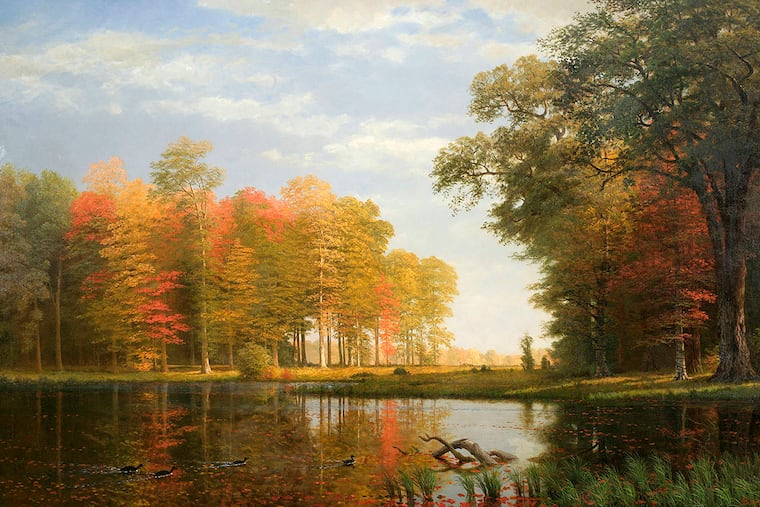
Bierstadt is best known for his dramatic vistas of the American West, but his main painting in this show is Autumn Woods, Oneida County, State of New York (c. 1886), which shows an undramatic landscape and a pond with ducks. The trees are at their peak of fall color and are as realistic as Durand's, though the very neat groves of trees seem to owe more to the gardener's art than nature's.
Nevertheless, one has the sense of a beautiful clearing, discovered by chance on a ramble through the woods. This actual clearing suggests a clearing of mind, a moment of bright insight. I'm not sure whether I would call the effect magnificent or sublime, but it shows that you don't need to paint craggy mountains to evoke a spiritual experience - or to leave a viewer breathless.
Bierstadt is among the artists represented in "New Terrains: American Landscape Paintings from the Richard M. Scaife Collection," which opened Saturday at the Brandywine. This show of 25 works is the first look at part of the collection of paintings bequeathed by the newspaper publisher, political activist, and longtime Brandywine trustee.
The show wasn't nearly finished at the time I saw it, so I saw only a selection. It includes work by some important artists of the 19th and early 20th centuries, which were bought for Scaife's residences and share a generally domestic scale. Among them are some wonderful Japanese scenes by John LaFarge, and a view of a covered bridge in Bethlehem by Stephen Parrish, the Philadelphia-born father of Maxfield Parrish.
The big work in the collection, in every sense, is Martin Johnson Heade's New Jersey Salt Marsh (c. 1875-85). You can see this painting almost as an anti-Hudson River School painting, as it depicts a flat, featureless landscape in which workers are gathering hay. What's important here is the low horizon line beneath which the sun has just set, creating a dazzling sky of bottom-lit clouds and encroaching darkness.
Perhaps the greatest significance of this collection is that, like "The Poetry of Nature" and several other recent shows, it represents a step in the evolution of the Brandywine Museum from a shrine to the Wyeth family and the Brandywine illustrators into a wider-ranging institution. The bequest is probably not, as museums like to proclaim, transformative, but it does indicate that the Brandywine is being transformed.
LANDSCAPES AT BRANDYWINE
The Poetry of Nature: A Golden Age of American Landscape Painting
Through June 12
New Terrains: American Paintings from the Richard M. Scaife Bequest
Through Nov. 6
Brandywine River Museum of Art, U.S. Route 1 at Hoffman's Mill Road, Chadds Ford.
Hours: 9:30 a.m. to 5 p.m. daily.
Admission: Adults, $15; seniors (65 and older), $10; students and youths (6-18), $6; children (5 and under), free.
Information: 610-388-2700 or www.brandywine.org/museum