Avant-garde classicism in 1808
Visitors invited 208 years ago to the home of William Waln, a merchant in the China trade, and his wife were in for a shock. The new house, which stood at the southeast corner of Seventh and Chestnut Streets, was quiet on the outside, a cubic form standing gracefully in the garden.
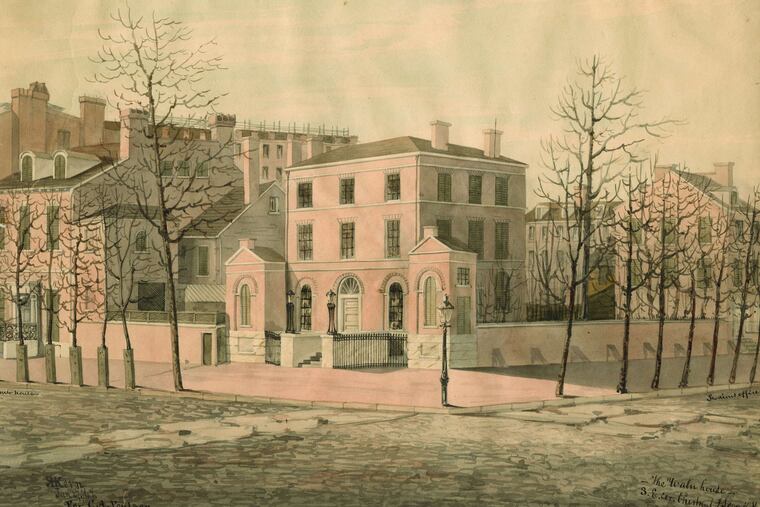
Visitors invited 208 years ago to the home of William Waln, a merchant in the China trade, and his wife were in for a shock. The new house, which stood at the southeast corner of Seventh and Chestnut Streets, was quiet on the outside, a cubic form standing gracefully in the garden.
But the interior was far from quiet. The three main ground-floor rooms where the Walns entertained were at once antiquarian and completely cutting edge. They had none of the fine woodwork and intricate cabinetmaking for which Philadelphia had long been famous. They were, instead, painted mostly black and red with gold accents. Scenes from Homer's Iliad and Odyssey were painted directly on the walls. And the rooms were furnished with chairs, tables, and couches one might see on an ancient Greek vase but not yet in an American drawing room.
The chairs, based on the classic Greek klismosform, placed the body in a more open and expansive position than earlier chairs did, and the entire setting seemed to embody a new set of attitudes. It was unabashedly luxurious, flamboyantly theatrical, and yet flatter, simpler, and more direct than what had come before. It was, in its way, modern.
All that remains from that house are 21 pieces of furniture. Ten of them, including the largest and most dramatic ones, are in the collection of the Philadelphia Museum of Art. They are the subject of the new exhibition "Classical Splendor: Painted Furniture for a Grand Philadelphia House," on view through Jan. 1.
You have probably seen at least some of these pieces on display at the museum before, but this show constitutes a dramatic reintroduction. It follows more than a decade of work by the exhibition's co-curators, Alexandra Alevizatos Kirtley, curator of American decorative arts, and Peggy A. Olley, associate conservator of furniture and woodwork. As a result of their scholarly research, CSI-like forensic examination, and careful removal of layer after layer of later paint and varnish, we now know a lot more about the furniture, and, most impressive, we can see exactly how it dazzled the Walns' guests when it was new in 1808.
One reason to do all this work is that the pieces are wonderful in themselves. Each of the seven splayed-leg, cane-seated chairs has its own pair of gilded mythological beasts set amid classical ornament on the back rails. The lyre-shape backless sofa, on which Mrs. Waln reclined when she entertained, seems a monument to ease. The gilded leaves on the columns of the large sideboard are alternately burnished and left matte, to give a sense of three-dimensionality and to catch the flickering candlelight that would have illuminated the rooms.
Delightful as the details are, however, the furniture is probably more important in providing a bigger picture of Philadelphian and American culture at a moment, not that long after independence, when the nation was defining itself. The chairs and tables were part of a set and of a total decorative scheme from which we can infer the architecture, and to a degree, the mindset of which they were part.
Benjamin Henry Latrobe, the English-born and -trained architect who designed them, was one of the most influential people of his age. He is usually considered America's first professional architect, someone who made his living not as a builder, but as a designer. He designed some of the most important buildings of the new republic, public and private, and he designed some of the key interiors at the Capitol and the White House in Washington. He also mentored other influential architects, such as his onetime employees William Strickland, designer of so many Philadelphia landmarks, and Robert Mills, designer of the Washington Monument in the capital; and the amateur architect and sometime client Thomas Jefferson.
It is amazing and very unfortunate that only one of his important buildings - the Baltimore Cathedral - survives. Latrobe set out to change American taste, and the Waln furniture is a rare extant example of how he meant to do it.
It is difficult to look now at these tasseled, fringed, and gilded pieces and see them as part of a new and rational approach to making buildings and places, which was what Latrobe argued. That is in part a natural impulse of architects - to delude themselves and others that their desires make good sense. But by simplifying structure, minimizing carving and other sculptural decoration, and achieving most of his effects with paint, he produced opulence efficiently.
Called upon to produce a temporary chamber for the Senate to meet in Washington, he worked with the decorative painter George Bridport, Latrobe's key collaborator on the Waln house and many other projects, to paint canvases for the walls that brought instant monumentality. Bridport, who advertised himself as "decorative architect," had worked in theater in England, and he knew how to make an impact. The show also calls attention to other members of what we would now call the design team: John Aitken, the cabinetmaker whose shop was on the same block as the Waln house, and upholsterer John Rea.
The other collaborators were the Walns themselves. William was a successful merchant in the China trade, which became very important in the first years of the republic as Americans needed to replace goods they were used to getting from England. Among the products he sold to China was opium. His father was known as an austere, doctrinaire Quaker.
Mary Willcocks Waln, who appears to have taken a leading role in the building of the house, came from a wealthy, socially prominent family and was said to have had "a handsome independent fortune." She was 23 and he was 30 when they were married at Christ Church in 1805. They moved into the house three years later, and it was immediately established as a center of fashion in the city. Mary Waln apparently worked hard to make sure the house exemplified what was new and interesting. (A fragment of her redecorating, a sideboard, is in the show.)
In 1821, they left the house, involuntarily. Waln's business was bankrupt. The furniture went to auction down the street and was dispersed all over the country. The house stayed empty for years until it was bought by a patent medicine entrepreneur. The ambitious, glittering Walns were forgotten. Now they are remembered, another modern American story.
MODERN (1808) LUXURY
StartText
Classical Splendor: Painted Furniture for a Grand Philadelphia House
Through Jan. 1 at the Philadelphia Museum of Art, 26th and the Parkway.
Hours: 10 a.m. to 5 p.m. Tuesday through Sunday; until 8:45 on Wednesday and Friday.
Admission: Adults, $20; seniors (65 and over), $18; students and youths (13-19), $14; children (12 and under), free.
Information: 215-763-8100 or philamuseum.orgEndText