'Holy grail of American ceramics' found in dig at American Revolution Museum
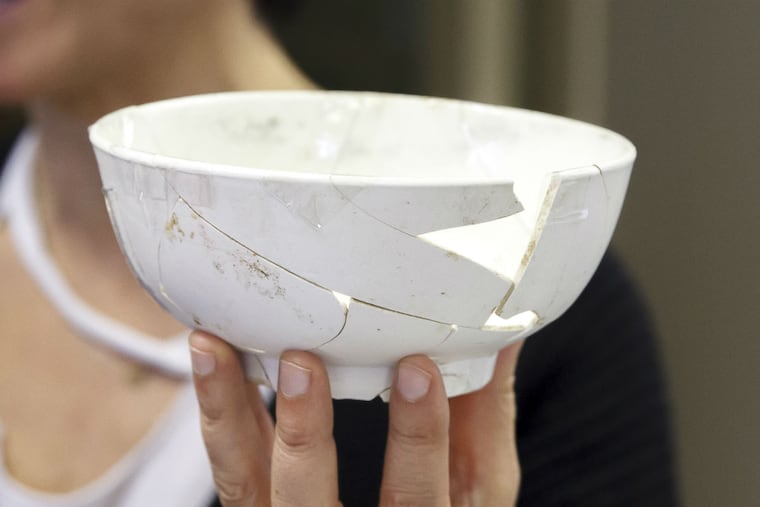
It's a simple, unassuming bowl: small, creamy white, with a matte finish.
When it was pulled from the ground during the archaeological excavation that preceded construction of the Museum of the American Revolution in 2014, no one paid much attention.
It was labeled a stoneware slop bowl and stuck in a box.
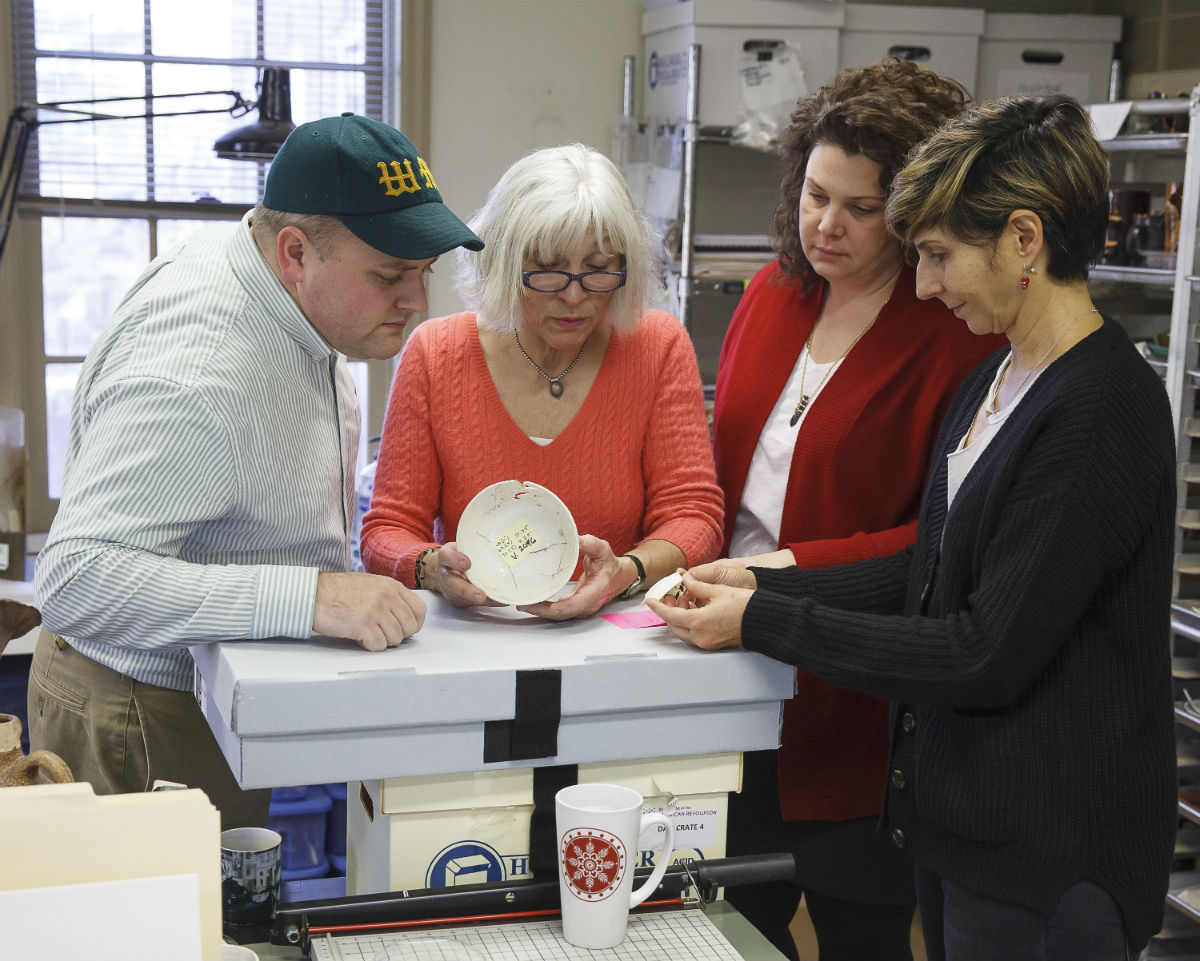
After all, the museum was excited about another bowl from the dig, a highly evocative punch bowl with an image of the sailing ship Triphena, linked to the run-up to revolution. Museum vice president Scott Stephenson invited ceramics maven Robert Hunter and artist and scholar Michelle Erickson to take a look at the Triphena bowl with an eye toward making a clean copy for exhibition.
But while Hunter was poking around the archaeological collection, he noticed something unusual.
"I saw this bowl stuck away in a box and I thought, 'That's a strange-looking bowl,' and I kept looking and looking," Hunter said. He became so intrigued he got the museum to allow him to send a fragment of the unassembled bowl off for chemical analysis.
The results are in.
Hunter now believes that, far from being an unassuming stoneware slop bowl, this find is the first physical evidence of high-grade porcelain made in North America.
"It's like the holy grail of American ceramics," Hunter said. "It appears to be the first evidence of American efforts to make hard-paste porcelain. It's not Chinese. It's not European. It appears to be from Philadelphia. So, even though we don't have the documentary record, it's a circumstantial case."
Hunter and Juliette Gerhardt, lab supervisor and principal archaeologist at Commonwealth Heritage Group in West Chester, have written a paper about the find, one of two that appear in Hunter's scholarly journal, Ceramics in America.
Now upgraded from "slop bowl" to "punch bowl," the small item – diameter a mere 5½ inches – will be displayed at the New York Ceramics and Glass Fair, Jan. 19-22, and Hunter will present the findings there as part of the fair's lecture series on Jan. 19.
Gerhardt supervised the washing and cataloging of the museum excavation, which produced about 85,000 artifacts from the site at Third and Chestnut Streets.
The bowl, which was in fragments, intrigued her, primarily because of its unusual finish.
"I didn't recognize it as porcelain," she said. "I recognized it as different, but I couldn't figure out what it was. It looked like something we call salt-glazed stoneware, but I was really perplexed by it."
She said that when Hunter took a look, he didn't know what it was, either.
"But he said, 'Maybe it's porcelain,' " she said. "He took a sherd and had it analyzed."
Hunter sent a fragment to J. Victor Owen, an expert on the geochemistry of archaeological ceramics and glass at St. Mary's University in Halifax, Nova Scotia, and one of the authors of the second Ceramics in America article.
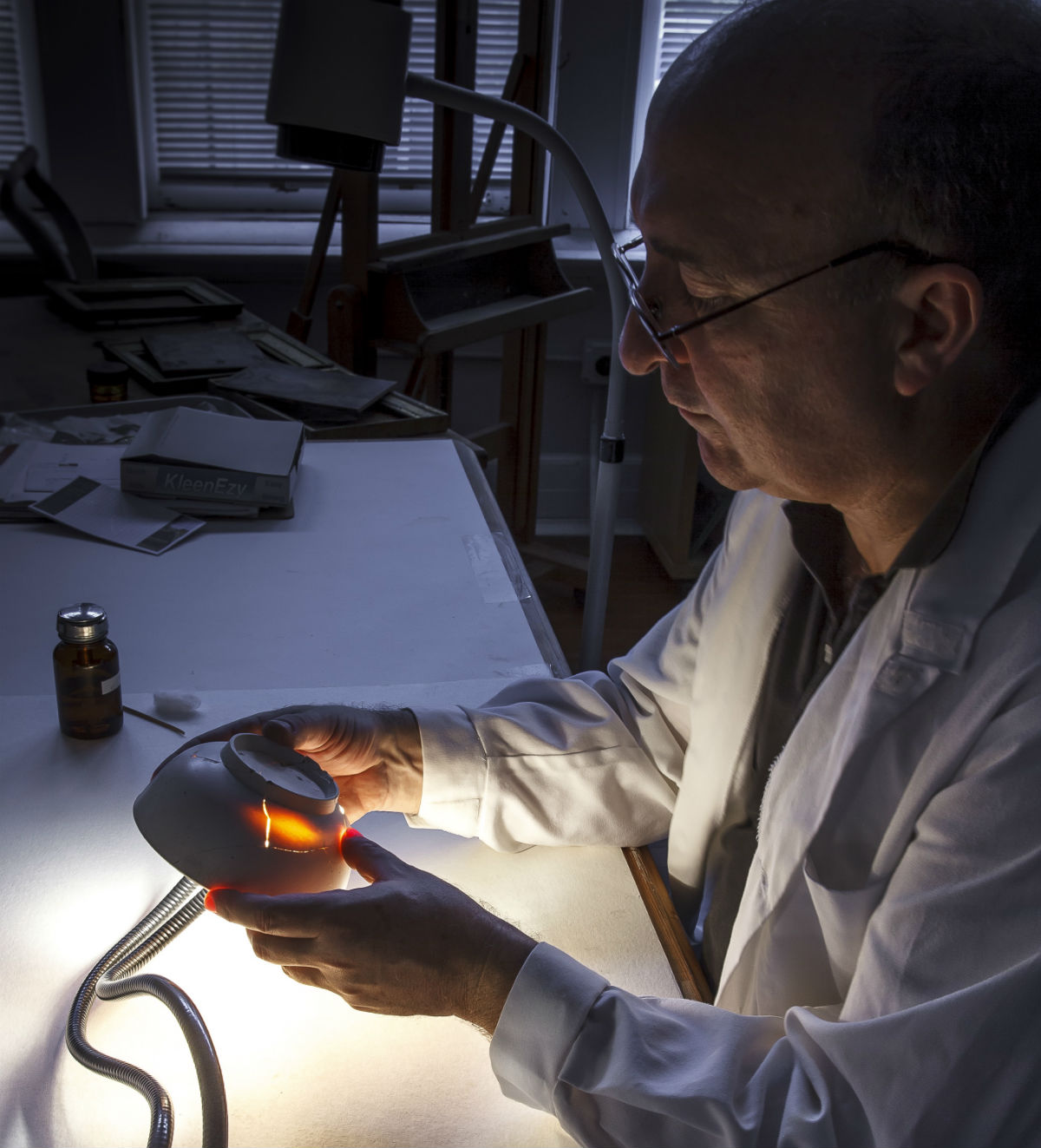
Owen's analysis was conclusive. It showed that the bowl was indeed high-grade porcelain. But beyond that, comparing its chemical profile with other examples, Owen bolsters the case that it was manufactured in Philadelphia, most likely by the firm of Gousse Bonnin and George Anthony Morris of the American China Manufactory.
He ruled out a Chinese origin, although the bowl could have come from Europe. That said, Bonnin and Morris had a shop near the museum site, and Owen mentions a mysterious German with knowledge of porcelain-making, reputed to be in Philadelphia around the time the bowl was manufactured, in about 1772.
Also present in the city, apparently, was a flamboyant ceramics maker, Andrew Duché, from Savannah, Ga., who had been plumbing the secrets of porcelain for more than 40 years and who had found a source of appropriate kaolin clay, so-called Cherokee clay, in North Carolina.
In any case, Bonnin and Morris' porcelain enterprise was short-lived. They began their South Philadelphia manufacturing operation around 1770, and by 1773, they were bankrupt.
Most of their efforts focused on making so-called soft-paste porcelain, which has a different chemical make-up and is fired at lower temperatures.
Experts have strongly suspected Bonnin and Morris also labored to create the trickier hard-paste porcelain — true high-grade porcelain — fired at very high temperatures, but there was no evidence they had produced any.
In fact, only a few dozen Bonnin and Morris pieces of any kind are known to exist.
"The story of pottery making is one of failure," Hunter said.
Even though the Chinese developed porcelain in the sixth or seventh century and it bedazzled Europeans from the 12th century on, it proved devilishly hard to recreate.
For one thing, it required a certain kind of clay fired at a specific, very high temperature. Germans in Meissen at last successfully produced hard-paste porcelain around 1708, and a manufactory was established there a couple of years later.
Though the secrets of porcelain were jealously guarded, Hunter notes, the lure of this extraordinary luxury good with a mysterious translucency proved excruciatingly tantalizing.
For the Museum of the American Revolution, which intends to exhibit the bowl when the museum opens in April, the discovery offers a perfect opportunity to explore the effort to create independent American manufacturing in the face of British dominance.
"There's a perception many have of homespun goods, that American-made goods from this period would be cruder than something made abroad," said the museum's Stephenson.
The bowl shows, in fact, that "colonial tradesmen were capable of producing anything," he said.
Hunter is particularly gratified.
"If I hadn't shown up that day in December, the bowl would have been stuck in a box in a repository somewhere and nobody would ever see it again," he said.