Gifted funnyperson writer Caitlin Moran hits the Free Library on whirlwind U.S. visit
Caitlin Moran talks so fast, my digital recorder couldn't keep up. I wanted to catch every word - because, as the English columnist, TV critic/celebrity writer, satirist, novelist, public intellectual, now-wave feminist, and funnyperson vroomed on at comet speed, she was talking more sense per femtosecond than your average extraordinarily gifted person.
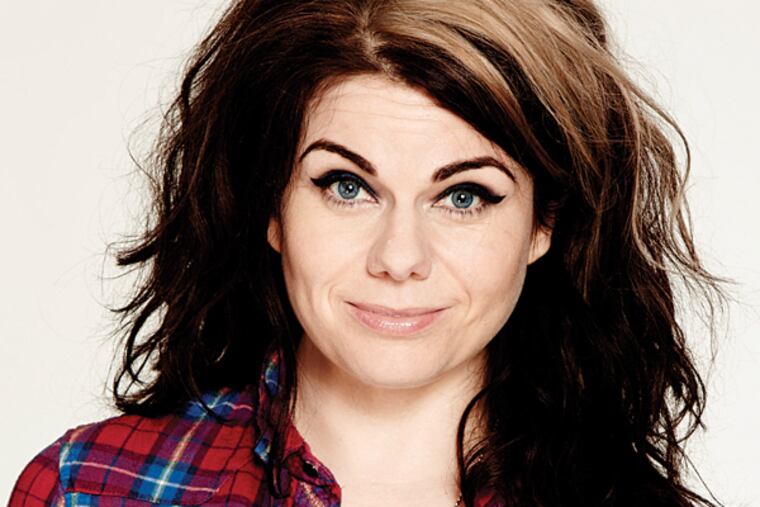
Caitlin Moran talks so fast, my digital recorder couldn't keep up.
I wanted to catch every word - because, as the English columnist, TV critic/celebrity writer, satirist, novelist, public intellectual, now-wave feminist, and funnyperson vroomed on at comet speed, she was talking more sense per femtosecond than your average extraordinarily gifted person.
Moran, who will speak Thursday at the Free Library, is cobbling together a cool, fresh way of thinking the future into being. From her home in London, she says, "I'm sitting here, huffing on an e-cig, just back from the Glastonbury Festival. I have two lungs full of poison." At Glastonbury, she saw headliner Kanye West: "I stood there stoically waiting for him to do anything not remotely mental. But he is such an incredible person. A rock star is supposed to be controversial and sow confusion. Kanye is very good at this."
That is Caitlin Moran - she's just as much in command of classic lit (Moby-Dick and Ulysses have both resided of late on her reading table) as surely as of the works of Laura Marling, Katy Perry, and Lorde, the deep ways pop culture can change the larger culture, which she sees as her job.
Much of it lies at the intersection between worthwhile ideas and standup: "I am coming to the States next Tuesday, darling, July 7, for an entire week, a city every day. I am going to make myself my own tour T-shirt with a marker pen. It will be like a proper standup tour, and we do signings afterward that last usually three hours. We cry a lot. I have recently taken to licking tears off girls' faces. So much so that my husband has taken me aside to say, 'See here, darling, I love you, but surely we must be mindful that there are health implications.' "
And so on: "Fifty Shades of Grey is ruining sex for several generations at one blow. Summarize this movie: Basically, a young virgin, in exchange for an iPad, allows herself to be spanked with a hairbrush. And there's no fun in it. When you're young, you have enthusiasms, dreams of the future, drinking, friends - it's not going to strangers' apartments and having sex you do not enjoy."
This, at great speed.
All has a point, important, humane, urgently of this moment: to encourage women, and by extension nonwomen as well, to embrace themselves and their as-yet-unmade futures with muscular, creative, witty joy.
Moran is not yet known in the States as well as she should and will be. But in this era of Amy Schumer ("I have such a girl crush on her, just awesome. Everything feminism hoped to be 20 years ago, she is now") and Mindy Kaling, the opportunity is there, the need for her cultured yet au courant voice.
Her most recent book, How to Build a Girl, is a hilarious and flimsily ("quite on purpose") disguised memoir of her personal coming into her own. ("The point is, you never stop building.") She says it's part of a trilogy: "The next one is How to Be Famous, about the next steps. And then, of course, we conclude with How to Change the World."
Puellile architecture for Moran started with "the normal sweaty anxiety of the socially awkward," went on to "compulsively copying what other brilliant people, largely brilliant blokes, were doing," and finished in a new somewhere-else: "As a kid, I would watch TV and read magazines and watch movies, and ask, 'What kind of woman can I grow into and do the things I'm interested in?' And there weren't any. 'Ah,' I said. 'No, I am going to have to invent a new kind of person. Get drunk, write in different styles. I can decide half my columns can be funny, and the other half can be about Syria and abortion. It took me 40 years to figure that out. So much that women do is worrying about themselves. You read women's magazines and see a quiz: 'Which of the four stars of Sex in the City are you?' Answer: 'All. None.' Women don't realize they spend half their energy trying to be other people, on other people's terms, rather than exploring and discovering and, when necessary, creating whatever it is they are going to be."
Moran says that as a writer, she first tried to write "incredibly mean rock criticism, to compete with the blokes around me. Until the man who would become my husband approached me and said, 'What are you doing, exactly? This isn't what you do.' Correctly, I realized. Eventually, I got the point: You do not argue right and wrong. You create a reality and make it cool."
Without undue violence, Moran hears the idea that the dour harangues and confrontational humorlessness of early feminism may have earned an unfortunate reputation for all of feminism. "But we needed the angry feminists to come along," she says. "They did the marching, and angry lesbians in dungarees got a lot of work done, so now I can be a more laid-back feminist. Where the push is now, it's not academic or political feminism, as cool as those can be - it's cultural feminism. So many of the greatest musical artists now are women - I mean, what more can a white man with a guitar do, right? - and so many of the world's funniest people are women."
In which she sees great potential for pop culture to change cap-C Culture. She names Schumer, Louis CK, Father John Misty, Chris Rock, Jon Stewart ("We're so envious you have him over there"), David Bowie, Kanye West, and many more as workers in that vineyard.
One way Moran tills the vines is with her Twitter feed (542,000 followers), basically a smart, entertaining head-party the approximate size of New Haven, Conn. "People say, 'The Internet's not real.' Of course it's real. This is the first time the world has been able to talk to itself. Now, everyone who is a writer has an international audience," she says. "When I first started, I saw how Twitter had started off as joyful and gotten mean. Young people put on the cynicism armor early. But you can't dance in armor. And I want people to dance. I want to share the lesson I learned: that cynicism doesn't help anyone."
AUTHOR APPEARANCE
StartText
Caitlin Moran: How to Build a Girl
7:30 p.m. Thursday at the Free Library
of Philadelphia, 1901 Vine St.
Admission: Free.
Information: 215-567-4341
or www.freelibrary.org.EndText
215-854-4406@jtimpane