The Pittsburgh novel with big hype, and problems
In 1987, a 24-year-old wunderkind sold his master's thesis to a New York publisher. The Mysteries of Pittsburgh, Michael Chabon's literary debut, garnered a record advance of $155,000.
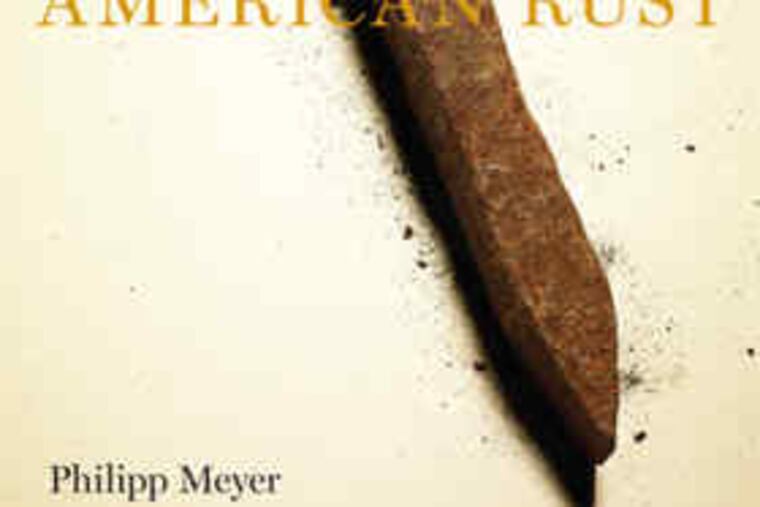
By Philipp Meyer
Spiegel & Grau.
384 pp. $24.95
nolead ends nolead begins
Reviewed by Peter Oresick
In 1987, a 24-year-old wunderkind sold his master's thesis to a New York publisher.
The Mysteries of Pittsburgh
, Michael Chabon's literary debut, garnered a record advance of $155,000.
That bar is now raised by Philipp Meyer, 34, from the Michener Center for Writers at the University of Texas.
Meyer's thesis, like Chabon's book, is also a Pittsburgh novel featuring twentysomethings, though his characters are far less buoyant and cheerful than Chabon's. American Rust, set in an ex-steel town along the Monongahela River, sold to a Random House imprint "for a sum so large," the Austin American-Statesman reported, "it seems almost fictional: $400,000."
In late January, the Guardian newspaper broke the story of an unusual product placement in Patricia Cornwell's latest mystery, Scarpetta. The best-selling crime novelist's "sharp-dressing blonde heroine spots a yet-to-be-published debut novel as she arrives at a crime scene and meets the police officer in charge." The book? Meyer's American Rust.
The hype continues. On her Web site, Cornwell touts Rust as worthy of the Pulitzer Prize. The Guardian pointed out that "Cornwell was sent the American Rust manuscript by her agent, who also happens to be responsible for Meyer, a hedge-fund trader turned construction worker turned author, and his sizeable advance."
Even without big money and celebrity endorsement, Meyer himself is a media story. The Baltimore native is a high school dropout who entered Cornell University at age 22, after being twice rejected, to study English. Next he earned big bucks as a Wall Street trader of derivatives. He went on to grad school in Texas, where he worked in construction and as an EMT, including a stint during Hurricane Katrina.
American Rust is a simple yet intense story. Its setting is the fictional Monongahela Valley mill town of Buell, Fayette County ("Fayette-nam, as it was popularly called").
Billy Poe and Isaac English are buddies planning to hop a train together to the West and a better future. In an abandoned factory near the river's edge, a drifter tries to rob and molest Poe. English intervenes and accidentally kills the man.
When the two friends return to drag the hobo's body into the Monongahela River, police are already on scene. The plot grows out of the pair's resistance.
Meyer, like Chabon, is a talented prose stylist. His novel's structure, however, is problematic. The tale is told in a round-robin fashion through the eyes of five viewpoint characters, none of whom is likable. The lack of a sole, sympathetic protagonist is frustrating. Also this method inches the plot along painfully, and adds pages to the story. Less would be more.
But the fatal flaw is that Meyer's characters, other than Chief Bud Harris, are cartoonishly destitute. His style is a kind of noir. Life in Meyer's Rust Belt is consistently pessimistic and deterministic across the classes. This broad-brush effect skirts the stereotype of Appalachian white trash. Like Erskine Caldwell after Tobacco Road was published, Meyer will hear complaints that his novel is exaggerated and needlessly cruel. The mayors of Brownsville and Charleroi will not be flattered.
In the long run, I'll bet that Meyer, the new wonder boy, prevails. For all of its literary flaws, American Rust depicts a stunning postindustrial landscape. Perhaps like the North Dakota or Arizona of the Coen brothers, Monongahela Valley noir will translate to the big screen under the right direction - and lucratively, given Meyer's track record.