A man compelled to walk - without knowing why
Very few debut novels in recent years have been as auspicious as Joshua Ferris' Then We Came to the End, which was nominated for the National Book Award and won the PEN/Hemingway in 2007.
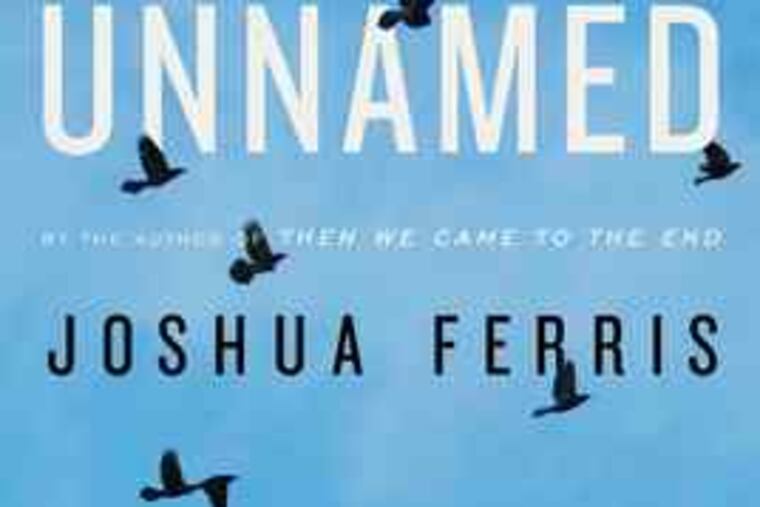
By Joshua Ferris
Reagan Arthur Books (Little, Brown).
310 pp. $24.99
nolead ends nolead begins
Reviewed by Kevin Grauke
Very few debut novels in recent years have been as auspicious as Joshua Ferris'
Then We Came to the End
, which was nominated for the National Book Award and won the PEN/Hemingway in 2007.
Set in the office of a flailing advertising agency, its first-person-plural narrator captured note-perfectly the banality of the cubicle-hive that is the workplace for so many of us. Noting Ferris' acidly humorous evisceration of the business world's day-to-day absurdities, as well as his heartfelt humanism, many critics and readers aptly compared his debut to Joseph Heller's in 1961, the wisely hysterical and surreal wartime masterpiece Catch-22.
But after the accolades of an auspicious debut fade, the inevitable question comes: what next?
Fear of the sophomore slump haunts writers and expectant readers alike. Heller took 13 years to follow Catch-22 with Something Happened, which, though loved by many, failed to surpass his debut's genius or influence. Hardly three years after his own debut, Ferris has now presented us with his follow-up, The Unnamed, and like Heller's, his second offering both darkens its tone and restricts its scope to the deteriorating life of just one man. Unlike Heller's second offering, however, Ferris' may well outshine his first.
What refuses to be named in The Unnamed is the sickness that has come to afflict Tim Farnsworth, a successful attorney at a prestigious Manhattan law firm, for the third time. What can be named, however, is what this sickness does to him: It compels him to walk and walk and walk until he finally collapses in exhaustion.
Unable to control himself, he walks out of the office, out of court, and even out of the home he shares with his loving wife and sullen teenage daughter. Disconcerted, he often wakes up many miles away, in neighborhoods and locales utterly alien to him. These journeys disrupt his work, his marriage, and his very notion of life's value. And not one doctor can find this malady's cause - is it rooted in physiology or psychology? - or provide a remedy.
Initially, we expect (and hope) that Tim can eventually put a name of some sort to his condition, although he himself has already given up almost all hope after a countless number of futile consultations with everyone from medical specialists to dharma gurus. Soon enough, however, we realize not only that the unnamed will remain unnamed, but also that Tim will never escape it.
And it is at this point that the novel truly begins to shine. What starts as a compelling enough story of a man cursed by a strange condition develops into a metaphoric exploration of the relationship between body and mind, the notion of free will, and the nature of identity.
As Tim's situation continues to deteriorate, the novel becomes less an account of the peculiar circumstances of his tragic life and more a thought-provoking meditation on the odd mixture of primal and spiritual qualities that makes humans human. Stripped of practically every aspect he has relied on to define himself as a husband, a father, and a man, Tim desperately struggles to maintain his faith in himself as a being more substantial and valuable than what he is merely as a corporeal body:
He had never given much thought to heaven before, but now he was certain it existed. Without God, the body won, and that couldn't be possible. He was one thing, his body a different thing altogether, and he was willing a separation, in which he went off to eternal repair while it suffered its due fate of rough handling, dirt, and rot.
This portrait of Tim's escalating physical, emotional, and spiritual troubles does not make for an afternoon of easy reading. But that is exactly what makes it such a bold and moving novel, particularly considering the comparative hilarity (dark though it was) of Then We Came to the End. Except for just a few moments of uncomfortable humor here and there, Ferris refuses to loosen his grip on Tim Farnsworth's throat, or on ours.
Whether we want to or not, we tumble into the abyss along with Tim. If not for the compassion Ferris has shown in his portrayal of Tim (who is, after all, a stand-in for all of us), the question this novel ultimately poses might be too much to bear: "Once everything you have and everyone you love and everything you hold to be true has been stripped away, do you really have any idea who you truly are?"