Suffragist Alice Paul, so very today
'The past is a foreign country: they do things differently there," wrote the novelist L.P. Hartley. But as the author of A Woman's Crusade demonstrates so compellingly in chronicling the work of suffragist Alice Paul, the past, with all of its anomalies, can sometimes uncannily resemble the present.
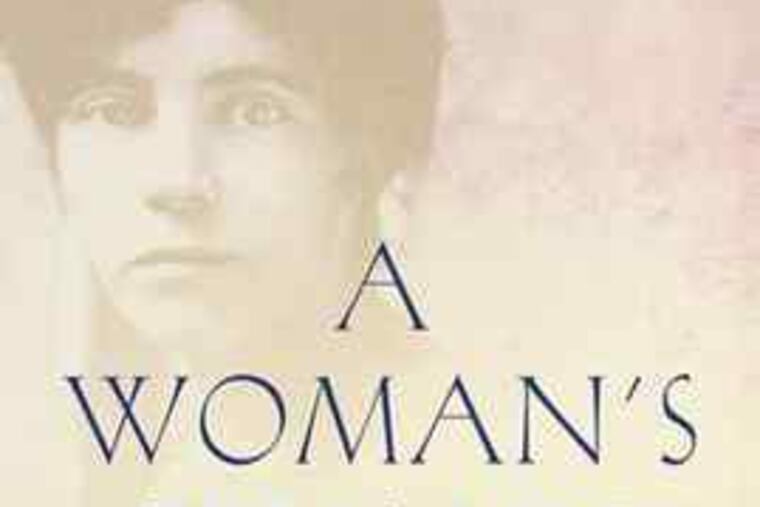
Alice Paul and the Battle
for the Ballot
By Mary Walton
Palgrave Macmillan. 304 pp. $28
nolead ends nolead begins
Reviewed by
Elizabeth Eisenstadt Evans
'The past is a foreign country: they do things differently there," wrote the novelist L.P. Hartley.
But as the author of A Woman's Crusade demonstrates so compellingly in chronicling the work of suffragist Alice Paul, the past, with all of its anomalies, can sometimes uncannily resemble the present.
Former Inquirer reporter Mary Walton focuses on Paul's campaign of nonviolent protest that helped lead to the ratification of the 19th Amendment in 1920, giving women the right to vote. In doing so, Walton illuminates how the feisty Paul, a canny tactician, used strategies that would not be out of place in a modern campaign.
Pickets, lobbying, public protests ending in prison sentences, marches on Washington - all resulted in more publicity for the cause. Paul's genius for fund-raising, attracting attention from a drama-hungry press, and putting pressure on politicians in Congress and state legislatures could easily be strategies ripped from the pages of a modern campaign playbook.
From a devout Quaker family with deep community roots, the Mount Laurel native and 1905 Swarthmore College graduate spent time as a social worker in New York, then earned a master's degree in sociology and a doctorate in economics from the University of Pennsylvania, as well as a law degree from Washington College of Law in Washington and two other law degrees from American University. While on a scholarship at a Friends center in Birmingham, England, in 1907, Paul encountered the women's suffragist militant, Christabel Pankhurst, daughter of the famous suffrage leader Emmeline Pankhurst, and became an ardent convert to the cause.
When she returned to the United States in 1909, Paul was well-versed in the tactics used by suffragists and by their opponents - protests, very often tailored to suit the occasion, would be followed by imprisonment, hunger strikes, and force-feeding.
Paul, already known to the press for her protests in England, put her considerable talent for organizing and generating publicity to work for the suffragist cause. Her passion soon led her to involvement in the National American Women's Suffrage Association (the "National") and advocacy for a federal amendment granting women the vote.
Walton's account makes it seem almost inevitable that Paul's flair for grabbing headlines and provoking politicians would lead to a collision with the aging leadership of the "National" - and the formation, first, of the Paul-led Congressional Union and then in 1916, the National Woman's Party.
One of the chief points of dispute, which often seems to have taken a distinctly personal turn, was whether it would be more effective to campaign state by state, or work for a national constitutional amendment. History, as we know, was on the side of Paul and her compatriots.
As contemporary as Paul's tactics may sometimes sound, there is something fascinatingly intimate about the accounts of suffragists' meetings with President Woodrow Wilson, who became their chief target in the campaign to gain women's votes. It is not hard to imagine, from Walton's account, how the suffragist "Silent Sentinels" at the White House gates, protesting Wilson's refusal to support women's suffrage, would affect a president who had to see them almost every time he arrived and departed his home. The book offers a nuanced portrait of Wilson as a complex leader, ambivalent about women, sharing the racial prejudices of his time, and rent by the collision of his ideals with the reality of a world war.
Of course, Paul did not labor by herself for the suffragist cause. Characters in the book, some well-known, many less so, include Harriot Stanton Blatch, daughter of campaigner Elizabeth Cady Stanton, "National" president and sometime Paul adversary Anna Howard Shaw, lobbyist and organizer Maud Younger, movement martyr Inez Milholland Boissevain, and many others.
Drawing upon press accounts, oral histories, original papers, and books written by contemporaries of Paul's, Walton is able to give her accounts of certain incidents, such as the suffragist's brutal imprisonment in Virginia's Occoquan Workhouse, a colorful immediacy.
Walton sometimes appears uncertain about whether she wants to write a biography of Alice Paul or chronicle the last decade of the women's suffrage struggle. Walton's account of a woman who possessed the drive and vision to help alter history is often a flat recitation of facts rather than a richly textured biographical portrait. Readers learn tantalizing bits of information about Paul's Quaker roots, her social life, and her friendships, but not enough to give a sense of her personal evolution.
For those more interested in the tactics and sheer audacity that earned women the vote after roughly 70 years of trying, Walton's book offers lessons in the tenacity, courage, and fierce discipline needed to overcome the obstacles pioneers often face.
Knowing the ending doesn't spoil the drama of the long, hard battle for women's votes - or amazement that the bravery of a band of often brazen women was able to achieve a reality for which many women and men had worked for so long.
After reading Walton's account, we may not be as prone to take women's suffrage for granted - and if that is the one lesson we take away from her book, it is a worthwhile one indeed.
.