'Swamplandia!' about a Florida theme park, gators, and a ghost ship
Karen Russell proved she could write funny, modern fairy tales in St. Lucy's Home for Girls Raised by Wolves. Those stories reminded me of Flannery O'Connor's in their dark insights, fresh similes, and grotesque juxtapositions of humor and horror.
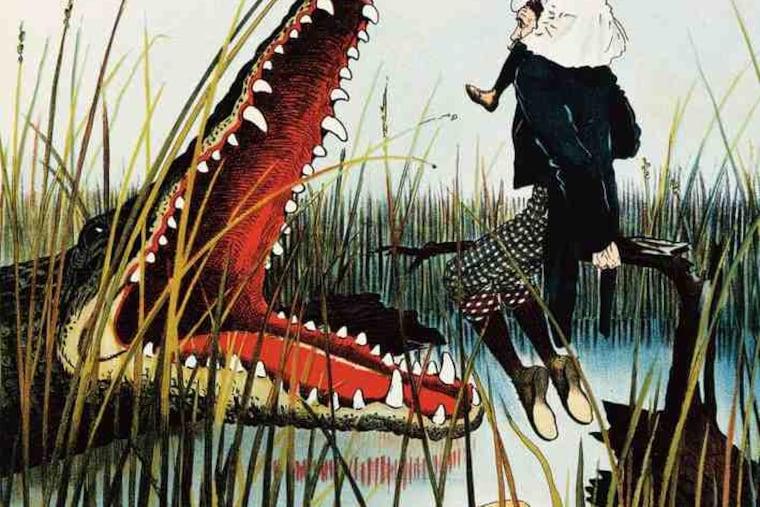
By Karen Russell
Knopf. 318 pp. $24.95 nolead ends nolead begins
Reviewed by Susan Balée
Karen Russell proved she could write funny, modern fairy tales in
St. Lucy's Home for Girls Raised by Wolves
. Those stories reminded me of Flannery O'Connor's in their dark insights, fresh similes, and grotesque juxtapositions of humor and horror.
Now Russell (who will read at Kelly Writers House at the University of Pennsylvania on March 23) has expanded "Ava Wrestles the Alligator," one of the stories from St. Lucy's Home, into the novel Swamplandia! Again, it's hard to miss the resemblance to O'Connor, a brilliant short story writer who could not master the challenges posed by the longer novel form.
Luckily, before readers realize the plot is eddying like water in a mangrove swamp, they may well be hooked by the charming characters. The Bigtrees, a family of white Indians, own and operate the titular swampy theme park on one of the barrier islands off the coast of southwest Florida. Ava Bigtree, 13, the novel's primary narrator, wrestles alligators for tourists. She has stepped into the shoes of her mother, Hilola, who died of cancer before the novel began and before we can know or care much about her. Her husband - the Chief - tries to keep the park going with the help of Ava, her older sister Ossie (short for Osceola), and brother Kiwi.
Ava's view of her family is endearing, and Russell's clever similes infuse her descriptions of the Bigtrees: "The fan was blowing at the Chief's headdress, flattening every feather so that they waved in place, like a school of fishes needling into a strong current." Kiwi, at odds with his father, "could manufacture laughter as joyless as flat cola." Ossie, who has begun dating dead boys with the help of an old book and a Ouija board, ignores them both: "When she was doing a séance her pupils blew wide and her violet eyes became as hard and shiny as bottle caps."
Both the Bigtree family and Swamplandia! begin to falter without Hilola Bigtree. Tourists used to come to watch her swim through a lake of alligators unscathed, an act no other Bigtree can perform. Meanwhile, on the mainland, a new theme park called The World of Darkness has sucked away the rest of the paying customers. Kiwi, irritated by his father's lame attempts to revive the park, runs away from home. Unbeknownst to his family, he takes a grunt-level job at the rival park. Soon the Chief also departs on a "business trip," leaving the two teenage sisters alone on the island with the moribund family business and hundreds of cold-blooded predators.
The timing is perfect for a ghost ship - a dredge from the 1930s - to wash up on the island's edge. As the story breaks its moorings, the similes become more strained: "The canal had swollen to seven or eight feet and twisted and hissed now like an unbungalowed snake." Huh? What kind of a snake? Their real world among the gators was weird enough, but now the girls enter the twilight zone: "The boat was always covered in twenty-odd buzzards [that] continued to pour over Swamplandia! in clothy waves . . . " Migration patterns, Ava hears on the radio, have been disrupted. Ossie can't stay away from the dredge boat, and soon she won't let her sister join her. She begins to spend her nights aboard with only the mosquitoes and Louis Thanksgiving, a ghost who died on the boat at 17, for company.
It would give away too much to say what happens next, but the plot does begin to move again, in peristaltic waves, like a snake digesting an unbungalowed hamster.
There's a fine, funny section devoted to Kiwi's travails in the belly of the whale. Literally - see, the World of Darkness is built in the shape of a leviathan, and the guests, also known as "Lost Souls," enter the amusement park by strolling into its mouth, then sliding down its massive tongue. Kiwi, the valedictorian of his family's island, is reduced to cleaning toilets in the Whale's Gullet: "Kiwi could feel his intelligence leap like an anchored flame inside him. His whole body ached at the terrible gulf between what he knew himself to be capable of (neuroscience, complicated ophthalmological surgeries, air-traffic control) and what he was actually doing."
By the last third of the novel, I was back into it because I wanted to know what would happen to Ava, Kiwi, and Ossie. Russell energizes the story by describing a journey by skiff through what is clearly the Everglades, a landscape I know well from both my own childhood and the tales of Zora Neale Hurston and Marjorie Kinnan Rawlings, two great Florida writers. As Russell regains her confidence, her similes regain their brilliance. Alone and afraid in the wilderness, Ava sees her surroundings: "Red clouds massed in the southeast and it looked like the sky was getting its stitches out after an operation."
Readers who can hang on through the unstable middle third of the book will be in for a bang-up finish. Russell's true form is the short story, but her prose dazzles in any medium.