A fresh look at Roy Campanella, ballplayer and survivor
He began life as a roly-poly squatty-body, a pudgy slab of cookie dough with a falsetto that begged to be mocked. Ah, but with a bat in one hand and a catcher's mask in the other, he was miraculously transformed into a playground legend in that serendipitously named neighborhood of North Philadelphia, Nicetown.
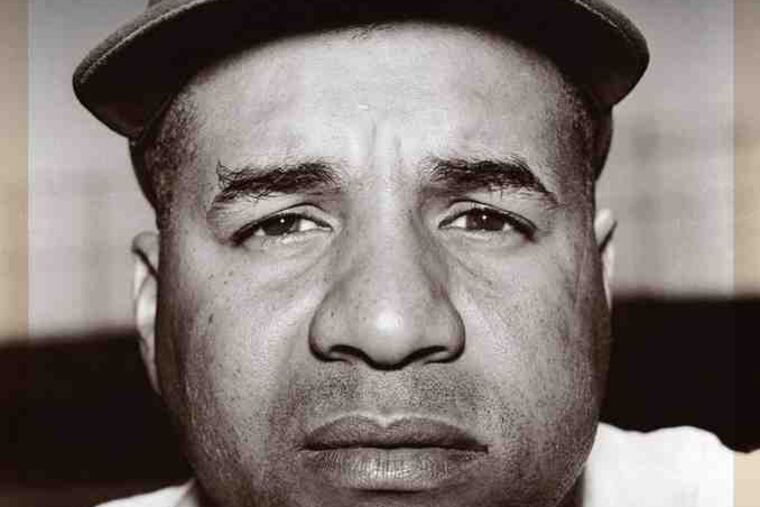
The Two Lives of Roy Campanella
By Neil Lanctot
Simon & Schuster. 528 pp. $28
nolead ends nolead begins
Reviewed by Bill Lyon
He began life as a roly-poly squatty-body, a pudgy slab of cookie dough with a falsetto that begged to be mocked. Ah, but with a bat in one hand and a catcher's mask in the other, he was miraculously transformed into a playground legend in that serendipitously named neighborhood of North Philadelphia, Nicetown.
For someone obsessed with baseball, this was Nirvana - Shibe Park, home of the A's, and Baker Bowl, home of the Phillies, were each within an easy walk. You could get a bleacher seat in Shibe for 50 cents and a rooftop seat on the rowhouses across the street for a quarter.
And there was always a sandlot game beckoning him, the bats fashioned from sawed-off broomsticks, and the rubber balls taped up until they were hard as iron. Young Roy Campanella was always in demand in those games. He was always the catcher, because everyone else shied away from that position, the cruelest, most demanding there is in all of sports, and because, oh yes, because Campy was good. Hall of Fame good. Three-time National League MVP good.
And yet for all that, his greater achievement, his most glorious triumph, was fashioned while he was imprisoned in a wheelchair, paralyzed from the neck down. Campy's is a story worth not only the telling, but also the retelling, which is precisely what Neil Lanctot set out to do three years ago. A fellow scholar had suggested to him that the time seemed just about "ripe" for a new Campy biography, not just a plowing of old ground but a freshening, one with new material.
And so, right on cue and just in time for another baseball season, here comes Campy: The Two Lives of Roy Campanella. It is yeoman work, rich in detail, relentlessly researched (nearly 100 pages of notes and interviews) and presented unsparingly.
The tireless gathering of material had to have been especially taxing for the author because Campy, by all accounts, loved to perform, delighted in mesmerizing audiences, and had a fondness for fabrication. It took little or no effort to get him to spin stories, rarely any of them malicious, and the truth was often elusive, buried somewhere in the layers of embellishments and fabrications. Many of his stories came under the label of If this isn't true, it should be. Fact and fiction danced an ever-changing tango.
But Lanctot, who lives in West Chester, is patient and diligently digs away, like a dinosaur hunter sifting through an ancient boneyard. He is a historian, has written extensively on baseball, and is the author of two previous books.
Lanctot traces Campanella through semipro ball (at 15 he was making $25 for a weekend's effort) and then the Negro League, the Mexican League and the Cuban League, Triple-A minor league, and, finally, the big time with the Brooklyn Dodgers. It was a grinding odyssey - in just 1937 alone, Campy claimed to have traveled 30,000 miles across Jim Crow America, in buses with faulty brakes and no air-conditioning, to play 179 games.
And rookies were tested early and often. They danced to chin music, and when pitchers weren't knocking them down they were doctoring the ball - a banana, of all things, hidden in the cap; a needle sewn into the glove, plus sandpaper, emery boards, and that old reliable, spit. Some umpires armed themselves with guns and knives.
From all of this, from the unrelenting bigotry and prejudice, Lanctot writes, Campy learned the delicately balanced law of survival - don't back down but don't be afraid to turn the cheek.
That served him well - so well, the author reveals, that Campy, not Jackie Robinson, very nearly became the first African American to play in the major leagues. As it was, he was the second, and also the first catcher. The two teammates, as Lanctot writes, actually had little in common and, in fact, their relationship turned contentious before finally settling into an uneasy truce late in life.
Campy had become so popular that in the balloting for the 1954 All-Star Game, he outdrew such luminaries as Mickey Mantle, Ted Williams, and Yogi Berra - and Campy, injured, wasn't even playing.
Life changed forever for him the night of Jan. 28, 1958, when his car skidded and crashed into Pole No. 25 of the New York Telephone Company, leaving him a quadriplegic, paralyzed from the neck down. A number of theories have been advanced as to what caused the accident, and Lanctot offers some new ones, not all of them flattering.
The celebrated novelist F. Scott Fitzgerald famously said that in America there are no second acts. Campy begged to differ. For a remarkable 35 years he lived in a wheelchair, refusing self-pity, and impacting thousands of lives, a source of continuing inspiration. Many who were moved by his example never saw him play baseball. It was their loss.
But what they did see was even more enthralling.
On June 26, 1993, his heart gave out. Long before that, he had become much more than a ballplayer.