'Turning the Tide': 12 critical weeks that helped win the Battle of the Atlantic
When we think of World War II, we tend to think of two theaters of war: the European continent and North Africa, and the Pacific.
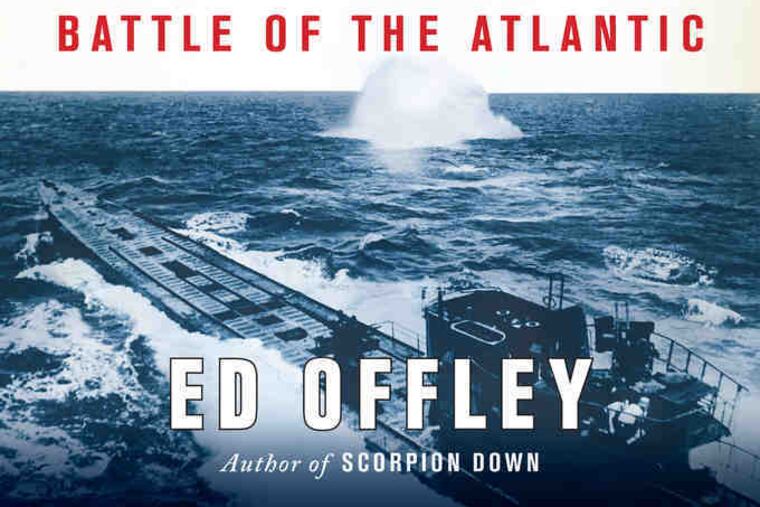
How a Small Band of Allied Sailors
Defeated the U-boats and
Won the Battle of the Atlantic
By Ed Offley
Basic Books. 477 pp. $28.99
nolead ends nolead begins
Reviewed by Paul Jablow
When we think of World War II, we tend to think of two theaters of war: the European continent and North Africa, and the Pacific.
The images from song and popular culture are embedded even in today's consciousness, with classic or near-classic films such as Patton or Saving Private Ryan¸ stage fantasies like South Pacific, or the magnificent HBO series titled simply The Pacific.
Far less attention has been paid to a third theater, the brutally cold, gale-slashed North Atlantic, where the British and American navies struggled against German U-boats to protect the supply lifeline that made the eventual Allied victory in Europe possible.
Ed Offley's well researched, tautly written account does its part to even the scales a bit. Coming 30 years after the best film account of the struggle, Das Boot, Offley uses a much wider lens, although not as wide in some ways as one might have wished.
The Battle of the Atlantic started in September 1939 with Britain's declaration of war against Germany, following the Nazi invasion of Poland, and ended only with the German surrender in May 1945.
It widened dramatically in the summer of 1941 after President Franklin D. Roosevelt signed the Lend-Lease Act, ending all pretense of American neutrality in the war and opening the entire ocean, including the East Coast of the United States, to U-boat attacks. It was not unusual for persons walking the beaches of Virginia or Long Island to see the horizon lit up by the distant flames of torpedoed merchant ships.
By the war's end, Germany had sent 830 U-boats into the battle, 2,653 Allied merchant vessels and 175 warships had been sunk, and more than 71,000 civilian crewmen and naval gunners had been killed, most of these losses coming in the North Atlantic. The German submariners fared much worse, with 717 of the U-boats sunk or wrecked, a 70 percent fatality rate, and almost half the 11,510 surviving crewmen in Allied prison camps.
Offley, a veteran military reporter for newspapers and online publications, concentrates on a 12-week period from March to May 1943 when the Allies literally turned the tide.
Partly because they were able to get more escort combat vessels and submarine-hunting planes from their respective military commands and partly because of advances in radar and code-breaking, American and Commonwealth forces turned the U-boats from hunters to hunted and saved the supply lifeline that would make the Normandy invasion possible a year later.
At times, Offley's account has the mind-numbing detail of the whaling digressions in Moby-Dick, but for the most part, he sticks to a good yarn, evoking the special brand of terror faced by both sailors and submariners. It must have been clearly different from that felt on Omaha Beach or Guadalcanal or on a bomber flight over Germany, but bordering just as closely on the unimaginable. Think waiting for the shark to hit in Jaws.
Personal portrayals help drive and enrich the story. Not surprisingly, two of the most interesting are the respective brains behind the rival operations, Fleet Adm. Karl Dönitz, commander-in-chief of the German navy, and Adm. Sir Max Kennedy Horton, picked by Churchill to lead the war on U-boats because Horton had a background as a submariner.
Dönitz was fierce and intense, driven almost to distraction both by the Allied successes and by his own submariners' tendencies to exaggerate their accomplishments to a degree that made it difficult to map a coherent strategy. The war ended badly for him, to say the least. He lost his youngest son, whose submarine was sunk, and Hitler designated him as his successor before committing suicide in his bunker. Convicted of war crimes in Nuremberg, Dönitz served 10 years in an Allied prison.
Equally intense but far more eccentric, Horton would spend his afternoons golfing and show up in the situation room at night in his bathrobe and slippers, barking out intricate orders that showed uncanny anticipation of the Germans' next moves. Night was when most of the fighting took place, he explained.
Although Offley doesn't deal much with the war's broader canvas, it is hard to go through his book without thinking how lucky the Allies were that Hitler tried to play general and did it so badly. Had he had Roosevelt's ability to defer to his best military minds, the war in Europe could have turned out much differently.
In the Battle of the Atlantic, this was reflected in Hitler's refusal to give Dönitz the resources he needed, both numerically and in technology. It was of a piece with his obsession with jet bombers and the V-1 and V-2 rockets to punish the British population, rather than with the jet fighters that might have made the Normandy invasion more difficult, if not impossible.
Add his suicidal attack on the Soviet Union and one can see that the Allies were fortunate, indeed.