Sympathy, celebration for the poet
If reading a guidebook to contemporary poetry appeals to you about as much as diving into a history of space heaters in this triple-digit summer, David Orr, poetry columnist for the New York Times Book Review, knows how to turn on the AC.
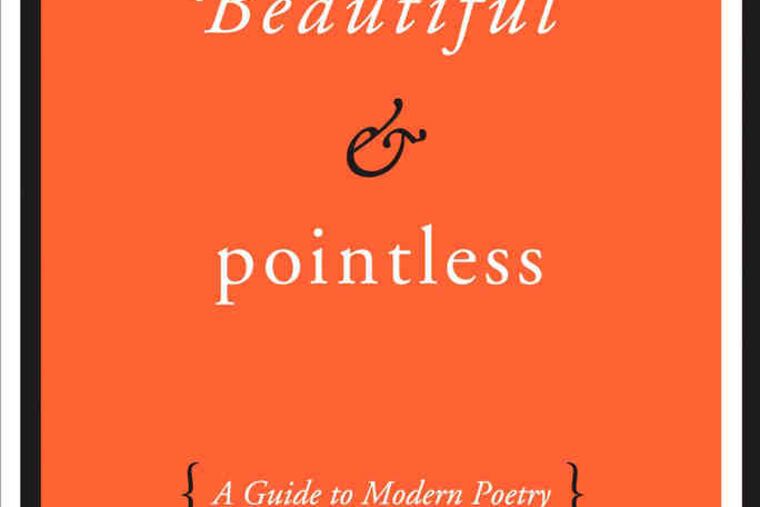
A Guide to Modern Poetry
By David Orr
HarperCollins. 224 pp. $20.99.
nolead ends nolead begins
Reviewed By Helen W. Mallon
If reading a guidebook to contemporary poetry appeals to you about as much as diving into a history of space heaters in this triple-digit summer, David Orr, poetry columnist for the New York Times Book Review, knows how to turn on the AC.
In Beautiful & Pointless, Orr admits that books on poetry tend to read like math texts. Either that, he says, or they are rapturous "testimonials announcing poetry's ability to derange the senses" and make us "dance naked under the full moon, and so forth."
Orr is no highbrow who expects readers to know the difference between a villanelle and Valpolicella before he'll pop a beer with them. If anything, he arouses reader sympathy for the poor poet, whose visions will never be optioned by Hollywood, and whose main audience will ever be limited to other poets. Even though Percy Bysshe Shelley wrote in what amounted to an 1821 version of a self-help pamphlet that "poets are the unacknowledged legislators of the world," the political engagement of poets is in a "potentially awkward position relative to the larger political world, which is generally not paying much attention." (At least not in this country. Shelley might have been heartened to know that in Soviet Russia, China, and Burma, poets would be hounded like domestic terrorists.)
This leaves the contemporary American poet laboring beneath the twin burdens of irrelevance and Greatness. In fact, Orr dedicates an entire chapter to ambition because "it's especially difficult to talk about the situation of poetry" - is it healthy? endangered? postmortem? - "when the people talking about it appear to agree on little, except possibly that a poem should begin with words."
Instead, he approaches "what it means to write a poem" slantwise, "by talking about a related concept. . . . Not about what poetry is, but about what we want it to be." This touches on what Philadelphia poet Daisy Fried calls "capital-G Greatness," and opens up a discussion of style. A style approved as ambitious, Orr says, is "less likely to involve words like 'canary' and 'sniffle' and 'widget' and more likely to involve words like 'nation' and 'soul' and 'language.' " Our assumptions, he writes, "work like a velvet rope: If a poet looks the way we think a great poet ought to, we let him or her into the club quickly - and sometimes later wish we hadn't."
Orr traces the implications of poetic assumptions. He enters via the arenas in which poetry has traditionally taken a stand, including "The Personal," "The Political," and "Form." His touching concluding chapter is titled "Why Bother?", which, it seems, is a question poets ask themselves with depressing frequency.
Regarding the personal: "Poetry, we're told, is . . . a means of answering Pete Townshend's question 'Can you see the real me?' " Orr questions how personal a personal poem really is. Is the "I" of the poem "in basic concordance with the facts relating to the poet-as-he-walks-around"? That's a tricky question, because "the personal depends on juxtapositions, not revelations."
By way of explanation, Orr illuminates the contrasting effects of very different poems: "The Tay Bridge Disaster," which Orr calls "possibly the worst poem ever written about a public calamity"; the embarrassing "Saved From Myself" by pop singer Jewel; and the last by the "seemingly casual" poet Frank O'Hara. Orr argues that the successful "personal" poem, such as O'Hara's "The Day Lady Died," relies on our sense that some experiences, such as grief, "don't sit very well alongside our day-to-day activities, so that when they're brought up abruptly in a poem filled with ephemera, we're forced to decide whether the sudden emergence (juxtaposition) of this other, more personal identity can be accommodated." He admits this is a risky strategy, because "it courts humiliation." Perhaps a poem is "personal" simply because it takes lonely courage to write one.
People keep writing the stuff. Yet if poets themselves are to be believed, it was all over a long time ago. Orr cites the "lamentations and counter-lamentations" reflected over the years in essay titles by Dumbledore-caliber authorities: "Who Killed Poetry?" "Death to the Death of Poetry"; and "Poetry is Dead. Does Anybody Really Care?"
Orr concludes that "poetry is a small, vulnerable human activity no better or more powerful than thousands of other . . . activities." But the truth is that humans have been creating poetry far longer than they've been creating timepieces or gecko habitats. Perhaps the persistence of lively poetry scenes in many places, including Philadelphia, means that poetry's traditional yearning for immortality isn't merely quixotic. "Yo, Philly!" Our poets sing. "There is life after death."