A guide to Pennsylvania's tombstone territory
He was one of the most famous men of his time. An inventor, author, scientist, diplomat, signer of the Declaration of Independence and the Constitution, Benjamin Franklin had become such a popular figure that more than 20,000 mourners attended his funeral at Christ Church in 1790. It's an astonishing figure considering the city's population in 1790 was 28,522. By contrast, only 4,000 attended George Washington's funeral nine years later.
He was one of the most famous men of his time. An inventor, author, scientist, diplomat, signer of the Declaration of Independence and the Constitution, Benjamin Franklin had become such a popular figure that more than 20,000 mourners attended his funeral at Christ Church in 1790.
It's an astonishing figure considering the city's population in 1790 was 28,522. By contrast, only 4,000 attended George Washington's funeral nine years later.
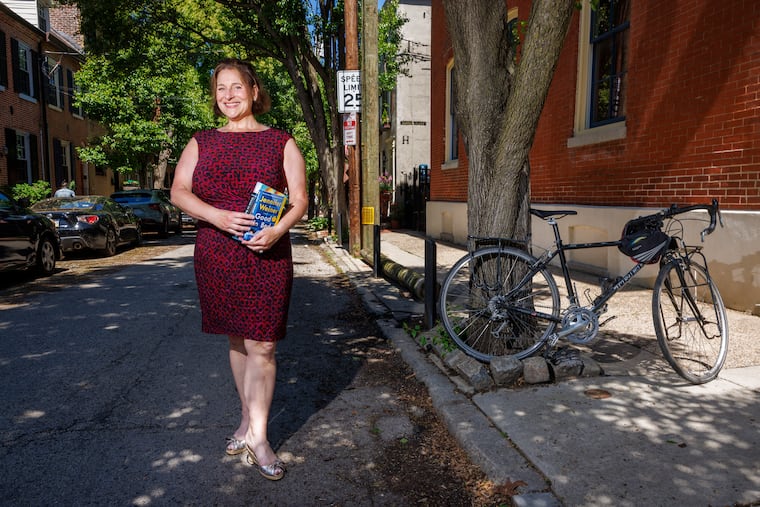
Franklin's final resting place at Christ Church Burial Ground in Old City is one of 30 famous Pennsylvania grave sites profiled by Joe Farley and Joe Farrell in their new book, Keystone Tombstones: Volume One (Sunbury Press, $19.95).
One of a projected three volumes, the book is filled with delectable biographical information and offbeat stories about a wide range of notable men and women buried in the Keystone State, including novelist Pearl S. Buck; baseball Hall of Famer Connie Mack (born Cornelius McGillicuddy); John W. Geary, a Civil War hero, onetime San Francisco mayor and Pennsylvania's 16th governor; Philly Mayor Frank Rizzo; and revolutionary artist Andy Warhol.
Farrell and Farley's selection is eclectic. One of their most notable entries is on Wilkes-Barre native Mary Jo Kopechne, who is famous only for her tragic death in 1969: She was the woman killed in Sen. Edward M. "Ted" Kennedy's infamous car accident on Chappaquiddick Island, Mass. (She's buried in Larksville in Luzerne County.)
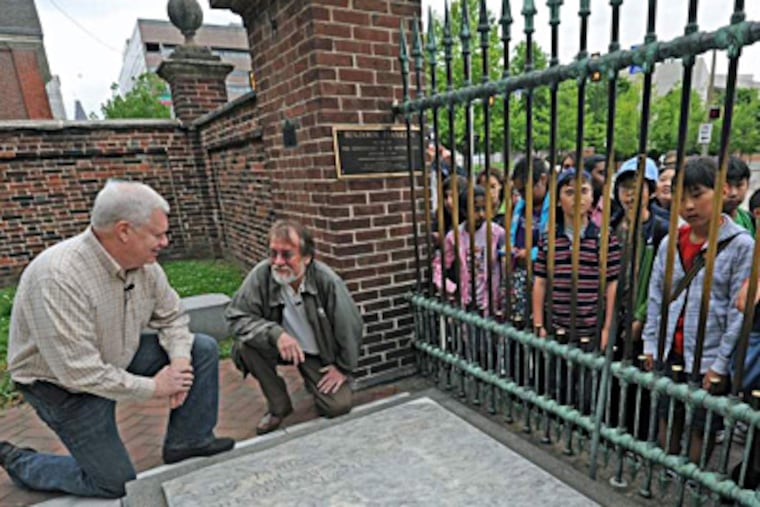
The Joes, as they are known, showed off Franklin's grave during a recent visit to Christ Church Burial Ground.
They grinned in concert at their guest's shocked expression: "The First American," as Franklin is known, is not entombed in a grand mausoleum as one might expect from his accomplishments. No marble statues mark his grave.
His is the most modest plot in the cemetery: No statues. Not even a headstone. All that marks his grave is a roughly hewn, flat rectangular gravestone. (It's known as a "ledger" grave marker in the business.) It bears the equally sparse inscription, "Benjamin And Deborah Franklin: 1790."
Farrell pointed out the closest thing to an ornament: A cluster of coins grouped around the center of the stone. "Those are grave goods," he said referring to the ancient tradition of leaving the departed gifts, a practice that goes back to ancient Egypt and beyond.
"Franklin's grave popularized the custom in America," Farrell said.
What happens to the coins?
"We deposit them in a bank account," said John Hopkins, burial ground coordinator at Christ Church. "We get $4,000 to $5,000 a year just from Ben's grave." (It goes to the cemetery's upkeep.)
Lifelong Pennsylvania state civil servants — they worked together for more than 20 years at the Pennsylvania Public Utility Commission — Farley, 60, and Farrell, 65, came up with the idea for Keystone Tombstones shortly after Farley retired from the PUC in 2010.
Farley said he was clearing up boxes of books he had accumulated when he came across Red Smith's To Absent Friends, a collection of newspaper pieces by the Philadelphia Record and New York Times sportswriter.
"It's a series of columns about sports figures he knew who had recently passed away," Farley said. "I was reading through it and I thought, I bet there are a lot of famous people buried in PA."
The Joes, who said they are always up for exploring local pubs and breweries across the state, took to the road and visited dozens of cemeteries. (Their book includes information about eateries located near cemeteries they cover.)
"It took us about 18 months to finish the first volume," said Farrell. "We made a list of about 70 people and began writing the stories."
Farley chimed in without missing a beat: "We kept sending chapters to our publisher until one day they said, 'That's enough for a book, you can stop now.'?"
They didn't stop: Having amassed stories about more than 100 people, they completed a second volume — it's due in September — and are at work on a third.
Close friends for nearly 40 years, the Joes seem to be synced on the same wavelength. They anticipate each other's train of thought and are liable to finish each other's sentences.
They even live near each other in the New Cumberland/Harrisburg area.
Farrell moved on from the PUC five years ago to become executive director of the disciplinary board of the Pennsylvania Supreme Court. A widower (his wife, fellow civil servant Casey, died in 2008), he has two grown children and three grandchildren.
Farley lives with his wife, Sharon, an occupational therapist, with whom he has three sons, all of whom, he noted with obvious pride, are Eagle Scouts.
He hesitates for a moment when asked to name his favorite entry in the book, eventually citing actress Jayne Mansfeld.
"One of the things I discovered in my research was that she was intelligent — she had a very high IQ — despite her [movie] roles" as often less-than-brilliant sex bombs. She spoke five languages and was a classically trained pianist and violinist.
Farley said he was surprised to learn that Mansfield is not buried in her hometown, Bryn Mawr, but in Pen Argyl, a hamlet of 3,600 in Northampton County just south of Stroudsburg. (Her mother, Vera Jeffrey Palmer, moved there shortly before the actress's death.)
Farrell went to baseball when asked for his favorite Keystone Tombstones personage: Sportscaster and Phillies play-by-play announcer Harry Kalas, who is buried in Laurel Hill Cemetery in Philly's East Falls section.
"I heard his famous 'home run' call-out many, many times over the years," Farrell said of Kalas' trademark cry: "That ball is outta here!"
"You can't but help smile when you see his headstone, which is topped by a huge radio microphone," said Farrell. "And his grave is flanked by two sets of baseball stadium seats."
Farrell admitted that Keystone Tombstones: Volume One doesn't have "as many people from Philadelphia as we'd like, but that'll be in Volume Two. The city is just a gold mine of famous graves." The second book, he said, will include an entire section on Philly mobsters, including Philip "Chicken Man" Testa and his son, Sal, considered "the Crowned Prince of the Philadelphia Mob," with more than 15 murders to his credit. The Testas, both assassinated by other mobsters, rest in their family plot, Holy Cross Cemetery in Yeadon, also home to another notable body profiled in Volume Two, H.H. Holmes, who is considered to be America's first serial killer.
"But we'll also have chapters on Saint John Neumann and Saint Katharine Drexel," Farley added.
How can the Joes stand being around so much death? Isn't it a bit morbid?
Not at all, said Farley, a U.S. history buff who has a degree in history from Bloomsburg University.
"It's a great way to study history," he said. "In a way, this book was a natural."