A suspenseful tale of conspiracy and the Cuban missile crisis
In a classroom discussion of civil-defense planning for a nuclear attack on the United States, Margo Jensen, the heroine of Stephen Carter's new novel, declares that because human beings are so complex, we can't predict how they will behave "until there's a nuclear warhead on the way. We have no data. We can't run a realistic test. So the only right answer is that there is no right answer."
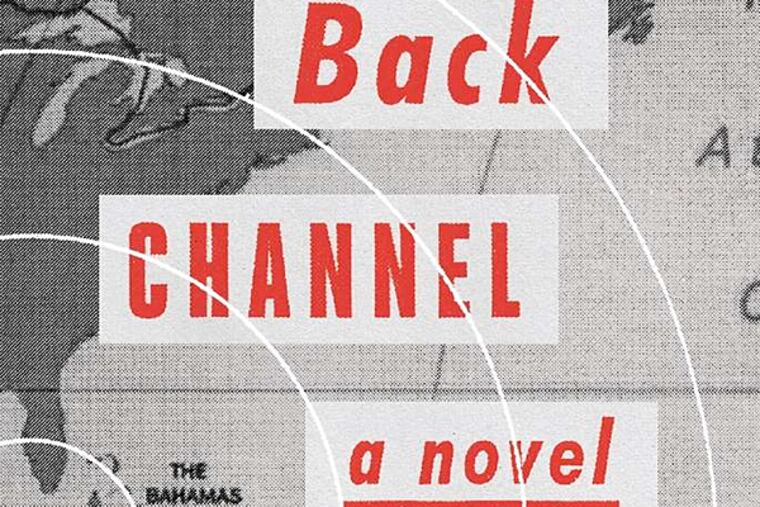
Back Channel
A Novel
nolead begins By Stephen L. Carter
Alfred A. Knopf. 464 pp. $27.95
nolead ends nolead begins
Reviewed by Glenn C. Altschuler
In a classroom discussion of civil-defense planning for a nuclear attack on the United States, Margo Jensen, the heroine of Stephen Carter's new novel, declares that because human beings are so complex, we can't predict how they will behave "until there's a nuclear warhead on the way. We have no data. We can't run a realistic test. So the only right answer is that there is no right answer."
"Not entirely wrong," says professor Lorenz Niemeyer, a character vaguely reminiscent of Henry Kissinger. Human factors - capriciousness, covetousness, fear, anger, and lust - are "the most dangerous part of any equation." Along with "the regrettable tendency to overestimate one's own capabilities" and "the odd unexpected moment of bravery or integrity."
A 19-year-old African American sophomore at Cornell University, Jensen soon will experience firsthand the role of human factors in a nuclear crisis. When President John F. Kennedy and his advisers discover in October 1962 that the Soviet Union has installed nuclear missiles in Cuba, she is enlisted, through a bizarre set of circumstances, as a "back channel" to facilitate unofficial negotiations between Kennedy and Soviet premier Nikita Khrushchev.
In Back Channel, Stephen Carter, a professor of law at Yale University and the author of eight works of nonfiction and six novels, including The Emperor of Ocean Park and The Impeachment of Abraham Lincoln, takes Jensen from Ithaca to Bulgaria to Washington, as he imagines vicious and violent internal conflicts with the governments of the two superpowers that bring the world to the brink of annihilation.
Carter has done his homework. He understands - and conveys - the nuances of deterrence theory and "the prisoner's dilemma." He makes much of the view, hinted at in 1962 and later confirmed by historians, that Khrushchev was not fully in charge in Moscow and that Kennedy had to placate military and civilian hawks in his administration. He sneaks in a reference to Rufus Youngblood, the Secret Service officer who rode in Kennedy's motorcade in Dallas on Nov. 22, 1963. And in an afterword, Carter reviews the changes he did - and did not - make to the known facts (including a false report of a launch of a Soviet intercontinental ballistic missile) and chronology surrounding the Cuban Missile Crisis.
Most important, Carter is a master at building suspense. His action-driven narrative, which navigates more twists and turns than a colonoscopy, induces a suspension of belief in plot developments, many of them palpably implausible. Although readers know how the story of the missile crisis will end, most of them will, as I did, compulsively turn the pages.
Carter, however, is less skilled as a writer. He feels compelled to tell readers what he has just shown them, at times in melodramatic "Perils of Pauline" prose. After Ms. Jensen is arrested in Varna, Bulgaria, Carter writes, "Her knees trembled. Her feet weren't working right. Suddenly the sweat was not just on her face but everywhere." Following a rough and revealing conversation between Niemeyer and his former wife, Carter refers to the professor's "telltales: the curled contemptuous lip, the rising disdain in the cultured voice." And, to cite just one more example, he informs us that after spending the night in a strange man's apartment, and letting him see her half-naked, Jensen "consoled herself with the knowledge that things couldn't get any worse. Except, of course, they could."
Back Channel is permeated with references to powerful, dark forces operating deep inside the government of the United States. Although they committed murder and came within an hour of plunging the country into a nuclear war, Jensen learns that the charges against the bad guys have been dropped.
"Grow up," an intelligence official tells her. "Washington has factions, just like the Kremlin." Factions "without which it is not possible to govern . . . contrary to what you may have heard, the President doesn't run the government." Insisting that "this is just the way it is," he concludes that "if I were the President, I suppose I'd watch my back."
And so, the novel leaves you wondering whether Stephen Carter is simply passing along - or endorsing - conspiracy theories that seem to have taken root in American culture.