'Dead Wake' by Erik Larson probes the Lusitania sinking
They had been warned. With war raging across the ocean, an eclectic group of passengers gathered in New York City in May 1915 for a trans-Atlantic voyage aboard the great Lusitania.
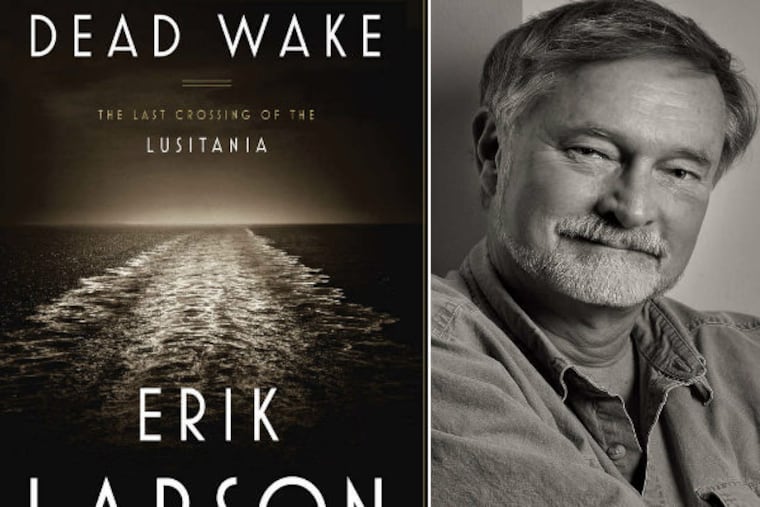
Dead Wake
The Last Crossing of the Lusitania
By Erik Larson
Crown. 450 pp. $28
nolead ends nolead begins
They had been warned.
With war raging across the ocean, an eclectic group of passengers gathered in New York City in May 1915 for a trans-Atlantic voyage aboard the great Lusitania.
Everyone knew the risks. The German embassy in Washington had even placed an ad on the shipping pages of New York's newspapers that leveled a veiled yet unmistakable threat at the ship.
"The truth is that the Lusitania is the safest boat on the sea," the Cunard company said. "She is too fast for any submarine. No German war vessel can get her or near her."
In the hands of a lesser craftsman, the fascinating story of the last crossing of the Lusitania might risk being bogged down by dull character portraits, painstaking technical analyses of submarine tactics, or the minutiae of World War I-era global politics.
Not so with Erik Larson. In Dead Wake: The Last Crossing of the Lusitania, the author's latest masterful fusion of history and storytelling, the former Wall Street Journal reporter effortlessly re-creates the collision course taken by Capt. William Thomas Turner and the man who would destroy his ship, Kptlt. Walther Schwieger, commander of Unterseeboot-20.
With a book release cleverly pegged to two months shy of the centennial of the ship's sinking, Dead Wake deftly weaves together a number of Larson's fascinations from previous books - technology, weaponry, wartime, Germany, weather, and period pieces.
Engaging in a favored chronological newspaper storytelling technique called a "tick tock" that exploits Larson's print journalism roots, the author invites readers on a journey on parallel tracks. He escorts us as we join the Lusitania's passengers readying for their voyage, departing from the New York wharves, sharing the rhythms of life aboard ship, fretting (or not) about the German warning, and dying or surviving catastrophe.
At the same time, Larson opens up the cramped quarters of a German submarine, illuminating the tensions of a dangerous life beneath the water and the zeal of the men commanding that country's undersea arsenal.
Larson not only has a keen eye for delicious detail and an endless appetite for research (as evidenced by his always enjoyable footnotes), but he also has a lot to work with, too.
With England and Germany battling for bragging rights on the high seas, Larson's book is filled with the larger-than-life characters of Woodrow Wilson and Winston Churchill; spiritualists, warmongers, and ship captains; and, of course, two impressive vessels, each with its own outsize personality.
As Turner and Schwieger barrel toward confrontation, in London a secret operation known as Room 40 deciphers coded German messages - ones that, had they been acted upon, could have saved the Lusitania and its 1,198 luckless souls. And in Washington, the newly widowed isolationist President Wilson grapples with his country's place in an increasingly fractured Western Hemisphere.
As has become his specialty, Larson wrestles these disparate narratives into a unified story and creates a riveting account of the Lusitania's end and the beginnings of the U.S. involvement in the war.
At the same time, Larson tries to answer the nagging journalistic questions that inevitably arise from such a focused examination. The great lingering questions of the Lusitania affair, are, he writes: "[W]hy was the ship left on its own, with a proven killer of men and ships dead ahead in its path?"
What if the Lusitania had not spent extra time taking on passengers from another ship? What if the heavy fog that day had lasted just a bit longer? What if the U-boat's torpedo had struck a different part of the vessel?
"In the end," Larson concludes, "Schwieger's attack on the Lusitania succeeded because of a chance confluence of forces. Even the tiniest alteration in a single vector could have saved the ship."