Colm Tóibín's 'Elizabeth Bishop': One writing life touches another
The Princeton University Press has some nifty book series going. My favorite is Writers on Writers, in which contemporary writers offer short, personal reflections on famous figures in literature. Each writer is given a long leash to be "creative," to explore, to go where s/he wants. That stamp of the personal makes this series singular. The volumes I've read so far - including the one at hand, On Elizabeth Bishop by Colm Tóibín - are exhilarating.
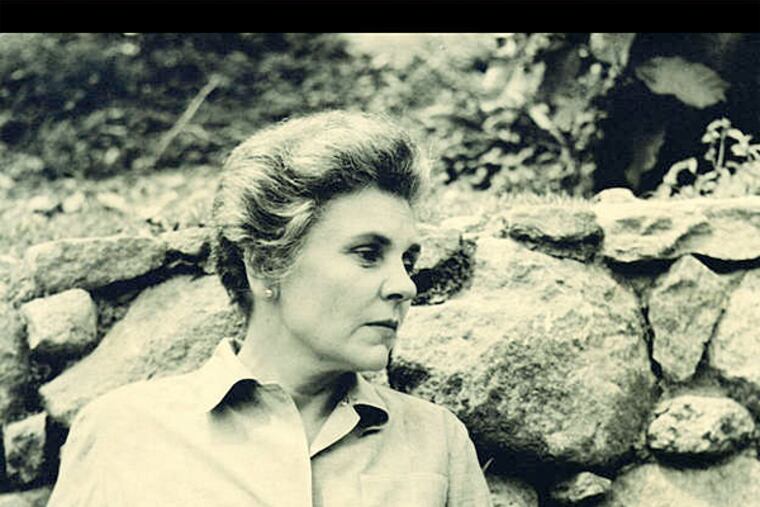
On Elizabeth Bishop
nolead begins By Colm Tóibín
Princeton University Press 224 pp. $19.95.
nolead ends nolead begins
Reviewed by John Timpane
nolead ends The Princeton University Press has some nifty book series going. My favorite is Writers on Writers, in which contemporary writers offer short, personal reflections on famous figures in literature. Each writer is given a long leash to be "creative," to explore, to go where s/he wants. That stamp of the personal makes this series singular. The volumes I've read so far - including the one at hand, On Elizabeth Bishopby Colm Tóibín - are exhilarating.
In On Whitman, poet and truth-teller C.K. Williams gives us a gusty, gutsy visit with Camden's poet. I wanted it to be longer. In What W.H. Auden Can Do For You, Alexander McCall Smith humanely surveys the poetry and life of Auden and makes a strong case for the good poetry does for people.
Just as good is On Elizabeth Bishop by Colm Tóibín. Bishop is a 20th-century U.S. master poet; Tóibín is an Irish fiction writer of today. You might wonder at this pairing. Well, none could pair comfortably with the uneasy, furtive Bishop. Turns out the two have much in common.
Tóibín's discovery of Bishop's poetry is a personal and artistic turning point. She's his biggest influence; her power lies in what she leaves (and must leave) unsaid. Just as she fled the United States for Brazil, Tóibín left Ireland for places new, including Spain and San Francisco. Like hers, his work returned to origins, to return itself, to the impossibility of return. With thrilling sobriety, Bishop's "In the Waiting Room," one of the 20th century's best poems, gives us the moment a little girl comes into herself:
I said to myself: three days
and you'll be seven years old.
I was saying it to stop
the sensation of falling off
the round, turning world
into cold, blue-black space.
But I felt: you are an
I,
you are an
Elizabeth,
you are one of
them.
Tóibín sees the same search for self and place in novels of his, such as The South and The Story of the Night. I just loved this: a writer so open about how his work and life touch another writer's. There's also a stunning comparison to James Joyce's short novel The Dead, in which a man comes to realize who he is, and how alone.
Little books like this make the world better, teaching us much and inviting more.
215-854-4406@jtimpane