'Watchman' an unworthy sequel to 'Mockingbird'
Eventually, the controversy surrounding Go Set a Watchman may fade, but as we set out to read the novel for the first time, it is impossible to ignore - nor should we.
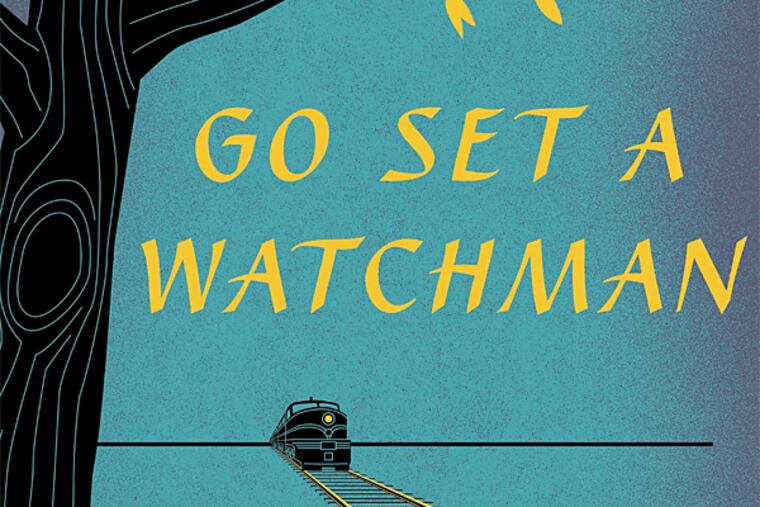
Go Set a Watchman
By Harper Lee
HarperCollins.
278 pp. $27.99
nolead ends nolead begins
nolead ends Eventually, the controversy surrounding Go Set a Watchman may fade, but as we set out to read the novel for the first time, it is impossible to ignore - nor should we.
Especially since Watchman fails as a novel.
After To Kill a Mockingbird came out in 1960, Harper Lee made it famously clear she had no intentions of ever publishing another book. Then out of the blue came an announcement in February: A second novel was coming, a sequel to her beloved classic, though written first. Lee set Watchman aside after her editor, Tay Hohoff, rejected it. She then took Hohoff's advice and reimagined the project. She wrote about Scout Finch as a girl growing up in Maycomb, Ala., rather than as an adult returning home to it. Mockingbird was the result.
According to Tonja Carter, Lee's attorney and estate trustee, the original manuscript of Watchman - long believed lost - had been found (exactly how, when, and by whom aren't clear). And Lee, contrary to her long silence, wanted it published.
Soon after Carter's announcement, the questions came. Had Lee, now 89, visually impaired, hard of hearing, and a resident at an assisted-living facility, really changed her mind? Or had she, in her fragile state, been taken advantage of? We may never know the true story. Regardless, Go Set a Watchman is now here.
For people who cherish Mockingbird, reading Watchman may come as a shock. Set generally during the years of its composition, the mid-1950s, Watchman reintroduces us to Scout, who, now an adult, goes by her given name, Jean Louise. She lives in New York (doing what, exactly, we never learn) and has come home to Maycomb for two weeks to see her boyfriend of sorts, Henry Clinton, and her father, Atticus, now in his 70s and suffering from rheumatoid arthritis. Long away, she finds herself disappointed by how its people have changed since her youth - especially her father.
It's just after the Supreme Court's ruling in Brown v. Board of Education, which struck down the doctrine of "separate but equal" - but the generally incorruptible and saintlike Atticus Finch of Mockingbird reveals himself to be a segregationist, much to the horror of his daughter.
Mockingbird, as it traces Scout's moral education as a young girl, is a masterful example of dramatic plot construction. As the chapters move from Scout's fascination with the mysterious Boo Radley to her father's legal defense of Tom Robinson, an African American wrongly accused of rape, Lee captivates us. Maycomb and its citizens are brought to vivid life as Scout comes to understand the importance of fighting for justice and protecting the innocent.
Watchman, on the other hand, reveals itself to be what it was: a manuscript with real problems, rightly rejected in the first place. Atticus' racism will undoubtedly be - and already is - what disappoints many readers most, but that's not why Watchman fails.
No, it fails because it doesn't hold together as a novel. Characters are sketched but not sufficiently developed. Family histories are provided to no lasting effect. Flashbacks, which take us to the nostalgic days we recognize from Mockingbird, the days Scout spent playing with Jem and Dill, are interspersed awkwardly and rather purposelessly.
But Watchman's most glaring weakness is probably that young Lee lets her characters hold forth too much, especially on the federal government's recent "interference" in the lives of the South's black and white citizens. These discussions provide us with a time-capsule glimpse back, but they are dead on the page, not unlike speechifying dialogue in a bad topical play.
At the climax, Atticus and Jean Louise take turns talking histrionically at each other. She says: "Why in the name of God didn't you marry again? Marry some nice dim-witted Southern lady who would have raised me right? Turned me into a simpering, mealymouthed magnolia type who bats her eyelashes and crosses her hands and lives for nothing but her lil'ole hus-band! At least I would have been blissful. I'd have been typical, one hundred percent Maycomb; I would have lived out my little life and given you grandchildren to dote on. . . . " And so forth.
Tay Hohoff did us and Harper Lee a favor when she sent Lee back to explore more fully the flashbacks that flavor Watchman. The people now looking after Lee's interests, however, have done her and her legacy an injustice. Reading this book simply illuminates Mockingbird's magic. Had Watchman been published when it was written, To Kill a Mockingbird probably would never have come into being, at least not as we know it, and Harper Lee might very well be a name forgotten decades ago.
of "Shadows of Men," a collection of stories. He is associate professor of English at La Salle University.