Musehouse goes from brick and mortar to many places - and online
Musehouse is the name of Kathleen Bonanno's nonprofit center for the literary arts. As a center for writing, reading, and teaching, it has earned affection and respect in the local literary community.
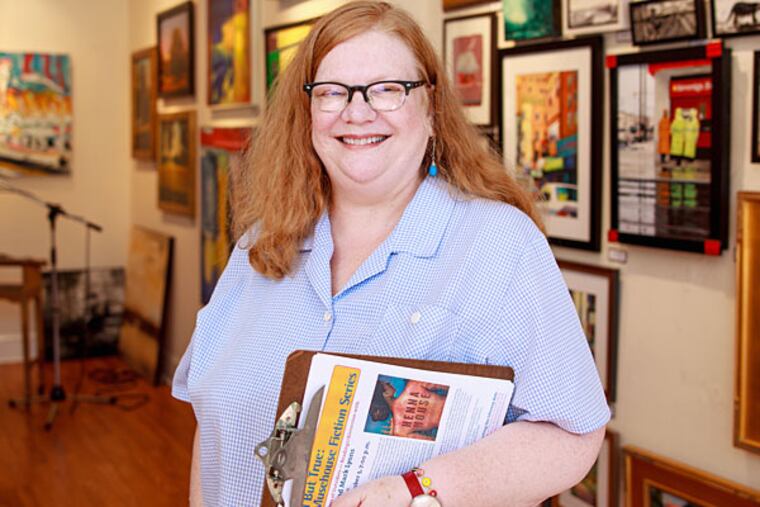
Musehouse is the name of Kathleen Bonanno's nonprofit center for the literary arts. As a center for writing, reading, and teaching, it has earned affection and respect in the local literary community.
When many people think of Musehouse (musehousecenter.com.), they think of its Germantown Avenue location. But changes in Bonanno's life have led to changes at Musehouse. It still exists, but in no one place. It is multicenter and virtual now, flourishing with workshops and classes held at a string of satellite spaces in Philadelphia and Oreland. It's a Musehouse of many walls - and of no walls at all.
As far as Musehouse people see it, that's a good thing. Board member, Musehouse student, and longtime Chestnut Hill resident Barbara Russell says she sees it "branching all over this Philadelphia Delaware Valley area." She also owns a needlepoint business in the neighborhood. "Without walls, it's much more of a mobile opportunity."
Courses at Musehouse have helped aspiring and established writers examine their lives in a supportive setting. "Right now, I'm writing a series of haikus of my son's life from birth to death, as a way of chronicling him," said Susan Holck, a memoir and poetry student who used to work for the World Health Organization in Geneva.
The writing center came to its brick-and-mortar location with a Knight Foundation grant that Bonanno won in 2011, the year she retired from teaching English at Cheltenham High School. Two years earlier, she published Slamming Open the Door, a critically acclaimed collection of poetry she wrote to cope with her adopted daughter Leidy's 2003 murder at the hands of an ex-boyfriend.
Losing her daughter was not the only thing that affected Bonanno's career. She was diagnosed with cancer in November 2013. So she took a hiatus, stepping back from Musehouse, returning gradually over the winter. A reduced interim staff kept classes and other events on track, but it couldn't keep operating at the rented Germantown Avenue building indefinitely. Musehouse left its first home behind.
"As is so often the case when you face a challenge, it will turn out that there are hidden benefits to that challenge," Bonanno said. "Right now, we're really enjoying collaborating with other spaces."
New community partners were found, such as the Church of St. Martin-in-the-Field in Chestnut Hill. Classes continue at the church for the fall semester, from Sept. 14 through Nov. 2, as well as at private residences. Offerings include memoir-writing - Bonanno will teach two such courses herself - and a flash-fiction class for teens and adults. For the first time, Bonanno will also teach a class on Zentangle, a pen-and-ink art form based on repetitive patterns. The technique has helped take her mind off her illness.
Musehouse readings, meanwhile, have been going on at another Chestnut Hill spot, Borrelli's Chestnut Hill Gallery. For Bonnano, between the readings and the artwork on display at the gallery, the Borrelli's gatherings are "kind of like an art experience to the second power." The next event in the series, a fiction night, takes place Sept. 5 and spotlights Nomi Eve and Mark Lyons.
Online courses may be next. As a transition between face-to-face learning and digital teaching, Musehouse will offer writers the option to participate in an independent study in which they email their work to an instructor for feedback and have one in-person meeting during the course of the class.
Poetry instructor Grant Clauser - with Leonard Gontarek, one of the earliest Musehouse team members - said that although he preferred the old-school, face-to-face approach, digital teaching was "all about fitting in the writers available."
Bonanno is still writing poems, too. Some are inspired by Hubble Space Telescope images. Fascinated by the contrasts between microcosms and macrocosms, the pieces, with titles like "Cat's Eye Nebula" and "Pillars of Creation," draw on the idea of finding "the whorl of a dog's ear" at the center of a galaxy. She is also interested in editing an anthology of other poets' responses to the images.
A more personal project imagines heaven as a Poconos resort. Some poems in the series, written in the first person, center on the boundaries between loss and the living. Imagining herself in heaven, Bonnano says, is a way for her to think optimistically about the future.
"I'm convinced now more than ever, given my health issues, that it's important . . . to focus your energy on what matters," she said. "For me, it seems that my creative projects are the fuel that's keeping me going, and Musehouse is a big part of that."