New volume of 'Hemingway's Letters' shows a young writer on the rise
Perhaps no 20th-century writer has had a greater influence than Ernest Hemingway. His novels, short stories, and journalism are penetrating and iconic; his personal life, thinly veiled in his fiction, was the stuff of drama and romance.
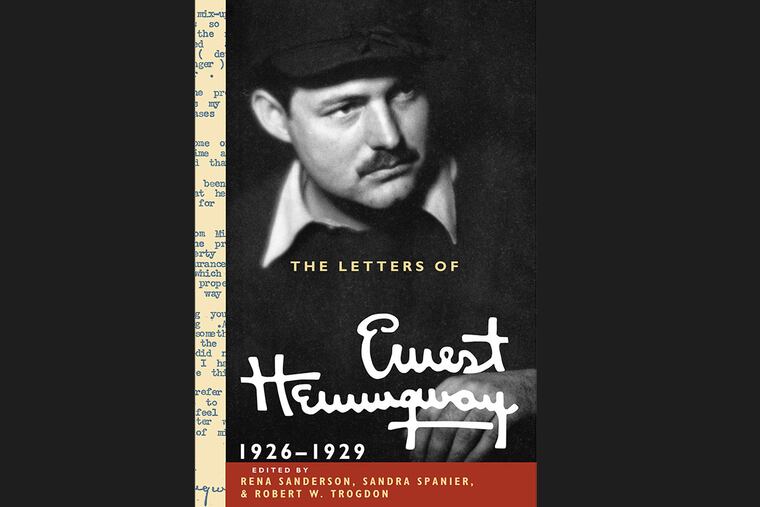
The Letters of Ernest Hemingway
Volume 3, 1926-1929
Edited by Rena Sanderson, Sandra Spanier, and Robert W. Trogdon
Cambridge University Press. 731 pp. $45.
nolead ends Perhaps no 20th-century writer has had a greater influence than Ernest Hemingway. His novels, short stories, and journalism are penetrating and iconic; his personal life, thinly veiled in his fiction, was the stuff of drama and romance.
Hemingway was rich, famous, and beloved by millions of readers worldwide. He had the freedom to live and travel anywhere he wanted, and he hunted and fished around the world. As a writer, he covered wars, crime, sports, and any subject that interested him. Although his life ended in suicide, he otherwise led what was for many the quintessential writer's life.
The Cambridge University edition's third volume of The Letters of Ernest Hemingway covers 1926 to 1929, years of ascent and recognition. By 1926, Hemingway was a rising star on the literary Left Bank in Paris. Editor Sandra Spanier notes that this volume traces his emergence from a group of post-World War I expatriate writers into the American mainstream.
Volume 3 includes 345 letters, more than 70 percent of them previously unpublished. The letters here are directed to 99 recipients: publishers, editors, writers, artists, family members, friends, and readers. The letters are profane, witty, gossipy, literary, emotional, and insightful.
F. Scott Fitzgerald introduced the young Hemingway to Maxwell Perkins, the legendary editor at Scribner's, who nurtured his talent. The next three years brought a legendary burst of literary achievement. Perkins published Hemingway's satirical novel The Torrents of Spring in 1926 and, later that year, published what Spanier calls (along with many others) one of the signature works of the 20th century, The Sun Also Rises. Scribner's became Hemingway's lifelong publisher. In 1927, Perkins published Hemingway's short-story collection Men Without Women, which included classic tales such as "Hills Like White Elephants" and "The Killers." In 1929, Hemingway published A Farewell to Arms.
"Hemingway's letters of this period reveal the progression of his relationship with other major literary figures of the day, including Pound, Fitzgerald, MacLeish, John Dos Passos, Sherwood Anderson, James Joyce, and T.S. Eliot," Spanier writes in her introduction. "The letters reflect the landmark events in his personal life as well: the dissolution of his first marriage to Hadley Richardson; his affair with their friend Pauline Pfeiffer; his marriage to Pauline; the birth of his second son, Patrick; and the suicide of his father."
Hemingway returned to the United States from Europe in 1928 and spent a year at Key West, where he developed his passion for big-game fishing, and traveled and hunted throughout the American West. As the volume ends in 1929, Hemingway returns to Paris as one of the major writers of his time.
"Hemingway was no ordinary correspondent, but a gifted writer with exceptional skills of observation and unusual sensitivity to his times," editor Rena Sanderson notes. "One of the distinguishing characteristics of his early fiction is its contemporary quality - its depiction of modern life during the early 20th century. The letters, like his fiction, reflect his sharp eye, and capture an era."
Some of the letters read as though they could have come from his novel Islands in the Stream. In one letter to Perkins in 1929, Hemingway writes about a day of deep-sea fishing: "had a wonderful time in the gulf stream - It was calm, almost oily - Hooked a sailfish that ran out 250 yards of line on the Vom Hofe reel and light rod and had 40-minute fight. He was just over 8 feet long - Record here for the year - Completely pooped me with light tackle - He seemed strong as a tarpon."
Having read nearly all of Hemingway's work as well as several biographies of the writer, including Michael Reynold's excellent five-volume biography, I found this familiar territory. But perhaps the reader less aware of Hemingway's life and work ought to read the above-mentioned early novels and short stories before cracking this tome.
Hemingway's boozing, boasting, and bullying have been well-documented elsewhere, but his body of work, and his letters here, illustrate what a truly great writer he was.
Paul Davis' Crime Beat column and his crime fiction are at www.pauldavisoncrime.com.