A thoughtful, thankful chronicler
The work of filmmaker Louis Massiah and his Scribe Video Center is documenting the area's "Precious Places" from the grass roots up.
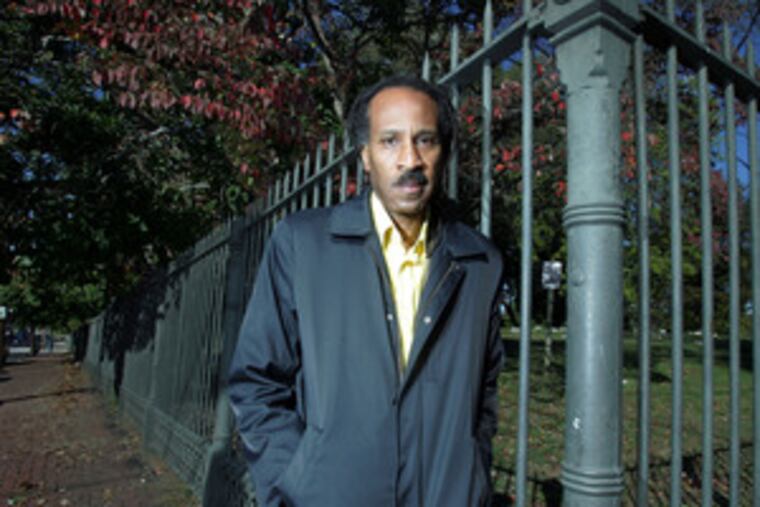
There's been a day in each of the last three years - a long, exhilarating day - when Louis Massiah has jumped into his car to cut crazy-quilt swaths across the city: Frankford to Mount Airy, Oxford Circle to Norris Square, Manayunk to Powelton, over the river to Camden, out into Ardmore, down to Chester, back to Brewerytown, across to Tacony.
"It's like being involved in a political campaign, helping out, leafleting," he says. "But this was actually a nicer experience, because you're a welcome visitor to each of the neighborhoods."
That's because instead of slinging candidate brochures, or badgering folks to vote, Massiah, a lifelong Philadelphian, was checking on squads of residents equipped with video gear- blacks, whites, Asians, Latinos, old Irish and new Vietnamese - out there on the very same day to record the oral histories of their respective communities.
The project, Precious Places, 41 chapters in all, can be seen on WHYY TV12 every Sunday night through January.
It's an extraordinary collection that documents the ethnic, cultural, social, religious and political diversity of the city and surrounding areas - of a church that's become a haven for Filipino Philadelphians; the discovery of evidence of enslaved Africans on what was once a Camden farm; the threatened displacement of old-timers in a gentrifying South Philly precinct; social activists and gardeners, stories big and small, personal and communal.
And it's Massiah's baby.
"It was my job to drive around and to make sure on that day that things were going well," he says about the three annual Precious Places shooting days. "It felt like such a privilege to be able to drive all over Philadelphia and see these grandmotherly types framing a shot and saying 'I want more close-ups,' you know?"
Massiah smiles. Seated at a table at the White Dog Cafe, across the street from Penn's law school, where he'd just spoken to a class, the man is clearly, and understandably, proud.
"You have this realization when you see these projects all together that we really don't know the city," he says. "We know our neighborhood, we know City Hall, and we know where we work, or where we have friends. But in terms of the hundreds of neighborhoods in Philadelphia, the places, people and things that are not on our immediate path, we don't really have permission to go into those different neighborhoods."
Precious Places grants every Philadelphian that permission.
Massiah, 53, is a filmmaker, a MacArthur Foundation fellow, a self-effacing guy who reads books like Exchanging Our Country Marks: The Transformation of African Identities in the Colonial and Antebellum South for fun. He's won an Emmy, lectured at Penn and Princeton, and directed the documentary W.E.B. Du Bois: A Biography in Four Voices, about the African American leader, writer, teacher and NAACP co-founder.
And 25 years ago next month, he founded Scribe Video Center, a place dedicated to grassroots film- and videomaking. Give people the training, equipment and skills to go out and make docs - and see what strange, illuminating, wild, wonderful stuff comes back. Toni Cade Bambara, Cheryl Dunye, Keith Fulton, and Louis Pepe are a few of the acclaimed indie filmmakers who emerged from Scribe's student and teaching ranks.
"It's a monumental thing that he's done," says Tina Morton, a Scribe alumna who is a filmmaker and professor at Howard University. "The city is changing so drastically, so quickly, it's just such an important program to implement. . . . When historians look back, and they look at Precious Places, it will be the voice of folks."
Starting small
Scribe's first headquarters was a room, provided rent-free, at the old Brandywine Workshop, the Philly print-making studio, then based on Kater Street. Later, the nonprofit moved to a tiny, tilted carriage house on Cypress near 13th and Spruce - the staffers huddled in one room, sharing a desk. Now, Scribe - and Massiah, its executive director - operate from state-of-the-art facilities at 4212 Chestnut St., in University City. With eight full-time staffers, its operating budget is just under $500,000.
"They had a few cameras and a tripod that they carted around in the trunk of a car," remembers Charlene Gilbert, a filmmaker and professor at the University of Toledo, who started with Scribe way back when. "I think what makes Scribe unique is that it has this deep, serious and philosophical commitment to community, and to working with communities in a way that's respectful and celebratory.
"And Louis is so thoughtful - nothing about how he does this work is quick or without insight. . . . None of his films are just thrown together. He has a serious methodology."
Massiah is serious and reflective, but with a self-deprecating humor, too. His eyes are alight with ideas. His passion for documentary filmmaking, for history, for the culture and traditions of the African American experience, is matched by a powerful intellect. He asks a lot of questions - of himself and others.
Raised in a house on 16th Street in North Philadelphia, the son of an engineer and contractor, Frederick, and a French teacher, Edith Lamarre, Massiah was "a lifer" at Friends Select in Center City, K-12. That's probably where some of those Quaker traits - modesty, empathy, tolerance - rubbed off on him.
"And then I left and swore I would never return again," he jokes. He studied astronomy and physics at Cornell, and went to grad school at MIT, where he discovered documentary filmmaking, hanging out with the folks who founded the Media Lab.
And then he came back to Philadelphia, first as a producer at WHYY. He returned to Boston to produce and direct two films for PBS's Eyes on the Prize II - Power! and A Nation of Law? Somewhere in there, he started Scribe, with a few colleagues. It wasn't long before Massiah was back in his hometown, for good.
When his parents passed away, he moved into the house he grew up in. He lives there to this day. "I guess one of the rules of being a filmmaker is try to keep your rent low," he says. Massiah's brother works for IBM in Connecticut, and his sister, Frederica Massiah-Jackson, is a Philadelphia Court of Common Pleas judge.
Executive vs. filmmaker
If Massiah shows any signs of restlessness, it's in juggling his duties as Scribe's executive director and his calling as a documentarian. He's long been at work on a feature charting the 200-year relationship between Haiti and the United States.
"It's a film that's made up of these little documentary short stories," he says, "beginning with Haiti's independence in 1804 and going up to modern-day New Orleans." And it's a project for which Massiah, even with his impressive CV, is still trying to drum up funding.
"For a certain type of documentary, it is certainly much easier these days to raise money," he notes. "If you're making a personality-driven documentary that has a clear potential of some kind of commercial release, the outlook is much better now than it was 10 years ago."
Which is great if you're a Michael Moore, not so great if you're a Louis Massiah.
"Historical documentaries that are not character-driven are a lot harder to get made," he says. But he finds his work at Scribe rewarding as well, and therein lies the conflict.
After winning the MacArthur "genius grant" in 1996, Massiah could focus on Scribe without worrying about paying the bills.
"I'm not complaining, but in some ways, after getting [the fellowship], I felt more compelled to work at Scribe. I had income coming in, so I could work there for free. . . . And as a result of that I wasn't making films, I was becoming an arts administrator. It's part of the reason why Scribe has grown - and also there are a number of really great people at Scribe. It's certainly not a one-person show."
Dwight Andrews, the composer who has collaborated with August Wilson on many of his plays, and who worked with Massiah on the W.E.B. Du Bois doc, offers his own take on Scribe's leader.
"Louis has a sense of the more profound purpose, which is giving people the power to express themselves," says Andrews, who teaches music theory and jazz studies at Emory University. "In that sense he's a very important presence in our world. And not all artists have that kind of community grounding - I don't think he'll ever abandon that sense of place and roots . . . unlike some of us who can't wait to find a way to get into our ivory towers. That won't be Louis. Louis - he has to be in the thick of it. That's what makes him so great."
'Precious Places' TV Schedule
Here is the schedule for "Precious Places" programs on WHYY TV12. Each show, at 11:30 p.m., runs 30 minutes. For information go to www.scribe.org.
Nov. 11: "Pride of the Hill" by Cramer Hill Residents Association; "The Manayunk Club" by Manayunk Neighborhood Council; "Ardmore, A Village at Risk" by Save Ardmore Coalition
Nov. 18: "To Badlands and Back Again" by Fair Hill Cemetery; "Girard Avenue - A New Destination" by West Girard Community Council; "Southwark: 30 Years and Growing" by the Neighborhood Gardens Association and Southwark Queen Village Community Garden
Nov. 25: "Parkside: A Camden Neighborhood" by Jewish Camden Partnership and the Parkside Business and Community; "Putting the Nice Back in the Town" by Nicetown CDC; "The Things that Put Powelton on the Map" by Powelton Village Civic Association
Dec. 16: "A Community in Transition" by Friends' Neighborhood Guild; "From the Del to the El: A Neighborhood Evolving" by New Kensington CDC; "Bridging Yesterday With Tomorrow" by Tacony Civic Association
Dec. 23: "The Story of a Neighborhood: The Square @ 58th Street" by Shoatz United for Education; "Nuestra Voz, Nuestra Perspectiva" by Hispanic Association of Contractors and Enterprises (HACE); "On Mt. Peace" by the Lawnside Historical Society
Dec. 30: "Las Parcelas" by Norris Square Neighborhood Project; "Francisville Community History" by Scribe Video Center; "Strawberry Mansion, Neighborhood by the Park" by the East Park Revitalization Alliance
Jan. 6: "Athletic Recreation Center: The Jewel of Brewerytown" by the Brewerytown Sharswood Community Civic Association; "Youth and the Houston Center: Growing Up Together" by the United Communities Southeast Philadelphia and the Southeast Philadelphia Collaborative; "The Industrial Past" by the Cardinal Bevilacqua Community Center
Jan. 13: "Keeping the Faith" by the Islamic Cultural Preservation and Information Council; "Eve's Garden" by Heart of Camden; "Yorktown: You Are Here" by Yorktown Community Organization
Jan. 20: "Petty's Island: An Untold History" by Camden City African American Commission; "Palmer Cemetery: The Heart and History of Fishtown" by the Fishtown Neighbors Association
SOURCE: Scribe Video Center
EndText